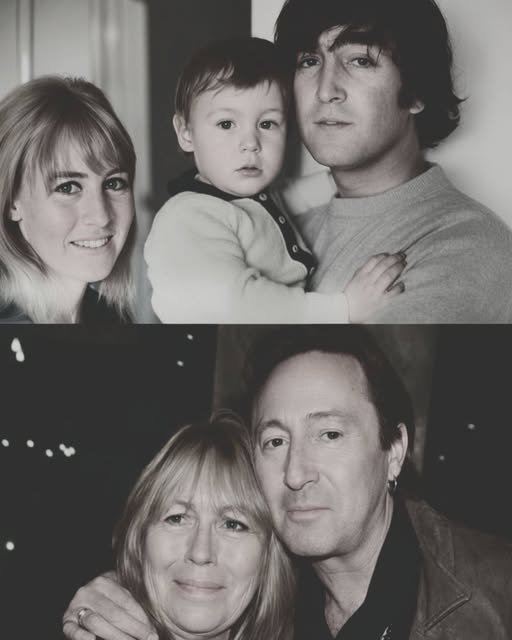
She opened the front door expecting an ordinary morning.
Instead, she walked into the moment that would end her marriage forever.
There, inside the home she shared with her husband, sat another woman.
Both were wearing bathrobes.
Both had clearly spent the night together.
The woman looked up casually and smiled.
” Oh, hi.”
For a moment, time stopped.
The room was silent.
The air felt heavier.
And the life Cynthia Lennon thought she knew suddenly disappeared beneath her feet.
Most people imagine heartbreak arriving with screaming.
With shattered dishes.
With dramatic confrontations.
Reality is often quieter.
Sometimes heartbreak arrives as a simple sentence.
A casual greeting.
A realization that changes everything.
Cynthia later admitted she was so shocked she could barely process what she was seeing.
The woman sitting there was Yoko Ono.
The husband beside her was John Lennon.
And the marriage Cynthia had spent six years trying to hold together was already over.
Before The Beatles Changed Everything
Long before the screaming fans.
Long before the sold-out stadiums.
Long before the world knew the name John Lennon.
There was simply a young art student in Liverpool.
And a young woman who fell in love with him.
Cynthia Powell met John Lennon at Liverpool College of Art in the late 1950s.
He was funny.
Rebellious.
Intelligent.
Complicated.
The kind of person who could make a room laugh one moment and create chaos the next.
Cynthia was drawn to him immediately.
Like many young women, she saw both his flaws and his potential.
She loved him before fame arrived.
Before money.
Before success.
Before millions of fans around the world claimed a piece of him.
In those early years, their life looked nothing like the mythology that would later surround The Beatles.
They worried about rent.
About jobs.
About the future.
About ordinary things.
When Cynthia became pregnant, the couple married quietly in 1962.
Neither of them could have imagined what was about to happen.
Within months, Beatlemania exploded.
And everything changed.
Remembering John Lennon – The Restless Viking
The Cost Of Loving A Global Icon
People often talk about the price of fame.
They rarely discuss the price paid by the people standing next to fame.
For Cynthia, life became increasingly lonely.
As The Beatles conquered country after country, John spent more time away.
Tours.
Recordings.
Interviews.
Appearances.
The world wanted more of him every day.
And there was less of him left for his
Cynthia remained at home raising their son Julian.
She watched her husband become one of the most famous men on earth.
At the same time, she slowly watched him drift further away.
Fame didn’t simply transform John’s career.
It transformed his entire identity.
The shy art student she had fallen in love with increasingly disappeared behind a global phenomenon.
Millions adored him.
Yet Cynthia often felt more alone than ever.
The Morning Everything Ended
By the time Cynthia walked into that house and found John with Yoko Ono, the marriage had already been under strain.
But seeing the reality in front of her was different.
No denial remained.
No explanations could change what had happened.
What makes the story remarkable is not the betrayal.
History is filled with stories of betrayal.
What makes it remarkable is Cynthia’s response.
She didn’t create a public scene.
She didn’t call reporters.
She didn’t seek revenge.
She didn’t attempt to destroy John’s reputation.
Instead, she quietly left the room.
And later, when nobody could see her, she broke down.
The marriage was over.
The future she had imagined was gone.
And she was suddenly facing life as a single mother.
A Divorce Conducted In The Shadow Of Fame
Divorce is difficult under any circumstances.
Divorce involving one of the most famous men in the world is something else entirely.
As the separation unfolded, Cynthia found herself battling not only heartbreak but public perception.
John initially attempted to shift blame.
Stories circulated.
Accusations were made.
The narrative became messy.
But eventually the truth emerged.
Yoko Ono became pregnant.
The relationship could no longer be hidden.
The marriage officially ended.
Financial negotiations followed.
What should have been a private family matter became international news.
Yet throughout the process, Cynthia maintained a remarkable restraint.
She refused to participate in a public war.
She refused to become a professional victim.
She refused to allow bitterness to define her future.
That choice would become one of the most important decisions of her life.
The Man Who Refused To Forget Her
Many people know the story of John Lennon and Yoko Ono.
Fewer know the story of what happened afterward.
Among those who watched Cynthia’s pain unfold was Paul’s friend and bandmate, Paul McCartney.
Unlike many people who simply moved on, Paul reached out.
One afternoon he drove to visit Cynthia.
Not as a celebrity.
Not as a Beatle.
Just as a friend.
According to Cynthia’s recollections, he arrived carrying a single red rose.
He apologized.
He listened.
He offered comfort.
Most importantly, he acknowledged her pain.
At a time when the world seemed eager to focus on John and Yoko, Paul remembered the woman who had been left behind.
As he drove home, his thoughts reportedly turned toward Julian Lennon.
A little boy struggling to understand why his father was gone.
A child trying to make sense of a broken family.
Those thoughts inspired a song.
Initially titled “Hey Jules.”
Later changed to Hey Jude.
“Take a sad song and make it better.”
The song would become one of the most beloved recordings in music history.
And at its heart was a simple act of compassion.
One friend refusing to let another friend’s child feel forgotten.
John Lennon once felt like his son wanted to have McCartney as his father
Rebuilding From The Ground Up
After the divorce, Cynthia could have spent her life living off her connection to The Beatles.
Many people expected her to.
Instead, she chose something more difficult.
She built a new life.
She moved to North Wales.
She focused on raising Julian.
She worked.
She struggled.
She adapted.
Eventually she opened Oliver’s Bistro.
There were no screaming fans there.
No record executives.
No limousines.
Just customers ordering meals.
Dishes needing washing.
Bills needing payment.
While John Lennon remained one of the most recognizable people on the planet, Cynthia was creating something real and independent.
A life built by her own effort.
A future that belonged to her.
Not to The Beatles.
Not to fame.
Not to anyone else.
Writing The Truth
In 1978, Cynthia published her memoir.
Many expected revenge.
Many expected scandal.
Many expected bitterness.
What they found instead was honesty.
The book presented John as a complicated human being.
Not a saint.
Not a villain.
A person.
Years later she wrote another memoir, one that explored darker aspects of their relationship.
The infidelities.
The emotional pain.
The difficult years.
Yet even then, readers noticed something remarkable.
There was sadness.
There was disappointment.
But there was very little hatred.
Cynthia seemed more interested in understanding the past than punishing it.
That distinction mattered.
Because revenge often keeps people trapped.
Understanding helps people move forward.
The Tragedy Of 1980
On December 8, 1980, the world received devastating news.
John Lennon had been murdered outside his New York apartment.
Millions mourned.
Fans gathered around the world.
Music stations played Beatles songs continuously.
For Cynthia, the loss was deeply personal.
Despite everything that had happened between them, John remained the father of her son.
He remained the young art student she had once loved.
He remained part of her life story.
Her focus immediately turned to Julian.
A seventeen-year-old boy now facing the permanent loss of his father.
Cynthia helped him navigate unimaginable grief.
Once again, she did what she had always done.
She stayed strong when someone else needed her strength.
A Legacy Bigger Than Headlines
When Cynthia Lennon died in 2015, tributes arrived from around the world.
Paul McCartney remembered her warmly.
Ringo Starr sent messages of peace and love.
Even Yoko Ono praised her as an extraordinary mother and a good person.
That says something important.
Because after decades of public narratives, what remained was respect.
Not scandal.
Not conflict.
Not resentment.
Respect.
The world often remembers the loudest people.
The most controversial people.
The people who dominate headlines.
But some of the strongest people are the ones who quietly endure.
Who rebuild after devastation.
Who refuse to let pain transform them into something bitter.
The Lesson Cynthia Left Behind
There is a reason Cynthia Lennon’s story continues to resonate.
It isn’t because she married a Beatle.
It isn’t because she appeared in history books.
It isn’t because she stood near fame.
It’s because she demonstrated something profoundly difficult.
She showed that dignity is a choice.
After betrayal, she chose dignity.
After humiliation, she chose dignity.
After heartbreak, she chose dignity.
She had every reason to become angry.
Every reason to seek revenge.
Every reason to spend the rest of her life telling the world how badly she had been treated.
Instead, she chose another path.
She raised her son.
She built a business.
She wrote her truth.
She moved forward.
And in doing so, she left behind a legacy far more powerful than bitterness could ever provide.
History often remembers legends.
But sometimes the most inspiring stories belong to the people who survive the legends.
Cynthia Lennon was one of those people.
Not because she escaped pain.
But because pain never succeeded in destroying the kindness, grace, and dignity that defined who she was.
And that may be the most remarkable achievement of all.