The Suitcases on the Porch
The first suitcase hit the porch steps before Audrey Bellamy even reached the front door.
The second one followed a moment later, falling open and spilling a sweater, a small photo album, and a folded stack of legal papers across the wet concrete.
Audrey stood frozen in the rain outside the townhouse in Savannah, Georgia, one hand resting gently over her stomach. She was four months pregnant with triplets, but no one inside that house knew.
Not her husband.
Not his mother.
Not the woman standing behind them in Audrey’s silk robe.
Eleanor Whitlock appeared in the doorway with her pearls shining against her black dress and a calm, practiced expression on her face.
“Seven years is long enough, Audrey,” Eleanor said. “My son needs a wife who can give this family a future, not someone who keeps taking up space in his life.”
Behind her, Pierce Whitlock stood near the dining room entrance. Audrey’s husband did not move toward her. He did not look angry. Somehow, that was worse. He looked tired, as if ending their marriage was simply another task his mother had arranged for him.
Beside him stood Celeste Marlow, holding a glass of white wine.
Audrey recognized the robe Celeste wore immediately. It had been Audrey’s, bought years ago after her first successful design commission in Charleston.
That small detail hurt more than the papers on the ground.
It told her she had been replaced before anyone even told her she was unwanted.
“Pierce,” Audrey whispered.
He finally lifted his eyes.
“It’s better this way,” he said quietly. “Mother already spoke with the attorneys.”
Eleanor smiled, pleased that a few neighbors had opened their doors just enough to watch.
“You never understood how this family works,” Eleanor said. “Take what belongs to you and leave with dignity.”
Audrey looked down at the papers scattered across the porch. They were not only divorce documents. There was a statement claiming she had chosen to leave the home voluntarily. There was a list of belongings she was “allowed” to take. There was even a letter prepared by the Whitlock family law office saying there were no recognized children or dependents in the marriage.
No recognized children.
Audrey’s fingers tightened over her stomach.
Inside her, three tiny lives were growing.
For one second, she almost reached into her purse for the ultrasound photo. She almost told Pierce the truth. She almost said that he was not only throwing out his wife. He was turning away his children.
But then Audrey looked at Eleanor.
There was no softness there.
No regret.
No protection.
If Audrey spoke now, those babies would not be loved. They would become claims, heirs, arguments, and weapons inside a family that cared more about its name than its heart.
So she said nothing.
She picked up the broken suitcase, placed the papers inside, and walked down the steps without looking back.
At the gate, the building manager, Mr. Hollis, stepped aside with a guilty expression.
“Mrs. Whitlock…” he murmured.
Audrey stopped. He used to call her Audrey. Now even her name sounded borrowed.
Rain blurred the quiet street. Savannah’s old oaks hung over the sidewalk, beautiful and indifferent. Audrey reached the covered entrance of a closed bakery and stood there, soaked and trembling.
Her phone buzzed.
An email from Whitlock & Hayes Legal Group appeared on the screen.
“Mrs. Audrey Bellamy Whitlock has voluntarily left the marital residence. No family obligations are currently recognized.”
Audrey read the line twice.
No family obligations.
Her children had not even been born, and already someone had written them out of existence.
Then a dark car pulled beside the curb.
The back door opened, and an older man stepped out beneath a large umbrella. He had silver hair, a dark wool coat, and the kind of steady eyes that did not ask careless questions.
“Excuse me,” he said gently. “Are you Claire Bellamy’s daughter?”
Audrey’s breath caught.
No one had said her mother’s name to her like that in years.
“Yes,” she answered carefully. “Claire was my mother.”
The man reached into his coat and removed a small photograph. In it, Audrey’s mother stood beside a fountain in Charleston, young and bright, holding a sketchbook against her chest.
Audrey knew that smile instantly.
“My name is Arthur Caldwell,” the man said. “Your mother once asked me to find you if the day ever came when you had nowhere safe to go.”
Audrey turned the photo over. On the back, in faded blue ink, her mother had written:
“If my daughter ever loses every door, help her find the one I left open.”
Before Audrey could speak, Mr. Hollis hurried from the townhouse with a brown envelope.
“Audrey,” he said, finally using her name. “I was told to give you this only if you were still here.”
Inside were copies of old medical notes, marked and highlighted. At the bottom of the last page, someone had written:
“If she mentions pregnancy, question her stability.”
Audrey felt the air leave her chest.
Arthur Caldwell looked at the papers, then at the lit windows of the townhouse. A curtain shifted upstairs.
“Get in the car,” he said calmly. “Tonight, they do not get to decide who you are.”
A House That Did Not Ask Questions
Arthur’s home sat behind a white fence in Charleston, South Carolina, tucked beneath magnolia trees and warm porch lights.
It was not the kind of mansion built to impress strangers. It felt like a place built to keep people safe.
A woman named Helen opened the door before Arthur even knocked. She took one look at Audrey’s soaked coat and did not ask for gossip, proof, or explanation. She simply brought towels, warm tea, dry clothes, and a soft blanket.
That kindness almost broke Audrey.
For years, she had lived in a house where every mistake was measured and every silence was used against her. Here, no one treated her like a burden.
Arthur made one phone call.
“Grayson, come to the house,” he said. “Bring your medical bag. It is urgent.”
Twenty minutes later, a man arrived with rain on his shoulders and concern in his eyes. Dr. Grayson Vale was the obstetric specialist Audrey had quietly seen one month earlier, the doctor who had confirmed her high-risk pregnancy and told her all three babies still had strong heartbeats.
He recognized her immediately but did not embarrass her with questions in front of everyone.
“May I check on them?” he asked softly.
Audrey nodded.
In a warm guest room, Grayson placed the portable monitor against her stomach. For a few seconds, there was only static. Then came one heartbeat. Then another. Then a third.
Three fast, tiny rhythms filled the room.
Audrey covered her mouth with one hand.
Arthur stood near the doorway, his head bowed with quiet respect.
“They are okay,” Grayson said. “But you need rest, careful monitoring, and as much peace as possible.”
Audrey let out a weak laugh.
“Peace is difficult when your husband’s family just put your life on the sidewalk.”
Grayson’s expression did not change.
“Then you will not be going back to that sidewalk.”
Later that night, Arthur brought Audrey into a small library lined with old books and framed sketches. From a locked cabinet, he removed a blue wooden box.
Audrey’s heart tightened.
Her mother had owned a box just like it.
Arthur placed it on the desk.
“Your mother and I knew each other when we were young,” he said. “I loved her, but I was not brave enough when I should have been. She went on with her life, and I carried that failure for a long time. Before she passed, she trusted me with this.”
Inside the box were letters, a key, notarized documents, photographs, and old business records.
Audrey saw her full name on the first page.
A restored historic building in Charleston, once used by her mother as a design studio, legally belonged to Audrey. There were also rights to several interior restoration projects, a protected account, and shares in a small preservation company her mother had quietly kept alive.
On the back of one photograph, Claire Bellamy had written:
“When Audrey learns the truth, I hope she never mistakes rejection for her worth again.”
Audrey cried silently.
It was not about money.
It was the discovery that her mother, even after leaving this world, had tied a rope around the darkness and waited for Audrey to find it.
Choosing Life Before Justice
The weeks that followed were not easy, but they were no longer lonely.
Grayson visited often to check the babies. Helen left fruit, soup, and folded laundry outside Audrey’s door. Arthur introduced her to a lawyer named Margaret Sloan, a calm woman with sharp eyes and a voice that made even powerful people listen.
Margaret reviewed every document the Whitlocks had sent.
“They planned this carefully,” Margaret said. “But they made one mistake. They tried to erase you before finding out what you could prove.”
Audrey kept everything.
The email.
The envelope from Mr. Hollis.
The marked medical notes.
The statement claiming she had left voluntarily.
She did not rush back to Pierce. She did not beg for answers. She did not send angry messages to Eleanor.
First, she chose to survive.
Then she chose to rebuild.
At seven months, Audrey gave birth to two boys and one girl in a private hospital in Charleston. They were tiny, loud, and stronger than they looked.
She named them Owen, Callum, and Lila.
When Audrey held them for the first time, she felt the world rearrange itself around their breathing.
Arthur stood behind the glass, wiping his eyes with a handkerchief.
Grayson stayed nearby, careful and steady, the way he had been from the first night.
In the months after the babies came home, Audrey reopened her mother’s design studio under a new name: Bellamy House Restoration. She specialized in preserving old Southern homes, antique interiors, damaged portraits, and forgotten rooms that still had beauty beneath the dust.
Her work began quietly.
Then a Charleston magazine wrote about her.
Then clients came from Savannah, Atlanta, and Nashville.
People who once would have called her abandoned now called her gifted.
People who might have pitied her now respected her.
Audrey was no longer a woman standing in the rain with broken luggage.
She was a mother, a business owner, and the keeper of a name no one could take from her.
The Invitation Meant to Humiliate Her
Almost two years after the night on the porch, an ivory envelope arrived at Bellamy House Restoration.
Audrey opened it in her office while Owen and Callum stacked wooden blocks on the rug and Lila sat beside Helen, brushing the hair of a cloth doll.
Pierce Whitlock and Celeste Marlow were getting married at a luxury estate outside Savannah.
Inside the envelope was a handwritten note from Pierce.
“Come if you want to see how Celeste gave my family what you never could.”
Audrey stared at the words.
For a moment, the room went quiet around her.
Then Lila laughed at something Helen said, and Audrey remembered exactly what she had now.
She was not empty.
She had never been empty.
Arthur read the invitation and closed his eyes.
“Well,” he said, folding the paper carefully, “then we will go. But not as the people they expect.”
The Wedding Garden Went Silent
The estate was covered in white flowers, pale linen, polished silver, and the kind of quiet music rich families chose when they wanted everything to look effortless.
Eleanor Whitlock had clearly planned every detail like a public victory.
Celeste wore an elegant gown and rested one hand over her stomach. Pierce stood beside her, smiling at guests with a tightness around his mouth, as though he needed everyone else to believe he had won.
Then the cars arrived.
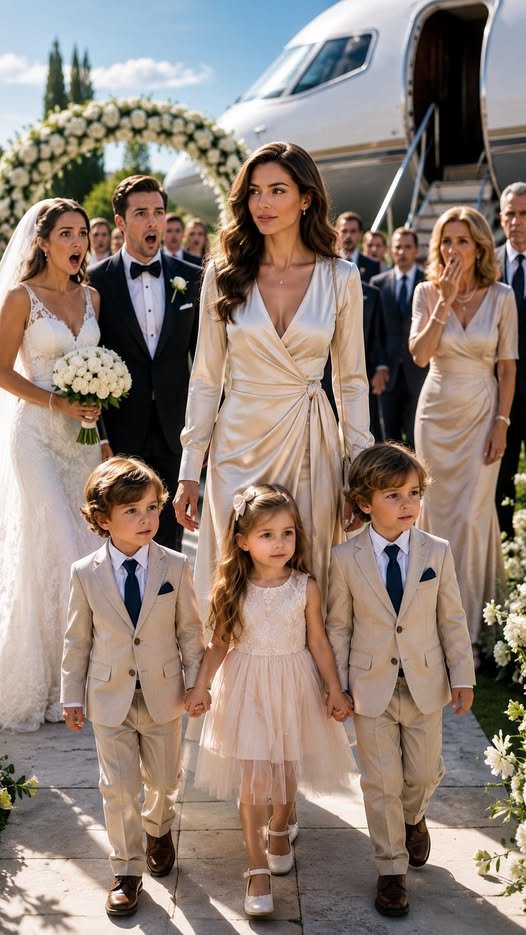
First came Arthur Caldwell, leaning lightly on a silver-handled cane. Then Helen stepped out with Lila in her arms. Grayson followed, holding Owen’s hand while Callum walked beside him, curious and serious.
Last came Audrey.
She wore a champagne-colored dress, simple and graceful, with her mother’s pearl pendant at her throat.
She did not look angry.
She did not look ruined.
She looked peaceful.
That was what disturbed them most.
Eleanor noticed the pendant before she truly saw Audrey’s face. Her expression shifted from surprise to calculation, then to something much closer to fear.
Pierce set down his glass and walked toward her as if the past had suddenly stepped into the garden.
“Audrey,” he said. “Who are these children?”
Owen moved closer to Grayson. Callum looked up at Pierce with open curiosity. Lila held her doll against her chest.
Audrey met Pierce’s eyes.
“They are my children,” she said. “The three children I was carrying when you let your mother put my suitcases on the porch.”
The garden fell silent.
Pierce went pale.
“That cannot be true.”
“I was four months pregnant,” Audrey said. “I did not tell you because that night showed me exactly what your family would do. Your mother would not have protected them. She would have turned them into property with the Whitlock name attached.”
Eleanor stepped forward.
“Be careful, Audrey.”
Arthur tapped his cane once against the stone path.
The sound was soft, but everyone heard it.
“We have the email from your family’s legal office, the envelope given to the building manager, the altered medical notes, and the statement falsely claiming she left by choice,” Arthur said. “I suggest you choose your next words with care.”
No one moved.
Then a man’s voice came from near the entrance.
“Celeste should choose hers carefully too.”
A young man in a pale gray suit walked into the garden. Celeste’s face changed before he even reached her.
“Daniel,” she whispered.
He stopped a few feet away.
“That baby is not Pierce’s,” Daniel said. “And you know it.”
Celeste’s hand dropped from her stomach.
Her tears did not look like shock.
They looked like defeat.
She looked at Pierce, then at Audrey, then finally at Eleanor.
“She knew,” Celeste said, her voice breaking. “Eleanor told me a strong family name could fix everything.”
The wedding did not collapse loudly.
It simply lost its shape.
Guests lowered their eyes. The music stopped. Pierce stood still, staring at Audrey as if he finally understood that the woman he left in the rain had not disappeared.
She had become someone he could no longer reach.
He tried to step closer.
“Audrey, I…”
“You can speak with my attorney,” she said. “My children will not become the place where your regret goes to rest.”
She did not say it cruelly.
She said it like a woman closing a door that should have been closed long ago.
Margaret Sloan handed a folder to the Whitlock family’s legal representative. It documented Audrey’s pregnancy, the attempts to discredit her, and the legal protections already in place for the children.
For the first time, Eleanor Whitlock had no elegant sentence ready.
Audrey took Owen’s hand, called softly for Callum, and adjusted the bow in Lila’s hair.
Then she walked back toward the car with the same calm strength she had carried out of the rain two years earlier.
Only this time, she was not carrying broken suitcases.
She was carrying the truth.
A Home Built From What Remained
Months later, in Charleston, Bellamy House Restoration opened a free training room for women starting over after difficult seasons.
Audrey taught them how to repair old wood, clean damaged frames, restore faded color, and see value in things other people had dismissed too quickly.
Arthur often sat beneath the magnolia tree in the courtyard, pretending to read while the children climbed into his lap and called him Grandpa Arthur.
Helen kept saying she was too old to chase toddlers, but she always chased them anyway.
Grayson kept coming by with warm bread, medical advice when needed, and the kind of patience that never pushed Audrey to feel before she was ready.
Love did not arrive like lightning.
It arrived like morning light.
Slowly.
Gently.
Without asking her to forget what had happened.
One afternoon, Audrey stood in the studio restoring a water-damaged portrait. Lila slept near the window while Owen and Callum played in the courtyard.
Grayson set a cup of coffee beside her and looked at the cracked painting.
“Can it be saved?” he asked.
Audrey studied the torn canvas, the faded colors, and the places where time had left marks.
Then she smiled.
“Yes,” she said. “It was damaged, but it was never beyond repair.”
Outside, sunlight moved across the old brick walls.
Audrey knew she was talking about the painting.
But she was also talking about herself.
She had lost a marriage, a house, and a family that had never truly made room for her at their table.
But she had found her mother’s final gift, her own name, her children, and a peace no one could write out of a legal document.
For the first time in years, Audrey did not feel like she was surviving someone else’s decision.
She felt like she had finally come home.
Some people will only see your value after they lose access to your strength, but by then, your healing may have already carried you far beyond the place where their apology can reach you.
A closed door can feel like the end of your life in the moment, but sometimes it is the first clear sign that you were being protected from a room that never deserved your heart.
The people who try to erase your name often forget that truth has a way of waiting quietly until the right moment to stand beside you.
You do not have to explain your worth to people who only understand love when it comes with control, status, or convenience.
Sometimes the greatest act of courage is not shouting back, but walking away with your dignity before the people who hurt you learn how much power they could have had over your future.
A mother’s love can survive distance, time, silence, and even loss, because true love keeps preparing shelter long after the world thinks the story is over.
Being rejected by the wrong people does not make you unwanted; it may simply mean life is moving you toward the people who will recognize your heart without asking you to prove it.
Not every broken season destroys you; some seasons reveal the hidden strength, hidden helpers, and hidden inheritance you never knew had been waiting for you.
Peace does not always come when the people who hurt you are punished; sometimes peace comes when you finally stop needing them to understand what they lost.
A life can be damaged, delayed, and deeply changed, but it can still become beautiful again when truth, courage, and love are given enough time to restore what pain tried to take.