My son was eight years old when I learned exactly how far my family would go to protect the wrong child.
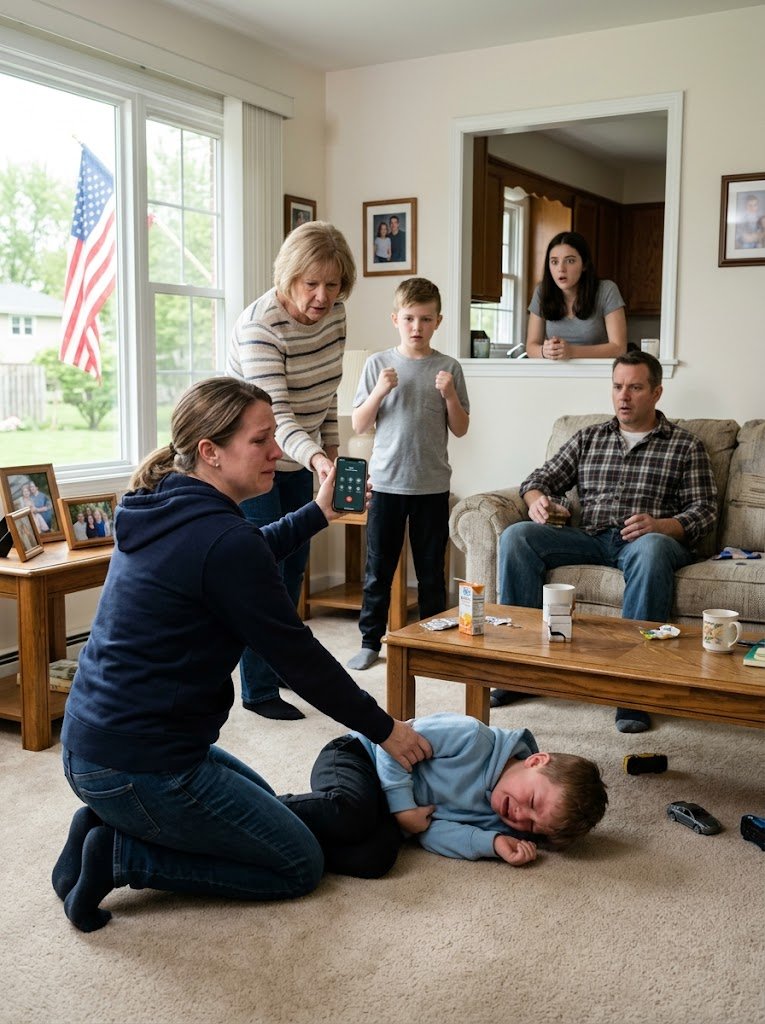
He was lying on my parents’ living room carpet with one hand pressed against his side, trying to breathe without making too much noise.
That was the first thing that broke me.Not the bruise blooming under his shirt.
Not Ryan standing there with his fists still clenched.
Not even my sister Carla smirking from the kitchen counter like she had been waiting years for a moment where my child finally looked weaker than hers.
It was the way my son tried to be quiet.
The room smelled like lemon cleaner and spilled soda.
The refrigerator hummed in the kitchen.
The TV kept throwing blue light across the wall, flashing over family pictures and the fake little sign by the hallway that said blessed home.
My son’s sneakers were in a strip of sunlight by the front window.
Everything looked normal except the child on the floor.
“Mom,” he whispered, “it hurts.”
I dropped beside him so fast my knee hit the coffee table.
“Where, baby?”He pointed to his ribs.
When I touched the spot, he cried out.
It was small, but it cut right through me.
Ryan stood across the room breathing hard.
He was twelve, bigger than my son by a full head, and his knuckles were red.
I had seen that look on him before.
He wore it when he broke things and waited for adults to rename the damage as personality.
Ryan was never mean in my family.
He was energetic.
He was strong-willed.
He was spirited.
When he shoved a smaller boy at a birthday party, Carla said boys were boys.
When he grabbed my son’s toys and laughed in his face, my mother told me not to make every little thing a courtroom.
When he broke a neighbor’s window, my father said the boy just needed space to run around.
My son learned the family rule before anyone said it out loud.
Ryan got excuses.
My son got told to move on.
That afternoon had started like any ordinary family stop-in.
I had come by after school because my mother said she had made chili and wanted to see the kids.
My son had his backpack, his inhaler, and a paper from the school office crumpled in the front pocket because he always forgot to hand me forms until the last second.
Carla was already there.
Ryan was in the living room, sprawled on the couch like he owned the place.
For the first fifteen minutes, I kept hearing the little things mothers hear.
A shoulder bump.
A toy dropped too hard.
A laugh that had an edge to it.
I told Ryan to back up once.
Carla rolled her eyes.
My mother gave me the look that meant don’t start.
Then I went into the kitchen to rinse a bowl.
There was a thud behind me.
A real one.
Not a stumble.
Not a dropped toy.
A body hitting the floor.
By the time I turned around, my son was curled on the carpet and Ryan was standing over him.
“What happened?” I asked.
Carla answered before Ryan did.
“He just shoved him,” she said. “Kids get rough.”
My son had tears sliding into his hairline, but his mouth was pressed tight.
He looked embarrassed to be hurt.
That is what people do to quiet children when they punish them for needing protection.
They teach pain to apologize for showing up.
I checked his breathing.
It was wrong.
Too shallow.
Too tight.
He kept taking little sips of air and stopping halfway through.
At 4:17 p.m., I pulled out my phone and dialed 911.
I remember the time because I looked at the screen.
I remember the green call button.
I remember my thumb shaking.
And I remember my mother moving faster than I had seen her move in years.
She lunged across the sofa and snatched the phone right out of my hand.
“Don’t you dare,” she snapped.
For one second, I just stared at her.
My own mother was holding my phone while my child was gasping on the floor.
“Mom,” I said, “he can’t breathe.”
“Boys fight,” she said. “You don’t destroy your nephew’s future over a playground scuffle.”
“My child is on the floor.”
My father finally looked down.
Not long enough to help.
Just long enough to decide it would be easier not to.
“You’re overreacting,” he muttered. “He’ll be fine in a day or two.”
Then I looked at Carla.
She was smirking.
That smile did something to me.
It took every little excuse, every holiday where I swallowed my anger, every time I told my son to be patient because grown-ups were complicated, and laid it all out in one clean line.
They were not confused.
They were choosing.
The room went still.
My father held his coffee cup in both hands.
The TV flashed blue across the wall.
Ryan’s sneaker squeaked once on the carpet.
My mother’s thumb hovered near the side button of my phone like she might shut it off completely.
Carla watched me like she was waiting for the old version of me to come back.
The version who tried not to make scenes.
The version who cared too much about keeping Thanksgiving comfortable.
The version who believed family peace was a real thing.
Family peace sounds beautiful until you notice who is always asked to bleed for it.
My son gasped again.
That sound ended something.
I stood up slowly.
“Give me my phone.”
“No,” my mother said. “You are not calling the police on family.”
Police.
She said it herself.
Not ambulance.
Not doctor.
Police.
That was how I knew she understood more than she wanted to admit.
For one ugly heartbeat, I saw the ceramic lamp beside the sofa in my hand.
I imagined it breaking.
I imagined everyone finally moving.
Then I looked down at my son.
He did not need my rage.
He needed me useful.
So I walked to his backpack.
I took his school ID from the front pocket.
I took his inhaler.
I checked the time again.
4:18 p.m.
I memorized Ryan’s red knuckles, my mother’s grip on my phone, Carla’s face, and my father’s refusal to stand up.
Then I bent down and lifted my son as carefully as I could.
He whimpered into my shoulder.
“Don’t let Ryan come with us,” he whispered.
Carla’s smile twitched.
My mother stepped into the hallway and blocked the door.
“Where do you think you’re going?”
I looked at her.
Then I looked at my father.
Then at Carla.
Then at Ryan, who had finally found the floor interesting.
“I’m taking my child to someone who cares whether he can breathe,” I said.
I opened the front door.
Cold air came in hard enough to lift the corner of the welcome mat.
The little American flag my father kept stuck in a porch planter snapped once in the wind.
And for the first time since my son hit the floor, Carla’s smile disappeared.
I made it halfway down the walkway before my mother followed me onto the porch.
She still had my phone.
“Get back here,” she said.
Her voice was loud, but not strong.
Outside, everything changed.
There were cars in driveways.
A dog barking behind a fence.
Somebody’s garage door opening across the street.
The world was bigger than my parents’ living room, and my mother seemed to realize it at the same moment I did.
My son’s fingers tightened in my coat.
“Mom,” he breathed.
“I’ve got you,” I told him.
The neighbor from the blue house stepped out beside her SUV with a grocery bag in one hand.
She looked at my son.
Then she looked at my mother holding my phone.
“Do you need me to call someone?” she asked.
My mother said, “This is family business.”
The neighbor did not move.
My son made that same broken little sound.
“Yes,” I said. “Call 911.”
The neighbor dropped the grocery bag onto her driveway.
A carton tipped sideways inside it.
She already had her phone out.
My father came onto the porch behind my mother, still holding that ridiculous coffee cup.
Carla appeared in the doorway.
Ryan stayed behind her.
Suddenly none of them looked like a family deciding what was best.
They looked like people who had been caught in daylight.
The dispatcher answered.
The neighbor put the call on speaker when I asked her to.
“What is your emergency?” the dispatcher said.
“My eight-year-old son was assaulted by an older child,” I said. “He is having trouble breathing. His ribs hurt. We need an ambulance.”
My mother hissed my name.
I did not look at her.
The dispatcher asked for the address.
I gave it.
She asked if my son was conscious.
“Yes.”
Breathing.
“Yes, but not right.”
Any visible bleeding.
“No.”
Any weapons.
“No.”
Was the person who hurt him still nearby.
I looked at Ryan in the doorway.
“Yes.”
That was when my father finally lowered his coffee cup.
“Carla,” he said softly. “What did Ryan do?”
Carla did not answer.
My mother did.
“She’s exaggerating.”
The neighbor looked at her with the kind of expression people use when they have just understood too much.
The ambulance arrived first.
Then a police cruiser came behind it.
Not because I asked for a show.
Because when a child is hurt and someone prevents a 911 call, adults in uniforms tend to have questions.
The EMT who stepped out had calm hands and a voice that did not waste time.
He asked my son his name.
My son answered.
He asked where it hurt.
My son pointed again.
When the EMT touched the same spot I had touched, my son cried out.
My mother looked away.
I saw it.
So did the officer.
At 4:34 p.m., the EMT wrote notes on a small pad.
At 4:39 p.m., my son was in the ambulance.
At 4:41 p.m., the officer asked my mother why she had my phone.
My mother said she had taken it because I was hysterical.
The officer asked if she had returned it.
She had not.
The silence that followed was the first honest thing my family had offered all day.
At the hospital intake desk, they gave my son a wristband.
A nurse asked the same questions in a voice that was gentle but exact.
What happened.
Who was there.
When did it happen.
Did anyone stop you from calling for help.
I answered every question.
My son lay on the bed with a blanket up to his chest, exhausted and still trying to be brave.
When the doctor ordered imaging, I stood beside him and held his hand.
He kept apologizing.
“I’m sorry I cried,” he whispered.
I bent so he could see my face.
“You never apologize for needing help,” I said.
He nodded, but I could tell the lesson would take longer than one sentence to undo.
The imaging showed a rib fracture.
Broken.
Not rough play.
Not a scuffle.
Not boys being boys.
A broken rib.
The doctor said it plainly, and I watched the words land on the hospital room like a stamped document.
A hospital social worker came in after that.
She was kind, but she was not soft.
She took notes.
She asked if my son felt safe going home with me.
He said yes immediately.
She asked if he felt safe around Ryan.
His face changed.
That was answer enough.
A police report was filed that evening.
I gave the officer the time.
4:17 p.m., first attempted call.
4:18 p.m., phone still withheld.
4:21 p.m., neighbor called 911 from the driveway.
I gave him the names of everyone in the room.
I gave him my son’s school ID because it had his full name and emergency contact information.
I gave him the hospital paperwork when the nurse printed the discharge summary.
For the first time all day, facts were being treated like facts.
My family started calling before we even left the hospital.
Carla called first.
I did not answer.
My mother called next.
I did not answer.
My father sent one text.
You went too far.
I stared at those four words in the hospital parking lot while my son slept in the back seat, carefully buckled in with a pillow between the seat belt and his ribs.
I typed back one sentence.
No, Dad. I finally went far enough.
Then I blocked him for the night.
The next few days were exactly what you think they were.
Carla cried to anyone who would listen.
My mother said I had humiliated the family.
My father said I should have handled it privately.
Ryan’s father, who had not been there, called once and demanded to know if I understood what a report could do to a twelve-year-old.
I told him I understood what a broken rib could do to an eight-year-old.
He hung up.
There were consequences.
Not movie consequences.
Real ones.
Slow ones.
Phone calls.
Statements.
Appointments.
A follow-up visit.
A school note explaining limited activity.
A counselor my son did not want at first and then slowly began to trust.
Ryan was not dragged away in handcuffs like some dramatic ending people imagine.
He was a child too.
But he was finally treated like a child who had hurt someone, not like a prince whose future mattered more than another child’s pain.
Carla had to sit in rooms where shrugging did not work.
My mother had to explain why she took a phone from a parent trying to call 911.
My father had to admit he saw my son on the floor and did not move.
That last part changed something in him.
I could see it months later when he tried to apologize.
He came to my apartment with a paper coffee cup in his hand, because apparently some men need something to hold when they are ashamed.
He said, “I should have stood up.”
I said, “Yes.”
He said, “I thought keeping everyone calm was the right thing.”
I said, “No. You thought keeping Mom calm was easier.”
He cried then.
I did not.
Not because I was stronger.
Because I had already done my crying in the hallway of a hospital while my son slept under a thin blanket with a band around his wrist.
My mother’s apology came later and worse.
It was full of soft phrases.
I was scared.
I panicked.
I didn’t understand how bad it was.
But the truth was sitting between us, plain as the phone she had stolen from my hand.
She had understood enough to stop me.
That is not confusion.
That is a choice.
Carla did not apologize for a long time.
When she finally did, it came through a message at 1:12 a.m.
I keep hearing him say he couldn’t breathe.
I read it once.
Then I set the phone down.
Some apologies are not requests for forgiveness.
They are people trying to hand you the weight they can no longer carry.
I did not pick it up.
My son healed slowly.
The rib healed faster than the fear.
For weeks, he flinched when bigger kids ran too close.
He stopped asking to visit my parents’ house.
He slept with the hallway light on.
Then one Saturday, he asked if we could go buy a new backpack because the old one reminded him of that day.
We went to the store.
He picked a navy one with too many zippers.
At the checkout, he handed the cashier his own money from a little Velcro wallet.
His hand shook a bit.
He still did it.
In the parking lot, he said, “I don’t have to be quiet when something hurts, right?”
I stopped walking.
“No,” I said. “You do not.”
He nodded like he was filing that somewhere important.
That was the real ending for me.
Not the report.
Not the hospital forms.
Not the family group chat going silent.
It was my son learning that pain does not have to whisper to be believed.
I have replayed that afternoon more times than I can count.
The lemon cleaner.
The spilled soda.
The blue TV light.
Ryan’s red knuckles.
My mother’s hand around my phone.
My father’s coffee cup.
Carla’s smile.
And then the cold air when I opened the door.
For years, I thought family peace meant staying quiet so everyone else could stay comfortable.
I know better now.
Family peace sounds beautiful until you notice who is always asked to bleed for it.
That day, my son stopped bleeding for it.
So did I.
Disclaimer : This content may be created by AI for entertainment purposes. Any resemblance to real persons, events, or places is coincidental.