The hood prop of my old Subaru felt greasy under my fingers, but it was the small, silver box cutter in my stepson’s right hand that made me pause. He was sliding the blade in and out with a quiet click, click, click that sounded like some kind of wood-boring beetle in a dead hemlock.
We had just come out of the diner, where I had paid two dollars for my coffee and left the ceramic mug on the formica counter. The steam from my cup had barely cleared before Evan started in about the papers again, his flat eyes never leaving his phone screen.
“Oil is down a full quart, Evan,” I said, wiping the steel dipstick with a yellow paper towel that had grease stains from the tractor.
He did not look up, his thumb moving in fast, jerky swipes. His fingernails tapped against the glass, a flat, dry sound that always made my neck stiffen up.
“We need to get moving if we are going to make the bank before three,” he said, his voice clipped and dry.
“I still have to sign those papers, Evan,” I said, watching his hand. “And I am not sure about giving up the only home your daddy built with his own hands.”
I rubbed my gold wedding band, feeling the familiar worn groove in my skin where George had slipped it thirty years ago. Since George passed, the cabin taxes had climbed to four thousand dollars a year, and my bank savings were down to eighty-two dollars.
“The highway is quicker,” I said, reaching for the plastic oil cap.
“We are taking Millers Ridge Road,” Evan said, his flat tone leaving no room for discussion.
The damp smell of rotting hemlock needles drifted from the treeline behind the diner parking lot, thick and heavy in the October air. A semi-truck roared onto the bypass nearby, its diesel engine letting out a high, metallic squeal as it shifted gears.
I closed the hood, the heavy metal clanging into place with a dull thud. Evan stood by the passenger door, still sliding that stainless steel box cutter back into his pocket, his face completely blank.
“Why that way, honey?” I asked, trying to keep my Appalachian drawl soft and easy. “Those curves are awful sharp for this old car.”
“Highway is blocked up with leaf-peepers,” he said, opening the door and sliding into the vinyl seat.
I looked back toward the diner window, where the two-dollar coffee sign was faded and peeling. A man in a dirty blue baseball cap was watching us through the glass, his face shadowed by the neon beer sign.
I got behind the wheel and turned the key, the engine catching on the second try. We pulled out of the gravel lot, leaving the highway behind for the dark canopy of the ridge.
The interior of the Subaru still smelled of George’s old cherry-blend pipe tobacco, a sweet, comforting scent that always made me feel like he was sitting right there in the middle seat. I reached down and touched the glove compartment where the signed quitclaim deed lay in its white envelope.
“The deed is in here, Evan,” I said, keeping my eyes on the road. “But we do not have to do this today. Your aunt Glenda is the only notary in the county, and she is busy with the church bazaar.”
“She will be at her office,” Evan said, his fingers tapping against the passenger door handle.
“I spent eighty dollars on a brake line replacement last month,” I said, trying to break the heavy silence between us. “The mechanic down at the garage said the rest of the lines looked fine.”Evan did not look at me, his eyes glued to his phone screen as his nails kept up their steady tapping.
“Old cars are money pits,” he said.
“It is a good car, Evan,” I said. “Your daddy bought it for me so I would not get stranded on the ridge during the winter.”The mountain rose up sharp on our right, a wall of gray shale and dripping moss that blocked out the afternoon sun. Evan sat perfectly still, his eyes fixed on the gray asphalt ahead, his hands folded in his lap.
“Your daddy loved these woods,” I said, steering around a pile of wet leaves. “He spent three years pulling those pine logs down to the creek bed by himself.”
He did,” Evan said.
“I know you miss him,” I said, reaching over to touch his shoulder, but he shifted his weight toward the window before my fingers could reach. “I know that is why you want the deed.”He did not answer, his eyes fixed on the steep drop-off to our left where the hemlocks gave way to empty air.
The road grew steeper, the yellow lines painted on the asphalt long since faded to a dirty gray. I shifted the Subaru down into second gear, the transmission whining under the floorboards.
“The taxes are high, Evan, but we will find a way,” I said, keeping my eyes on the next hair-pin turn. “I can take on some sewing work from the motel down in town.”
“You cannot afford it, Martha,” he said.
The flat coldness in his voice made me look over, but he was only staring at his own reflection in the side window.
We reached the crest of Miller’s Ridge, where the wind always blew harder, rattling the rusted metal sign that warned drivers of the steep grade ahead. I lifted my foot off the gas pedal, letting the car coast toward the first deep bend.
“We are going a bit fast,” I said, my hand drifting down to the gear shift.
I tapped the brake pedal to slow us down for the curve, but the pedal went soft under my shoe, sinking all the way to the floor without resistance.
“Evan,” I said, my voice rising just a bit.
I pumped the pedal twice, three times, but it stayed loose, flopping back and forth like a broken hinge.
“What is it?” he asked, his voice remaining perfectly flat.
“The brakes,” I said, my fingers gripping the steering wheel so tight my knuckles turned white. “They are gone.”
The gray trees began to blur past the windows as the Subaru picked up speed, gravity pulling us down the mountain like a stone.
I grabbed the emergency brake handle between our seats and pulled it upward with both hands, my shoulder muscles straining against the plastic grip. The rear tires gave a loud, rubbery squeal, but the momentum was too much, and the car started to fishtail toward the edge.
“Hold on!” I screamed, turning the wheel hard into the mountain to try and scrape the rock wall.
Instead, the front tire caught a wet patch of leaves, and the car veered left, straight toward the rusted iron guardrail.
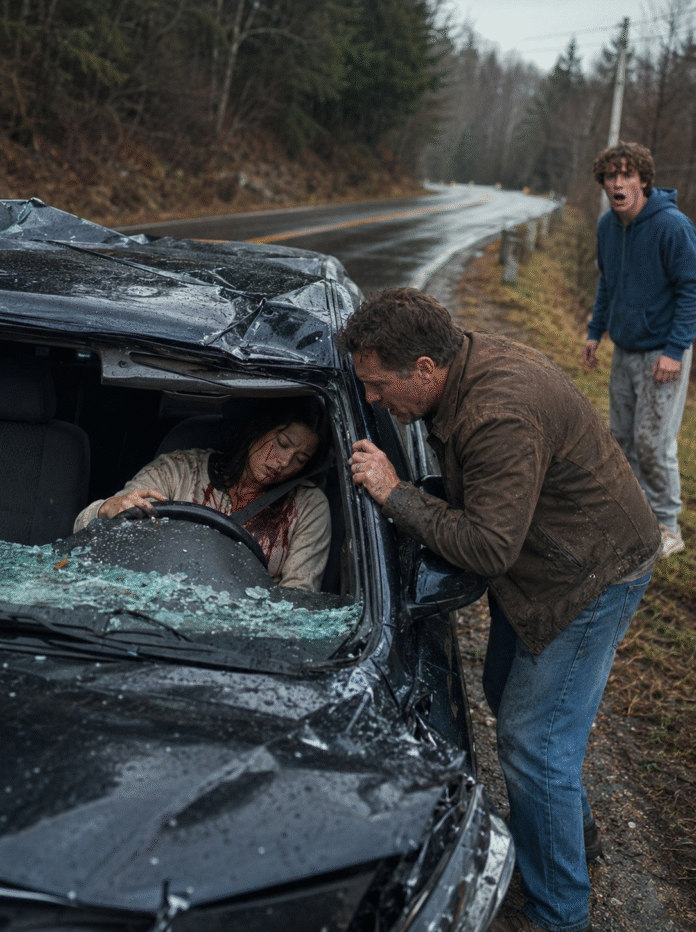
The metal guardrail tore open with a sharp pop, the post snapping like a dry twig as we went over the edge.
The world turned upside down in a rush of green branches and gray rock, the roof crushing downward with a heavy, deafening thud as we hit the first ledge. My head struck the side window, and then there was nothing but the sound of rushing water and the smell of hot oil.
When I opened my eyes, the dashboard lights were flickering, casting a pale green glow over the dirt on the ceiling. I was hanging upside down in my seatbelt, my chest squeezed so tight I could barely draw a breath.
“Evan,” I croaked, my throat dry and full of dust.
I turned my head slowly, the movement sending a sharp pain down my neck. The passenger door was wide open, swinging gently on its hinges, and the seat beside me was completely empty.
“Evan, where are you?” I called out, but the only response was the steady drip of fluid onto the dry leaves outside.
A heavy boot stepped into the mud just outside my broken window, the yellow hem of a heavy rain slicker brushing against the glass.
I tried to pull myself toward the door, but my left leg was pinned fast under the crushed steering column.“Do not move, Martha,” a low, gravelly voice said.
The man knelt down in the mud, his face lining up with the shattered window frame. It was Clint, the diner owner, his face pale and wet with the evening mist.“Clint,” I whispered, reaching out a hand. “Evan is gone. He must have been thrown from the car.”
Clint grabbed my hand, his grip surprisingly strong and steady, but he did not try to pull me out. He looked up toward the top of the ridge, his eyes narrowing.
“Stay still, he is still watching you from the ridge,” Clint whispered.
“Who?” I asked, my heart thudding against my ribs. “The sheriff?”
“The boy,” Clint said, his gravelly voice dropping even lower. “He is up there by the broken rail. Do not look up.”
I stared at Clint, my mind refusing to take in the words. My leg throbbed with a hot, pulsing pain, and the smell of raw gasoline was getting stronger by the second.“He is waiting to see if you get out,” Clint said, his thumb brushing over my knuckles. “Play dead, Martha. Just for a minute.”
“He is my son,” I whispered, the word tasting like copper in my mouth.“He was under your car this morning with a blade,” Clint said, his voice hard. “I saw him.”
I closed my eyes and let my head fall back against the torn fabric of the seat, my body going completely limp.
Through the shattered glass of the passenger side, I could see all the way up the steep, muddy slope to the edge of the road.
A dark silhouette stood perfectly still against the gray sky, framed by the jagged ends of the broken guardrail under the rain.
The ambulance cot had a stiff paper sheet that crinkled every time I shifted my weight, and the ceiling of the emergency room was nothing but rows of cold white squares. A doctor had already taped three small bandage strips over the scrapes on my cheek, but my ribs still ached from where the seatbelt had caught me.
Deputy Roy stood by the metal bedside table, his brown uniform trousers pressed so sharp they looked like they could cut paper. He cleared his throat, the sound dry as dry corn husks, before he pulled a small yellow notepad from his shirt pocket.
“The boys from the wrecking service said your steering was completely locked up when they hauled the Subaru out of the brush, Martha,” Roy said.
I rubbed the gold wedding band on my finger, sliding it back and forth over my knuckle. The metal felt warm, the only warm thing in the whole room. “The pedal went straight to the floor, Roy. I pumped it three times, but there was nothing there.”
Roy wrote something down with a yellow pencil, his silver watchband clicking against his wrist. “It was raining hard up on the ridge, and those asphalt curves get slicker than grease when the oak leaves start to drop. You had less than three thirty-seconds of tread on those front tires, according to the state guidelines.”
“It was not the tires,” I said.
“We will have the mechanic look at the master cylinder when the insurance adjuster gets down from Knoxville on Wednesday,” Roy said, tucking his notepad back under his badge. “But for now, I am listing it as a failure to maintain control on a wet surface.”He left the cubicle before I could tell him about the man in the rain gear who had pulled me from the cab, or the shadow that had been watching us from the broken guardrail.
By eight o’clock the next morning, the nurses had cleared me to sit in the hallway chair while Glenda went to sign the discharge papers. My knees were stiff, and every joint felt like it had been packed with sand.
Evan walked down the corridor with his hands shoved deep into his denim jacket pockets. He did not have a scrape on him, not even a speck of red clay from the ravine where the car had tumbled. He stopped three feet from my chair, his eyes fixed on the linoleum floor.
“They said you did not have any broken bones,” Evan said.
“The doctor said I was lucky,” I said.
He tapped the screen of his phone against his thigh, a steady, hollow sound that filled the gap between us. “Do you remember anything before we hit the post? You were looking at the oil stick back at the diner, and then you just went straight off.”“I remember the brakes going soft,” I said.
“Father always said that old car was a death trap,” Evan said, his voice flat as a timber board. “He left a note in the roll-top desk up at the cabin about it. A handwritten note, telling me to make sure you got something reliable if anything ever happened to him.”
I looked up at his chin, at the sparse little hairs he had started growing there to look older. “George never wrote anything down if he could help it, Evan. You know how his hands shook these last two years.”
“He wrote this one,” Evan said.
He turned toward the exit doors without waiting for Glenda to come back from the desk, his boots making a soft whistling sound against the wax.An hour later, I was sitting at the counter of the Gatlinburg Diner, my shoulder propped against the wooden partition to keep the weight off my bruised ribs. The smell of frying onions and chicory coffee was heavy in the air, the same as it was every Monday morning.
Clint came over with a fresh pot, his grease-stained baseball cap pulled down low over his forehead. He set a thick white mug down in front of me and poured the dark liquid until it reached the very brim.
“Two dollars,” Clint said, his voice gravelly and low.
I reached into my pocket for my coin purse, but he kept his hand on the handle of the pot, leaning in close enough that I could see the tiny flecks of gray in his beard.“Do not look around,” Clint said.
He reached into his apron pocket and drew out his hand, setting a small white paper napkin beside my saucer. He had folded it into a tight square, no bigger than a matchbook.
“Meet me behind the kitchen by the gravel bins after the sun goes down,” Clint said. “Do not bring your sister.”
He wiped the counter with his rag, erasing the wet ring my mug had left, and walked back toward the grill before I could ask him what he had seen on the ridge. I slipped the napkin into my cardigan pocket, my fingers brushing against the cool metal of my keyring.
Glenda’s kitchen smelled of cinnamon and dry toast when we finally got back to her house on the creek road. She poured two cups of sassafras tea and set them on the oilcloth table, her silver watch face catching the yellow light from the window.
“You need to rest that hip, Martha,” Glenda said, checking her watch before she even sat down. “The probate lawyer called twice while we were at the hospital, and he says the estate papers have to be filed before the twelfth.”
“I just need my keys,” I said, reaching into my purse. “I want to go up to the cabin and check on George’s things.”
I pulled the heavy brass ring out of my bag and laid it on the table between our teacups. The key to the Subaru was still there, bent slightly at the tip, alongside the small silver key to the mailbox.
Beside the mail key, the small round loop of wire was empty, the metal slightly pried apart.
“Your husband never wrote a note like that, Martha,” Glenda said, pointing at the ring. “And you are missing your cabin key.”
I stared at the empty space on the wire, the silver finish scratched where something had been forced off. The brass key George had cut for me at the hardware store forty years ago was gone.
I drove up the mountain path with my hands tight on the wheel. The gravel clicked against the floorboards of Glenda’s car, the only sound in the afternoon quiet of the ridge.
Evan was already there, sitting on a rusted folding chair on the front porch. He had three cardboard boxes from the attic stacked beside his boots, and he was digging through George’s old fishing tackle.
“You didn’t ask to come up here, Evan,” I said, letting the car door click shut behind me.
He did not look up from a yellow plastic lure he was spinning between his fingers. He had his phone resting on his knee, the screen dark.
“My dad built this place, Martha,” he said, his voice flat as a dry creek bed. “I don’t need an invitation to touch his things.”
“The key was missing from my ring,” I said, walking up the steps.
He reached into his jeans pocket and tossed the brass key onto the porch boards. It rolled and stopped against the toe of my shoe.
“I had a locksmith come out and change the deadbolt anyway,” he said. “You won’t be needing that one anymore.”
“We have until November to settle the estate,” I said, rubbing the gold band on my ring finger.
He stood up and pulled a folded piece of paper from his back pocket. He laid it flat on top of a cardboard box, smoothing the creases with the side of his hand.
“This is a quitclaim deed,” Evan said. “You sign it today, and we don’t have to wait on the court.”
“I am not signing away George’s work,” I said.
“You don’t have the money for the property taxes on this ridge, and we both know it,” he said, tapping his fingernails against his phone screen. “Sign the paper, Martha.”“No,” I said.
He picked up the document, folded it twice, and slid it back into his pocket without another word. He walked down the porch steps and got into his truck, leaving the boxes open under the gray sky.
I went inside and waited for my sister.
Glenda arrived twenty minutes later, her purse clutched against her chest like a shield. She did not even take off her coat before she went straight to the dining table and spread out the original property papers.
“He was here,” I said, watching her from the doorway of the kitchen.
“I saw his truck passing the creek road,” Glenda said, checking her watch. “We don’t have much time before the office closes in town.”
She flipped through the yellowed pages of the original title George had signed back in nineteen eighty-four. Her fingers moved fast, turning the corners down as she read.
“Look here,” Glenda said, pointing her finger at the bottom of the third page. “George put this in both your names with a survivorship clause.”
“What does that mean for us?” I asked.
“It means he couldn’t just leave it to Evan in some handwritten note,” Glenda said. “The law requires both signatures to transfer this title while you are living.”She reached into her canvas bag and pulled out a thick red ledger book with a leather spine. George had kept his daily logs in it for thirty years, marking down every foot of timber he sold and every bag of concrete he bought.
“We need to keep this ledger safe,” Glenda said, placing it in the center of the table. “His real signature is on every single page of this book.”
“He claims he has a note,” I said.
“He can claim whatever he likes,” Glenda said, checking her watch again. “But if that signature doesn’t match the hand that wrote his daily logs, a judge will throw it out in five minutes.”
“He changed the lock on the front door,” I said.
Glenda stopped turning the pages of the ledger and looked up at me. Her energetic eyes went wide, and she let out a short, sharp breath.
“He’s trying to lock you out before the probate date,” she said.
“I have the deed right here,” I said, touching the edge of the yellowed paper.
“It won’t matter if we can’t prove he’s acting in bad faith,” Glenda said. “We need to show the court what he’s doing.”
I looked out the window at the hemlocks.
The damp smell of rotting hemlock needles hung heavy in the air behind the diner. I stood near the grease trap, grease and old dishwater smelling sour in the cold night.Clint stepped out of the back door, carrying a heavy black garbage bag. He set it in the dumpster and adjusted his faded grease-stained baseball cap.
“You shouldn’t be out here alone, Martha,” Clint said, his gravelly voice low.
“I got your note,” I said.
“Your boy was down at the True Value hardware store yesterday morning,” Clint said. He leaned his shoulder against the brick wall of the diner. “The boy working the counter said Evan bought a professional lock tool.”
“He already got into the cabin,” I said. “He changed the deadbolt.”
“He’s looking for something,” Clint said. “And it isn’t just his daddy’s old fishing poles.”
“Glenda says the title requires my signature,” I said. “He can’t touch the land without me.”“The boy didn’t look like he was planning on waiting for a signature,” Clint said. “He asked the clerk if the tool would work on a standard brass padlock.”
“The tool shed,” I said.
“You need to get the sheriff to look at that Subaru,” Clint said, looking toward the dark woods behind the parking lot. “Before someone else gets to it.”“The brakes went out,” I said. “It was a mechanical failure.”
“It wasn’t a failure, Martha,” Clint said, his voice dropping even lower. “I know what I saw.”
“But he’s George’s boy,” I said.
“He’s a boy who wants eighty-five thousand dollars from a developer,” Clint said. “You go to the sheriff first thing in the morning.”
I did not answer him, but I nodded.
The sheriff’s office smelled of old coffee and floor wax. Deputy Roy sat behind his high desk, clearing his throat before he looked up at me. His uniform shirt was pressed neat, but he had his retirement calendar pinned to the corkboard right behind his head.
“The vehicle from the Miller’s Ridge accident,” Roy said, his voice formal and dry. “That would be the nineteen ninety-eight Subaru.”
“I need an inspector to look at the underside of it, Roy,” I said, leaning against the wooden counter. “The brakes went out completely.”
“Well, Martha, the report says you had bald tires and the leaves were wet,” Roy said.
“It wasn’t the tires,” I said. “I want the mechanic in town to check the lines.”
Roy cleared his throat again and looked down at a blue folder on his desk. He tapped his pen against the paper twice.
“We can’t do that,” Roy said.
“Why not?” I asked.
“The vehicle was moved three hours ago,” Roy said. “It’s no longer in the county lot.”
“Who authorized that?” I asked.
“It was released to a private yard,” Roy said. “Your stepson’s uncle owns the towing service over in Pigeon Forge.”
“He had no right to take my car,” I said.“The request came in with a signed release form from the family,” Roy said, closing the blue folder. “The law cannot help you if the evidence is already gone, Martha.”
I walked out of the office and stood on the concrete steps.
The empty sheriff’s parking lot sat quiet under a gray sky.
Clint set a thick mug on the table, the steam rising up to meet the heavy smell of fried bacon and old floor wax. He did not say a word at first, only adjusted his faded grease-stained baseball cap as he looked out the window at the morning fog.
“The coffee is still two dollars, Martha,” he said, his gravelly voice staying low so the couple in the next booth could not hear. “You drink up, and do not worry about the rest of it.”
“Thank you, Clint,” I said, my hand reaching down to rub my gold wedding band. “I just need a moment to think before I head back up the ridge.”
The brass bell above the heavy glass door let out a sharp jingle, and a draft of cold damp air swept across the floor.Evan walked in, his boots making a dry clicking sound on the linoleum as he headed straight for my booth. He did not look at Clint, nor did he look at the daily specials board by the cash register.
He slid into the vinyl bench directly across from me, his face completely blank.
“You should have stayed at the motel,” Evan said, his voice flat and clipped.
He placed his phone on the table between us and began tapping his fingernails against the glass screen.
Clint did not move away from the table, his large hands resting on the edge of the laminate wood. “You want something to drink, son, or are you just taking up space?”
Evan did not look up from his screen. “I am talking to my stepmother.”
“She is having her breakfast,” Clint said.
“She is spending money that does not belong to her,” Evan said, his voice rising just enough to make the elderly couple at the counter turn around. “Everyone in this valley knows she is trying to lock me out of my own father’s estate.”I felt the skin on my neck turn hot, and I pressed my thumb hard against my ring to keep my hand from shaking. “Evan, your father built that cabin with his own hands for us to live in.”
“He built it for his family,” Evan said, his fingernails making a rapid, rhythmic clicking against the phone screen. “Not for a woman who showed up twenty years later to claim the deed.”
A man at the counter lowered his newspaper, squinting at us through his bifocals.
Clint leaned down slightly, his shadow falling across the laminate table. “That is enough of that in here, Evan.”
“She is hoarding my father’s money, Clint,” Evan said, louder this time, his eyes wide and fixed on mine. “She has the savings accounts, the land, and now she is trying to keep the truck.”
“Get out,” Clint said, his gravelly voice dropping an octave.
“I have a legal right to speak to her,” Evan said, though he stood up anyway, sliding his phone into his back pocket with a swift, cold motion.
“Not in my place of business, you don’t,” Clint said.
Evan looked at me one last time, his lips tightening into a thin, bloodless line. “You cannot hide behind the cook forever, Martha.”
He turned and walked out, the brass bell jingling twice behind him as he stepped into the gray fog.
Clint stood by the table for a long moment, his eyes fixed on the empty street outside before he reached down to take my empty plate.
“He is trying to rattle you, Martha,” Clint said.
“I need to go to the bank,” I said, my voice barely above a whisper. “I need to see what he has done.”
Glenda was already waiting for me in the hallway outside the lawyer’s office downtown, her fingers drumming against her leather purse. She checked her watch twice before I even reached the top of the stairs.
“He has been in there for forty minutes, Martha,” Glenda said, her words coming out in a fast, energetic rush. “I saw his truck parked three blocks down.”
The heavy oak door at the end of the hall opened, and Evan stepped out, followed by a young man in a sharp blue suit holding a manila folder.
“Evan,” I said, stepping forward before I could lose my nerve. “What are you doing with my husband’s papers?”Evan stopped, his face showing no surprise at all. “They are my papers now, Martha.”
“Your father left that cabin to me in his will, and you know it,” I said, my Appalachian drawl sounding thick and slow against his flat tone.
Evan sneered, a cold, dry expression that made him look older than seventeen. “You are just a greedy stepmother with no blood relation to this family.”
“I took care of George for five years while he was sick,” I said.
“Everyone in this valley knows you only married my father for his land,” Evan said, his voice echoing in the narrow, plastered hallway.
The young lawyer in the blue suit did not look at me, instead focusing on his leather folder as he began to walk toward the stairs.
“We have nothing more to say to her, Evan,” the lawyer said, his voice formal and hollow. “The paperwork has already been filed.”
“What paperwork?” Glenda demanded, stepping between them and checking her watch again. “The probate deadline is not for another three weeks.”
Evan did not answer her, only walked past us as if we were made of glass.
“We need to see the teller right now, Martha,” Glenda said, pulling at my sleeve as she hurried down the stairs toward the street.
The lobby of the Gatlinburg First National Bank was quiet, smelling of damp wool coats and brass polish.We stood in the short line behind a farmer who was depositing a milk check, my hands still cold from the autumn wind outside.
Glenda kept shifting her weight from one foot to the other, her eyes scanning the security cameras on the ceiling. “We should have come here yesterday, Martha.”
“I did not think he could touch the joint account,” I said.
The teller, a woman named Clara who had gone to school with Glenda, beckoned us over to her window with a small nod.
“Morning, Martha, Glenda,” Clara said, her voice dropping into that quiet, careful tone people use when they know you are having trouble. “What can I do for you today?”
“I need to withdraw eighty dollars for a brake line replacement, Clara,” I said, reaching into my purse for my passbook.
Clara took the book, her fingers moving slowly over the keyboard of her computer as she pulled up the account number.
The screen flickered in the green light of the terminal, reflecting off her glasses as she stared at the numbers for a long moment.
“I cannot do that for you today, Martha,” Clara said, her voice dropping even lower.
“Why not?” Glenda asked, leaning over the marble counter. “That is a joint account with George.”
“The account has been frozen due to a pending estate dispute,” Clara said, her face hardening into a formal, professional mask.
There is no dispute,” I said, my hand going to my ring again. “The probate is still open.”
“A legal notice was delivered this morning from the executor’s attorney,” Clara said, her eyes meeting mine with a flat, empty expression.She printed out a single sheet of paper from the machine behind her, the ink still warm as she brought it back to the counter.
“I cannot release any funds until the court settles the title,” Clara said.
“But I need to pay for my car,” I said.
The teller did not answer me, only slid the frozen account statement across the counter.
Glenda set two thick ceramic mugs on her yellow oilcloth table, her knuckles white as she gripped the handle of the kettle. She checked her watch twice before the water even started to bubble, her small gold earrings clicking against her collar with every quick jerk of her head.
“I have five hundred dollars in the pantry, tucked right inside the empty oatmeal tin,” she said, her words running together the way they always did when her nerves got the better of her. “It was meant for the county tax office on the first of the month, but the county can wait thirty days. We are going to use it to hire a private mechanic to look under that carriage.”
I rubbed my gold wedding band, the metal warm against my cold skin as I watched the steam rise from the spout. “The sheriff said the car is locked up in Bobby’s private yard, Glenda. We can’t just walk in there with a toolbox and start turning bolts.”
“We are not going to walk in,” Glenda said, reaching into the deep corner of her cupboard to pull down the cardboard cylinder with the faded Quaker face on the front. “We are going to find Arthur Vance. He spent twenty-two years inspecting commercial rigs for the state before his knees gave out, and he knows every bolt on a Subaru.”
She dumped the roll of twenty-dollar bills onto the table, the green paper smelling faintly of cinnamon and old dust. It looked like a very small pile to stand between me and the truth of what happened on that mountain road.
“Arthur still keeps his state credentials in his desk drawer,” Glenda said, counting the bills into tens with her quick, practiced fingers. “If we show up with the money, he will write us an official report that the probate court has to look at.”
She checked her watch again, the metal strap clicking against her thin wrist. “He is usually at the hardware store until noon, but I will call his house first to make sure he has his pressure gauges ready.”
“He won’t go in there without a court order, Glenda,” I said. “He is too old to get caught trespassing on Bobby’s property.”
“Then we don’t take him with us,” Glenda said, sliding the money into a plain white envelope. “We go in first, we find the proof, and then we pay him to come sign the paper.”
She pushed the envelope across the table until it touched the edge of my mug.
The afternoon air smelled of wet asphalt and rotting hemlock needles when I walked down to the town square. I waited by the stone planter in the center of the lawn, holding my purse tight against my ribs while the logging trucks rumbled past the courthouse, their heavy diesel engines shaking the brick sidewalks.
Clint pulled his blue pickup truck to the curb, the engine idling with a heavy, rhythmic thrum that spoke of a bad cylinder. He rolled down the passenger window and leaned his elbow on the frame, his face shadowed by the brim of his gray baseball cap.
“Your sister told me what happened at the bank,” he said, his voice low and gravelly, like stones sliding down a dry creek bed. “Evan is moving fast, Martha. If we don’t get to that car today, his uncle Bobby will have it pushed into the crusher for scrap before the week is out.”
“Glenda has the five hundred dollars for the inspector,” I said, stepping closer to the passenger door so the passing tourists wouldn’t hear us. “But the gate is locked up tight with a heavy chain.”
Clint unlatched the door from the inside and pushed it open, the hinges giving a dry, metallic squeak. “Get in. The man working the gate tonight is Jerry Sise, and he owes me more than a few favors from the years I spent hauling gravel.”
I climbed onto the torn vinyl seat, the cabin smelling of diesel exhaust and peppermint gum. “What kind of favors, Clint?”
“The kind that make a man turn his back for ten minutes,” he said, shifting the truck into gear with a hard shove of his arm. “But we have to wait until the sun goes down behind the ridge, or Bobby will see us from his trailer.”
“He lives on the property?” I asked.
“In the double-wide right behind the office,” Clint said, looking in his rearview mirror as we pulled away from the curb. “But he is usually down at the tavern on Tuesday nights until nine.”He did not look at me while he drove, his eyes fixed on the steep curves of the bypass.
The gate to the salvage yard was a double sheet of corrugated tin secured by a thick brass padlock that glinted under the single yellow light bulb above the entrance. Jerry Sise stood in the doorway of the wooden guard shack, holding a plastic thermos in one hand and a grease-spotted paper bag in the other.
Clint killed the headlights fifty yards before the gate, letting the truck roll to a stop in the deep shadow of the wild cherry trees across the road. He turned to me and held out his hand.
“Give me the envelope, Martha,” he said.
I pulled the white paper from my coat pocket and pressed it into his palm, my fingers brushing his calloused skin. It felt like we were throwing my sister’s winter heating money into the dirt, but there was no other way to get behind that tin gate.Clint walked across the gravel road, his boots making a sharp, crunching sound that seemed too loud in the quiet valley. Jerry did not move from the doorway, but he lowered the thermos as Clint approached, his eyes cutting toward the highway behind us.
They spoke in low tones for a minute, their breath turning to pale mist in the autumn chill. I watched Clint slip the white envelope into the front pocket of Jerry’s canvas jacket, his hand moving so fast I almost missed it.
Jerry looked toward the double-wide trailer at the back of the lot, then reached into his jeans and pulled out a heavy ring of brass keys. He unlocked the padlock, swung the tin gate open just wide enough for a person to squeeze through, and pointed to the face of his watch.
“Ten minutes, Clint,” Jerry said, his voice carrying across the quiet road. “If Bobby’s truck comes down that hill, I’m locking the gate behind you.”
Clint turned and waved his arm, signaling me to get out of the cab.
The salvage yard was a maze of rusted fenders, broken glass, and the sharp, sour scent of spilled motor oil. My Subaru sat in the far corner against a row of dead hemlocks, its hood crumpled like a discarded piece of tin foil.
Clint clicked on a small silver penlight, keeping the beam low to the ground so the glare wouldn’t catch the eye of anyone passing on the ridge road. He knelt in the damp weeds beside the driver’s side front wheel, his knees sinking into the black mud.
“Hold this,” he whispered, pressing the cold metal cylinder of the flashlight into my fingers.
I held the light steady while Clint slid on his back under the crushed bumper, his shoulder wedging against the bent steel of the fender. The only sound was the slow drip of water from the radiator and the distant hum of the highway on the other side of the river.
“Shine it right behind the brake rotor, Martha,” he said, his voice muffled by the undercarriage. “A little more to the left.”
I pointed the yellow beam into the dark wheel well, where the black rubber hose of the brake line hung loose against the metal frame. The end of the hose was clean, the white inner cord showing through the dark casing.
Clint reached up with his thumb and pulled the rubber line down so it caught the center of the light.
“That is a clean cut, Martha, not a tear from the crash,” he said, his gravelly voice dropping even lower.
The yellow beam of the flashlight illuminated the sliced rubber hose, the edge of the rubber perfectly smooth where a sharp steel blade had sheared through it.
By seven the next morning, the mist from the river had settled into the hollows, turning the gravel drive gray. The damp smell of rotting hemlock needles drifted up from the woods below the porch, heavy and thick in the autumn air. I stood near the wooden railing with my wool sweater pulled tight around my chest, watching a white truck bounce slow over the deep ruts.
The engine of his truck sputtered and died, leaving only the sound of a crow calling from the top of the old hemlock by the creek. Evan sat inside the cab for a long moment, staring down at his phone, before he finally swung the heavy metal door open. He was carrying a white cardboard bakery box tied with red cotton string.
He walked up the three wooden steps, his boots making a dull thud on the pine planks. He did not look at me, but instead kept his eyes on the bakery box as he held it out.
“I bought those apple fritters you like from the bakery on Parkway,” he said.
I did not reach for the box right away. My hand went to my left ring finger, my thumb rubbing the smooth gold band George had placed there thirty-eight years ago.
“They are still warm,” Evan said, his voice flat and clipped.
I took the box from him, the cardboard warm against my palms. It smelled of fried dough and heavy white sugar, a scent that belonged to Sunday mornings when George was still alive to share them.
“Thank you, Evan,” I said. “That was thoughtful of you.”
“I was out of line at the diner the other day,” he said, staring down at the toe of his work boot. “I should not have said those things about the money.”
The screen door behind me stayed shut, but the quiet of the mountain seemed to stretch out between us. I wanted to believe him so badly that my throat felt tight, hoping that the boy I raised had finally found some peace after losing his father.
“People say things they do not mean when they are grieving,” I said.
“I want to make it right,” he said. “I think we should all have dinner tonight at the Alpine Grill.”
He finally looked up, his pale blue eyes completely blank. He tapped his index fingernail against his phone screen twice, a quick, dry sound.
“Just us?” I asked.
“We can bring Glenda,” he said. “Get it all sorted out.”I set the bakery box down on the small wicker table by the door. The red string was tied in a double knot that would take some doing to untangle.
“I will call your aunt Glenda,” I said. “What time?”“Six o’clock,” he said. “I already booked a table in the back.”
He turned and walked back to his truck without another word, his shoulders straight and stiff under his denim jacket. I watched him back down the driveway, his rear tire catching on the muddy edge of the ditch before he straightened out.The phone in my kitchen rang three times before I could get inside to answer it.
Glenda did not even say hello when she picked up.
“I am looking at my calendar right now, Martha, and I have exactly one hour free this evening,” she said, her voice coming through the receiver like a gust of wind.
“Evan wants us to meet him at the Alpine Grill at six,” I said.
“At the Grill?” she asked, and I could hear her checking her watch on the other end of the line, the small metal band clinking against her desk. “That place is twenty dollars a plate just for the chicken.”
“He says he wants to make things right about the cabin,” I said.
“I will believe that when I see it in writing,” Glenda said. “I will meet you in the parking lot at ten minutes to six.”
The day moved slow, the autumn light turning the hillsides a dull rusty copper. I spent the afternoon cleaning the grease off the kitchen stove, my mind running back to the way Evan had looked when he was a little boy, before his heart seemed to turn to stone.
At ten past five, I put on my good blue blouse and drove down the mountain.
The parking lot of the Alpine Grill was already half full of tourist cars when I pulled in. Glenda was waiting by the front doors, her fingers tapping against her leather purse.
“He is already inside,” she said, checking her watch again as I walked up. “We have fifty minutes before the dinner rush starts.”
The hostess led us to a booth in the very back, away from the windows that looked out over the river. The booth we took was in the very corner, where the green vinyl was patched with silver tape, and Evan was already sitting there, a glass of ice water in front of him.
“Thanks for coming,” Evan said, his voice dropping into that quiet, level tone.
“Let us get right to it, Evan,” Glenda said, sliding her purse onto the seat beside her. “I have a notary appointment at seven-thirty.”A waitress in a red apron set down three menus and asked if we wanted any sweet tea. We ordered three glasses, and the silence came back the minute she walked away.
The menu on the table listed a cup of coffee for two dollars, and I stared at the price just to keep from looking at my stepson.
Evan reached into his shirt pocket and pulled out a folded piece of paper, placing it flat on the wood table.
“Dad always wanted us to keep things simple,” Evan said. “He put a lot of sweat into those logs.”
I felt a small knot of hope loosen in my chest. He was talking about his father the way he used to, back when George would take him out to hunt for ginseng in the deep woods.
“He did,” I said. “He built every corner of that place with his own two hands.”
“That is why I think we should split the cabin sale fifty-fifty,” Evan said, his fingers resting on the edge of the paper. “We sell the land, we each take half, and we do not have to go through the courts.”
He slid the paper across the table until it rested against my water glass.
“It is just a standard agreement to list the property,” Evan said. “We both sign, and the broker can start showing it next week.”
The waitress returned with our sweet tea, setting the heavy glasses down with a wet thud. Evan immediately picked up his glass and took a long drink, his eyes fixed on the wall behind me.
“I need to use the restroom,” Evan said, sliding out of the booth. “Take your time looking it over.”
The moment his boots cleared the dining room carpet, Glenda snatched the paper off the table. She pulled her reading glasses from her pocket and slid them onto her nose with one quick motion.
“Let me see what this boy is trying to pull,” she whispered.
Her eyes moved fast down the first page, her fingernail tracing the lines of black print. I watched her brow furrow, her mouth drawing into a thin, tight line.“What is it, Glenda?” I asked, my hand going back to my wedding band.
“It is exactly what I thought,” she said, her voice dropping even lower.
She turned the page over, her thumb pressing hard against the corner of the paper.
“He has a clause in here that surrenders all your rights to the land immediately upon signing,” Glenda whispered. “It does not say a thing about a fifty-fifty split.”
She pointed to a line of tiny print near the bottom of the second page.
“Right here, Martha. It lists the parcel number forty-two on Millers Ridge Road, and then it says you transfer all title and interest to the party of the second part, which is him, for ten dollars.”
“Are you sure?” I asked.
“If you sign this, you do not own a splinter of that cabin by tomorrow morning,” she said, checking her watch again. “He is trying to sign over the entire deed to himself before the probate even finishes.”
The door to the restroom clicked open across the dining room. Evan walked back to the booth, his hands tucked into his pockets.“Everything look good?” he asked, sitting back down.
“We are going to need some time to have our lawyer look this over, Evan,” Glenda said, folding the paper and sliding it into her purse before he could reach for it.
Evan did not look at Glenda. He looked straight at me, his eyes narrowing just a fraction.
“The listing agent needs it by tomorrow morning if we want the autumn buyers,” he said.
“We will let you know tomorrow,” I said, my voice steadier than I expected.
The waitress came back to take our order, but Glenda stood up and pulled her coat over her shoulders.
“We have to go,” Glenda said. “Leave five dollars for the tea, Martha.”
Evan sat perfectly still in the booth as we walked out, his hands flat on the table.
The air in the parking lot was cold enough to show our breath in the yellow light of the pole lamps. Glenda walked me to my car, her boots crunching loud on the gravel.“Do not you sign a single thing he gives you,” Glenda said. “He is trying to steal that land right out from under you.”
“I know,” I said.
“I have to get to my appointment,” she said, unlocking her car. “Call me when you get home.”
I watched her drive away, her red tail lamps cutting through the dark towards the highway. I reached into my pocket for my car keys, but a shadow moved near the side of the building.
Evan was standing by the corner of the brick wall, his hands still deep in his jacket pockets. He walked slow towards my car, his shadow stretching long across the gravel.
“You should have signed it, Martha,” he said.
“Your father would be ashamed of what you are doing, Evan,” I said, holding my keys tight in my hand.He stopped three feet away from me, the smell of cigarette smoke and cheap cologne hanging around him in the cold air. His warm, polite demeanor was completely gone now, his face hard as stone.
“I wanted to do this the easy way, Martha, but you just will not let me,” he whispered.He turned on his heel and walked to his truck, the gravel spitting out from under his tires as he started the engine.
The red taillights of Evan’s truck disappearing down the dark street.
The back door of the diner was unlocked at six in the morning, just like Clint said it would be.
I stepped inside, the heat of the commercial dish machine hitting my face along with the heavy smell of old bacon fat and bleach. Clint stood by the three-compartment sink, his sleeves rolled up to his elbows, scraping grease off a stainless steel flat-top spatula.
He did not look up when the screen door clicked shut behind me.
“You should not have come through the alley,” Clint said, his gravelly voice low beneath the hum of the exhaust fan.
“Evan is trying to take the cabin, Clint,” I said, leaning against the dry-storage shelf where the large cans of sliced peaches were stacked. “He had a paper with a clause that would have stripped me of everything if I had signed it.”Clint set the spatula down in the dirty water with a heavy splash.
“I know what he is doing, Martha,” he said, turning to face me. “But you cannot be seen talking to a driver like me. It looks bad to the folks in town.”
“You are not a driver,” I said, looking at his clean leather boots and the way he moved around the kitchen like he owned every ladle on the wall. “I looked up the registry for the regional freight line you mentioned. There is no Clint on that run.”
He grabbed a yellow dish towel and began drying his hands, slowly rubbing each knuckle.
“No,” he said. “There is not.”
He gestured with his chin toward the narrow hallway that led past the dry pantry.
“Come back here before the prep cook gets in,” he said.
He led me into a small office where a single bulb hung from a frayed cord over a metal desk. The desk was piled with food distributor invoice sheets, bread crates, and a commercial order ledger.“I own this place, Martha,” Clint said, pulling out a metal folding chair for me. “I bought the diner nine years ago when my brother died in that wreck on the bypass.”I sat down, my hand automatically going to my gold wedding ring, spinning it twice around my finger.
“Why did you tell me you were just a trucker passing through?” I asked.
“Because the morning your car went over the ridge, I was out back by the grease dump,” Clint said. “I saw Evan. He had that little stainless steel box cutter, the one with the sliding blade.”
He leaned against the desk, his weight shifting onto his heels as he looked down at the floor.
“He was under the rear axle of your Subaru for less than a minute,” Clint said. “By the time I realized what he was doing, you were already turning the key in the ignition. I ran for my truck to catch you, but you were gone.”
The small office smelled of stale tobacco and old paper.“You saw him,” I whispered. “You saw him cut the line.”
“I saw him do it, Martha, but the police will never believe a man with my past,” he said.He reached into his pocket and pulled out a small brass key, laying it on the desk between us.
“That is the key to the back door of the diner,” Clint said. “I kept it because I wanted to help you, but you need to go to the sheriff.”
“If you saw him, you have to tell Roy,” I said.
“I cannot do that, Martha,” Clint said.
“Why not?” I asked.
“Because of what is on my record from twenty-five years ago,” he said, looking away toward the small window that faced the alley.
“The court does not care about twenty-five years ago if a boy tried to kill me,” I said.
“They care if the witness is me,” Clint said.
I picked up the brass key from the desk, its metal cold against my palm.“I am going to the sheriff anyway,” I said.
Deputy Roy’s cruiser was parked in the gravel driveway when I got back to the cabin at two in the afternoon.
Roy was leaning against the fender of his Ford, chewing on a toothpick, his brown uniform trousers looking sharp and stiff in the mountain light.“Martha,” he said, clearing his throat before he spoke. “I got a call from your stepson’s lawyer. They say you are refusing to let the surveyors onto the property.”“Evan cut my brake lines, Roy,” I said, stepping off the porch onto the grass. “He did it with a box cutter in the diner parking lot. I have an eyewitness who saw the whole thing.”
Roy took the toothpick out of his mouth and looked down at his boots.
“Who is this witness?” he asked.
“Clint,” I said. “The man who runs the diner in town. He saw him under the car.”Roy shook his head, his face turning solemn as he put his hands on his utility belt.
“Clint Vance has a prior record for interstate carrier fraud from back in ninety-eight,” Roy said. “He served three years in federal prison for signing off on false shipping manifests.”The wind blew through the dry oak leaves above us, making a dry scratching sound against the tin roof of the wood shed.
“He saw him, Roy,” I said. “He was right there.”
“A defense lawyer will tear him to pieces on the stand, Martha,” Roy said, opening his car door. “A convicted felon’s word against a boy with no record is not going to get me an arrest warrant.”
“But the evidence is in the impound yard,” I said.
“That car belongs to the estate now, and the estate is contested,” Roy said. “I cannot touch it without a judge signing off.”
He got into the cruiser and started the engine, leaving me in the dust of the driveway.
“The probate hearing is set for next month, Martha,” Roy said through the open window. “You ought to talk to your sister.”
He backed down the gravel road, the tires kicking up small gray stones that rattled against the undercarriage.
Glenda was waiting inside when I opened the front door, her purse already sitting on the kitchen table next to a stack of legal folders.
“I talked to the clerk at the courthouse,” Glenda said, checking her watch as she stood up. “The probate judge is not going to wait on this.”She reached into her bag and pulled out a photocopy of a dusty court document, laying it flat on the wood.
“Roy was telling the truth about Clint,” Glenda said, her voice dropping as she pointed to the paper.
In the center of the page was a black-and-white mugshot of Clint from twenty-five years ago, his shoulders square and his hair darker, looking straight into the camera under a county jail marker.
“His testimony is useless, Martha,” Glenda said. “You are entirely on your own.”
I looked at the picture of the man who had pulled me from the ravine.
Clint’s eyes in the photograph looked older than his years, tired and flat under the harsh camera flash.“We have to find another way to prove the forgery,” I said.
“There is no other way without a witness or the car,” Glenda said, closing her folder with a sharp snap. “And the car is locked up in his uncle’s yard.”
“What about the red ledger?” I asked.
“The ledger has George’s real signature, but Evan has that handwritten note,” Glenda said. “The court will look at both, but without proof of how he got it, the judge will lean toward the blood relative.”
She stood up and walked to the window, looking out at the gravel driveway where the sheriff’s car had been.
“You need to think about what you are going to do if the judge rules against us,” Glenda said.
“I am not leaving this cabin, Glenda,” I said.
“The court can make you leave, Martha,” she said.
I sat down at the table and placed my hands flat on the cool oilcloth cover.“We have until the twelfth of November,” I said.
“That is less than three weeks,” Glenda said, her fingers tapping against her leather purse. “And Evan’s lawyer is already filing the emergency motion to clear the title.”
I looked down at the photocopy of Clint’s record, my thumb tracing the edge of the paper.The document had the official seal of the state of Tennessee stamped in the corner, faded and smudged from the copier.“He tried to kill me, Glenda,” I said.
“I know,” she said, her voice turning soft as she stepped close to my chair. “But the law does not care about what we know. It only cares about what we can prove in front of a judge.”
She picked up her folders and tucked them under her arm, her watch ticking loudly in the quiet room.
“I have to get back to the office,” Glenda said. “I will call the surveyor and see if we can delay them another two days.”
She walked to the front door and opened it, letting in the cool afternoon air that smelled of dry leaves and wood smoke.
“Do not do anything foolish, Martha,” she said.
The door clicked shut behind her, leaving me alone in the kitchen with the shadow of the mountain creeping across the floor.
I reached out and picked up the photocopy of the court record, folding it twice until it was small enough to fit into my apron pocket.Clint’s old mugshot printed on a dusty court document Glenda holds.
Glenda held the dusty court document in her left hand, her thumb covering Clint’s old mugshot. She folded the paper twice, her silver watch ticking against her wrist as she slid the record into her leather purse.
“This changes how we have to play it,” Glenda said, looking out the passenger window of the car as we sat in the courthouse parking lot. “The court is not going to listen to a man who spent eighteen months in federal custody for mail fraud, Martha.”
“Clint saw him, Glenda,” I said, my thumb rubbing the gold wedding band on my finger. “He saw the boy under my Subaru with that box cutter.”
“It does not matter what Clint saw if a defense lawyer gets him on the stand,” Glenda said, checking her watch. “The clerk closes the morning docket in eight minutes, and we need to be inside.”
We walked up the concrete steps of the county courthouse, the wind carrying the sharp smell of wet coal smoke from the valley below.
Deputy Roy was leaning against the heavy oak railing outside the clerk’s office, his hands tucked behind his leather utility belt. He cleared his throat before he spoke, the sound gravelly in the empty corridor.
“Martha,” Roy said, nodding once to Glenda. “I got your message about the restraining order.”
“We need the paperwork filed before noon, Roy,” I said. “Evan was at the cabin again yesterday, looking through the shed.”
“The judge is going to want to see a domestic incident report,” Roy said, his voice dropping into that formal, bureaucratic tone. “We do not have a single physical altercation on file for the boy.”
“He cut my brake line,” I said, keeping my voice down as two lawyers walked past us. “I nearly went over the ridge.”
“The wrecking yard report says mechanical failure due to age,” Roy said, adjusting his belt. “I have thirty days left on this job, Martha, and I am not going to write up an arrest warrant based on what a diner owner thinks he saw from fifty yards away in the rain. I am trying to get to my retirement without a lawsuit on my desk.”“You know Clint,” Glenda said, her voice rising. “He is not a liar.”
“He has a record, Glenda,” Roy said, clearing his throat. “That is all the county attorney is going to see. My hands are tied until you have a certified mechanic write up a formal statement, and that private yard is not going to let a state inspector near that car without a court order.”
The heavy oak door of the judge’s chambers clicked open, and a clerk in a grey sweater beckoned us inside. The room was small, lined with brown leather books that smelled of dry paper and vinegar.
Judge Harrison did not look up from his desk when we sat down at the small table. He had a pair of reading glasses perched on the tip of his nose, his eyes scanning a blue folder.
“Mrs. Campbell,” the judge said, his voice dry. “Your sister has filed an emergency petition for a temporary restraining order against Evan Campbell.”
“Yes, sir,” I said. “He is trying to force me off the property.”“I have a copy of the memorandum of agreement here,” the judge said, tapping a document on his blotter. “It appears to be signed by your late husband, George, three weeks before his passing, leaving the cabin sole title to his son.”
“George never signed that,” I said. “He could barely hold a pen that week.”
“The signature is notarized by a standard county seal,” the judge said. “And the sheriff’s department has no record of any physical threats or harassment.”
“The boy tampered with her car,” Glenda said, leaning forward. “We have proof the rubber line was cut with a blade.”
“The report from the private yard is not certified by a state inspector,” the judge said. He closed the blue folder with a soft slap. “I cannot restrict a legal heir’s access to an undivided estate without a pending criminal charge or an official state police inspection.”
The gavel sat on the corner of his desk, untouched. He did not need to use it.
“The petition is denied,” the judge said. “The probate hearing remains the proper venue for these disputes.”
We walked out of the courtroom into the bright light of the lobby. The brass handles on the doors were cold under my hand.
“He did not even look at the mechanic’s notes,” Glenda said, her fingers snapping the latch of her purse shut.
“He looked at the signature on that note,” I said.
“We need to get back to the cabin before Evan does,” Glenda said, checking her watch again.The drive up Millers Ridge Road was quiet. The road was damp, the yellow leaves from the poplars sticking to the asphalt like wet paper.
When we turned the final curve before the driveway, I saw the white pickup truck parked near my woodpile.A man in a bright orange safety vest was standing near the well house, a metal tripod set up in the weeds.
Evan was standing on the porch, his hands in his pockets, watching the man work.Who is that with him?” I asked, my hand going to my wedding ring.
“That is a surveyor from the county line,” Glenda said, her car tires crunching on the gravel as she stopped behind the truck.I opened the door before the engine had fully died. The damp smell of rotting hemlock needles was thick under the trees, cold and heavy in my lungs.
“Evan,” I said, walking toward the porch steps. “What are you doing with a surveyor on this land?”
Evan did not move his hands from his pockets. He tapped his fingernails against his phone through the fabric of his trousers.
“Establishing the boundary line,” Evan said, his voice flat. “The north forty acres are being split off.”
“This land is not split,” I said. “The estate is still in probate.”
“Not according to the clerk,” Evan said.
He reached into his jacket pocket and pulled out a long white envelope. He held it out toward me, his face showing nothing at all.“The clerk signed the preliminary writ this morning,” Evan said. “Based on the memorandum.”
I took the envelope, the paper feeling thick and cold in my hand. Inside was a single sheet of blue paper with the county seal at the top.
“You have seventy-two hours to vacate the property, Martha,” Evan said.
“This is my home,” I said. “Your father built this chimney with stone he hauled from the creek.”
“The paper says the house goes to the sole blood heir,” Evan said.
“That paper is a forgery,” Glenda said, coming up behind me. “We are taking this to the probate judge on the twelfth.”
“The date changed,” Evan said, looking past us toward the highway. “My lawyer had it moved up.”
“They cannot do that without notice,” Glenda said.
“The notice is in that envelope,” Evan said, pointing a finger at the paper in my hand.
The surveyor by the well house struck a wooden stake with a heavy mallet. The sound was sharp, echoing off the ridge behind the cabin like a pistol shot.
“We are going inside to pack your medicines, Martha,” Glenda said, her hand tight on my elbow. “Do not say another word to him.”
The cabin kitchen was cold. The pilot light on the stove had gone out, and the air smelled of stale grease and old wool.Glenda set four brown cardboard boxes on the kitchen table, the cardboard dry and rough under my hands.
“We will start with the pantry,” Glenda said. “The canned goods can go in the bottom of the green chest.”
“I am not leaving his plates,” I said, looking at the blue willow cups on the shelf.
“We are only taking what you need for a week,” Glenda said, her tape gun clicking as she pulled a long strip of clear tape across a box. “The rest will have to stay until the hearing.”
“When is it, Glenda?” I asked. “What did the paper say?”
“Next Tuesday,” Glenda said, not looking up from the box. “November fifth.”
“That is seven days before the probate deadline,” I said. “George always said the twelfth was the final day.”
“The lawyer used the eviction writ to expedite the docket,” Glenda said. “He told the judge the property was being neglected. He wants to settle the title before we can get the state inspector to look at the Subaru.”
“And the bank accounts?” I asked.
Next Part upload tomorrow