The phone call came at 3:17 on a Tuesday afternoon.
I remember the exact time because I had spent seven years wishing for that call.
And by then, I had finally stopped believing it would ever come.“Mr. Parker?” the woman asked. “This is Lakeside Animal Rescue. We scanned a cat this morning, and your name came up on the microchip.”
For a few seconds, I couldn’t speak.Then she said the name.
“Oliver.”
My chair hit the wall when I stood up.
Seven years disappeared in one breath.
My name is Michael Parker, and Oliver had been missing for so long that most people assumed he was dead.
Sometimes I assumed it too.
I just never had the courage to say it out loud.
I first met him on my twenty-sixth birthday.
My sister Rachel walked into my apartment in Cedar Grove, Ohio, holding a cardboard carrier with tiny holes cut into the sides.
“You said you wanted company,” she told me.
Inside was the smallest orange kitten I’d ever seen.
Bright amber eyes.
Huge ears.
A ridiculous pink nose.
He climbed out, sniffed my shoe, then marched straight up my jeans like he’d already decided I belonged to him.I named him Oliver after my grandfather.
Within months, every routine I had included him.
He sat on the bathroom counter while I shaved.
He waited beside my coffee maker every morning.
He slept on the back of the couch while I watched television.
And every evening when I came home from my accounting job, I could hear him running before I even unlocked the door.
People who don’t have pets sometimes say, “It’s just a cat.”
Oliver was never “just” anything.
He was the one living thing waiting for me every single day.
Five years after I adopted him, he disappeared.
It happened on a warm April afternoon.
Oliver liked sitting in the fenced backyard while I gardened.
He never wandered far.
That day my phone rang.
A client.I turned away for maybe two minutes.
When I looked back, Oliver was gone.
At first, I wasn’t worried.
I checked under the porch.
Behind the shed.
Along the fence.
Then I started calling louder.
“Oliver!”
Nothing.
By sunset, I was walking neighborhood streets with a flashlight.
By midnight, I was driving slowly through alleys calling his name out the window.
The next morning, I printed flyers.
Three hundred of them.
I taped them to telephone poles, grocery store boards, veterinary offices, laundromats, gas stations.
I called every shelter within fifty miles.I posted online.
I knocked on doors.
I searched drainage ditches.
I walked wooded lots behind subdivisions.
Weeks passed.
Then months.
I hired a pet tracker.
Nothing.
Every orange cat became Oliver from a distance.
More than once, I slammed on my brakes because I saw a flash of ginger fur near the road.
It was never him.
The hardest part wasn’t losing him.
It was not knowing.
If someone had told me he’d died, I could have buried him.
Grieved him.Said goodbye.
Instead, every night I looked at my porch expecting to see him.
A year passed.
Then two.
Friends suggested I adopt another cat.
I couldn’t.
It felt like replacing somebody who might still be trying to come home.
So I worked.
Too much.
I stopped going out.
Stopped inviting people over.
Oliver’s picture remained on my desk.
Seven years after he disappeared, my company promoted me and transferred me to Columbus.
Nearly a hundred miles away.
Leaving Cedar Grove hurt more than I expected.
The morning I loaded the moving truck, I stood on the front porch looking at the sidewalk.A completely irrational part of me thought:
What if he comes back tomorrow?
I almost didn’t move.
But eventually, I locked the door.
In Columbus, I tried becoming someone new.
New office.
New neighborhood.
New routines.
One Sunday, I read an article about a local animal shelter needing volunteers.
I don’t know why I signed up.
Maybe helping other animals was the closest I could get to helping Oliver.
Every Saturday, I cleaned cages, filled food bowls, walked dogs and sat with frightened cats nobody wanted to touch.
It hurt sometimes.
But it helped too.
Then came that Tuesday.
While I was sitting in my office, Lakeside Animal Rescue called.
The woman on the phone sounded hesitant.
“Mr. Parker, we received an elderly orange male this morning. He was found behind a warehouse.”
My heart started racing.
“He’s in rough shape,” she continued. “Very thin. Dehydrated. Multiple infections. Our technician found a microchip during the final exam.”
Final exam.
Something about those words bothered me.
“What do you mean final?”
Silence.
Then she answered carefully.
“Because of his condition, euthanasia had been discussed.”
I stopped breathing.
“But the chip registered to you. The name on the file is Oliver.”
My keys were already in my hand.
I don’t remember telling my boss where I was going.
I remember driving too fast.
Missing one turn.
Running from the parking lot.
A shelter employee met me near the front desk.
“Michael?”
“Where is he?”
She led me down a hallway.
The closer we got, the more terrified I became.
Seven years.
What if it wasn’t him?
What if the chip was wrong?
What if he didn’t know me anymore?
Then she opened a small room.
A cage sat against the wall.
Inside it, curled tightly in the back corner, was an old orange cat.
His fur was dull.
His ribs showed.
Half his left ear was torn.
He looked exhausted.
Nothing like the young, bright-eyed cat from my photographs.
And yet somehow, instantly, I knew.
“Oliver?”
His ears moved.
I stepped closer.
“Buddy?”
His head lifted.
Slowly.
Painfully.
Then those amber eyes opened.
And looked directly at me.
The woman beside me covered her mouth.
Oliver stared for maybe three seconds.
Then he made a sound.
A weak, broken little chirp.
The exact sound he used to make every night when I came home from work.
My knees almost gave out.
I opened the cage.
“Oliver…”
He tried to stand.
His back legs shook.
He stumbled once.
Then, somehow, this old, sick cat walked straight toward my hand.
He pressed his face against my fingers.
And began to purr.
Not loudly.
Barely enough to hear.
But after seven years, I knew that sound better than my own voice.
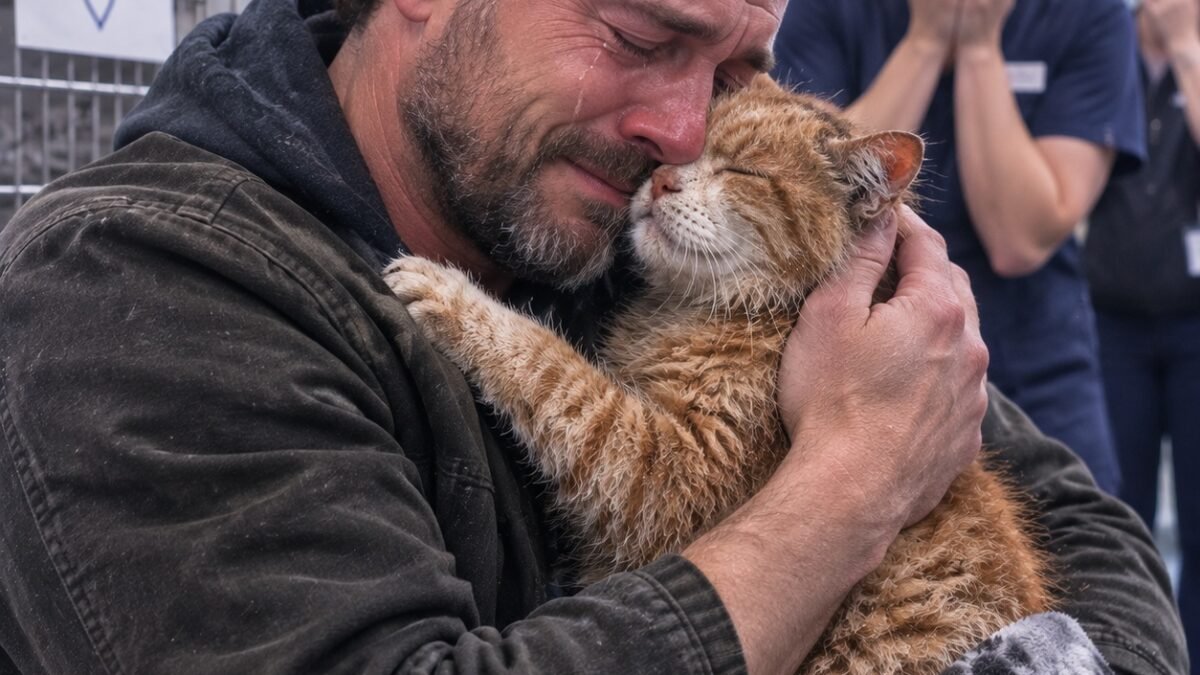
I picked him up.
The moment his body touched my chest, Oliver buried his face beneath my chin exactly the way he had when he was a kitten.
I heard somebody behind me crying.
Then someone else.
But all I could do was hold him.
“I’m sorry,” I kept whispering. “I’m so sorry it took me this long.”
Oliver pushed harder against my chest.
And then the veterinarian walked into the room carrying his test results.
The look on her face told me that finding him had only been the beginning.
“Please sit down,” she said.
I didn’t.
I couldn’t stop holding him.
“Tell me.”
Her name was Dr. Elaine Morgan.
She had kind eyes, but I’d spent enough time around shelters to recognize that expression.
The one professionals wear when they’re trying to be gentle without lying.
“Oliver is severely underweight. He’s dehydrated. His teeth are in poor condition. He has an upper respiratory infection and probably hasn’t had consistent food for a long time.”
“Can you treat it?”
“Most of that, yes.”
Most.
I heard the word.
“What else?”
She hesitated.
“His kidney values are concerning.”
I looked down at Oliver.
He was still purring.
“There may be chronic kidney disease. We need more tests.”
“How long?”
“We don’t know.”
“What do you mean?”
“I mean he could respond well to treatment and have meaningful time left. Or we may find that his body has been struggling for too long.”
The reunion I had imagined for seven years had never included this part.
In my fantasies, Oliver came home healthy.
He jumped onto the couch.
Ate from his old bowl.
Slept beside me.
We got our missing years back.
But life doesn’t return what it takes.
It gives you whatever is left.
“I want everything done,” I said.
Dr. Morgan nodded.
“We’ll start immediately.”
Oliver spent two nights at the clinic.
I barely slept.
When I finally brought him home, I had transformed my guest room into something between a hospital and a luxury cat hotel.
Soft blankets.
A heated bed.
Water bowls everywhere.
Prescription food.
Medication lined up by time.
And, sitting beside the bed, one ridiculous blue stuffed mouse.
Oliver’s old favorite toy.
I had kept it for seven years.
The moment I placed him on the blanket, he sniffed the mouse.
Then rested one paw on it.
I sat on the floor and cried.
The first week was difficult.
He ate very little.
Some days he seemed confused.
He slept nearly eighteen hours.
I took time off work.
Every few hours, I checked his water.
His breathing.
His medications.
At night, I slept on the floor beside him.
On the fourth morning, I woke to something touching my face.
Oliver’s paw.
He was sitting beside my pillow.
“Hey.”
He chirped.
Then walked across my chest and settled under my chin.
Just like before.
That was when I finally believed he was really home.
His recovery wasn’t miraculous.
It was slow.
One ounce gained.
Then another.
His infections cleared.
His fur became softer.
His appetite returned.
His kidneys were damaged, but manageable.
Dr. Morgan warned me not to expect miracles.
“He’s old, Michael.”
“I know.”
“He’s been through a lot.”
“I know.”
She smiled.
“But he’s stubborn.”
“That I definitely know.”
Within three months, Oliver had gained nearly four pounds.
The first time he chased a toy across the living room, I laughed so loudly I scared him.
He froze.
I froze.
Then he pounced again.
I laughed even harder.
Something else changed too.
Me.
For years, I’d used Oliver’s disappearance as an excuse to close myself off.
I didn’t realize it at the time.
I simply told myself I preferred being alone.
After he came back, that explanation stopped working.
I started spending more time at the shelter.
Not because I was searching anymore.
Because I wanted to help.
People began hearing Oliver’s story.
A woman whose dog had been missing for three months came to talk to me.
A family whose cat disappeared during a move emailed me.
I told everyone the same thing:
Keep microchip information updated.
Call shelters again.
Then call again.
Don’t assume somebody will contact you immediately.
And don’t give up just because time passes.
That was also how I met Hannah.
She volunteered on Thursday evenings.
The first time she visited my apartment, Oliver inspected her for almost ten minutes.
Sniffed her shoes.
Her bag.
Her hands.
Then jumped into her lap.
“Well,” she said, looking at me, “apparently I’ve passed.”
“That’s a higher standard than anything I could come up with.”
She laughed.
Oliver closed his eyes and started purring.
After that, Hannah became part of our life.
And I mean our life.
Because for a while, it felt like Oliver and I were rebuilding everything together.
One rainy evening, nearly two years after the reunion, I came home and found Oliver sitting beside the front door.
Not lying down.
Waiting.
Exactly like he used to before he disappeared.
I put my keys down.
“Did you hear the elevator?”
He chirped.
I crouched.
He walked toward me and pressed his forehead against mine.
For some reason, that moment hurt more than the reunion.
Because suddenly I could see the years.
The young cat who used to race toward the door.
The old cat standing there now.
Everything between us.
Everything missing.
Everything returned.
Oliver lived almost three more years after I found him.
His final winter was gentle.
He slept more.
Ate less.
Stopped jumping onto high furniture.
But every evening, he climbed into my lap.
Hannah and I bought a house that spring.
Small backyard.
Big windows.
Lots of sunlight.
Oliver’s favorite place became a cushion beside the living-room window.
One Saturday morning, I found him there watching birds.
I sat beside him.
He leaned against my leg.
His breathing had changed during the night.
I knew.
Sometimes you know before the doctor tells you.
We took him to Dr. Morgan.
She ran tests.
The kidney disease had progressed.
There were options.
Fluids.
Hospitalization.
More medication.
Maybe days.
Maybe weeks.
Maybe discomfort.
I looked at Oliver.
He looked tired.
Not frightened.
Just tired.
“Can I take him home?”
Dr. Morgan nodded.
“Yes.”
That afternoon, Hannah opened every curtain in the house.
Sunlight filled the living room.
I put Oliver’s blue mouse beside him.
He placed one paw over it.
I sat on the floor.
Hannah sat beside me.
For hours, we talked to him.
I told him everything I should have said years before.
That I never stopped looking.
That I had blamed myself.
That I hoped wherever he had been, somebody had shown him kindness sometimes.
That finding him again had given me more than I could ever give back.
Near sunset, Oliver climbed into my lap.
Slowly.
He curled against my chest.
His head rested beneath my chin.
Exactly where it had rested the day I found him at the shelter.
He purred.
Quietly.
Then more quietly.
Until eventually, I realized I couldn’t hear it anymore.
Oliver died in my arms.
And yes, it broke my heart.
But grief was different this time.
Seven years earlier, I had lost him without an ending.
No goodbye.
No certainty.
Only questions.
This time, I got to hold him.
I got to tell him he was loved.
I got to know that his final home was safe.
A week later, I returned to Lakeside Animal Rescue.
There was an empty cage near the back.
Inside sat a frightened orange kitten who had been surrendered that morning.
He wasn’t Oliver.
Nobody could ever be Oliver.
For years, that fact would have made me walk away.
Instead, I opened the cage.
The kitten backed into the corner.
I sat on the floor.
Didn’t reach for him.
Didn’t rush him.
Just waited.
Eventually, he came closer and sniffed my hand.
The shelter worker smiled.
“Thinking about adopting?”
I looked at that tiny orange face.
Then at Oliver’s old photograph on my phone.
“Yes,” I said.
“I think I am.”
I named him Sunny.
Not because he replaced Oliver.
Because Oliver had finally taught me that love doesn’t become smaller when you give it somewhere new.
Years ago, when he disappeared, I believed losing him meant the story was over.
I was wrong.
Seven years later, a microchip, a shelter worker who looked one more time, and an old orange cat who somehow remembered my voice gave us another chapter.
Not forever.
Just enough.
Sometimes, when Sunny races to the door when I come home, I think of Oliver.
I remember that weak chirp from inside the shelter cage.
The way his eyes opened.
The way he struggled to his feet.
The way he buried his face against my chest as if seven years had lasted only seven minutes.
And I understand something now that I didn’t understand when I was younger.
We don’t get to decide how long the people—or animals—we love will stay.
We don’t get to protect ourselves from every goodbye.
What we do get to decide is what we do with the time that comes back to us.
I lost Oliver once.
Then, against every reasonable expectation, I found him again.
And those final years didn’t erase the seven we missed.
They did something better.
They gave the story an ending filled not with wondering…
but with love.