The night before everything changed, I had spent nearly forty minutes brushing my twelve-year-old daughter Emily’s hair. It reached almost to her waist, thick and chestnut brown, and she treated every inch of it like something precious. Every Sunday evening, she sat between my knees while I carefully worked through the tangles. Whenever I suggested even a small trim, she reacted as though I had proposed shaving her head.
“I’m never cutting it,” she always said. I believed her. That was why I knew something was wrong the moment she returned from spending Monday afternoon with my mother-in-law, Linda. It was ninety-two degrees outside. Emily walked through the front door wearing an oversized hoodie with the hood pulled tightly around her face. “Emily?” “Hi, Mom.” She hurried toward the stairs. “Aren’t you boiling in that?” “I’m cold.” I almost laughed. Then I noticed the way she refused to look at me.
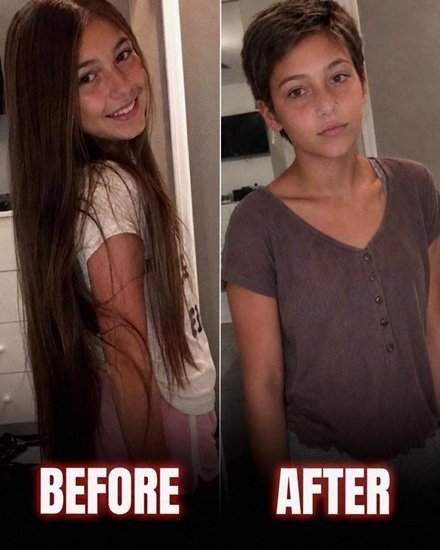
“Come here.” “I have homework.” “Emily.” She stopped. That was when I saw several short brown hairs clinging to the back of her sweatshirt. My stomach tightened. “Take the hood down.” She didn’t move. “Please.” Slowly, Emily reached upward. The hood fell. Her beautiful waist-length hair was gone. In its place was a very short pixie cut. It was neat enough to have been done professionally, but the change was so dramatic that for several seconds I could only stare. “What happened?” Emily’s eyes filled with tears.
“Don’t be mad.” “Who cut your hair?”
She looked toward the floor.
“Grandma knows.”
That was all I needed to hear.
I grabbed my keys.
Linda and I had never had the easiest relationship.
She loved Emily deeply, and I knew that.
But she also had strong opinions about parenting.
I had spent years feeling that she believed I worked too much, missed too many school events, and allowed my career to occupy space that should have belonged to my daughter.
The uncomfortable part was that she wasn’t entirely wrong.
I worked for a demanding manager named Melissa.
Melissa treated evenings as extensions of the workday.
Weekends were opportunities to “get ahead.”
Vacations were simply days when employees answered emails from somewhere prettier.
And I had allowed it.
I told myself I was providing for Emily.
The mortgage mattered.
Groceries mattered.
Savings mattered.
What I did not admit was that I had gradually allowed my employer to convince me that every work emergency mattered more than whatever was happening at home.
Linda attended the events I missed.
Science fairs.
School concerts.
Parent presentations.
Award ceremonies.
I usually had an explanation.
A meeting ran late.
A client needed something.
Melissa called.
Traffic was terrible.
I watched recordings afterward and told myself that was almost the same.
It wasn’t.
Still, when I reached Linda’s house that afternoon, none of those thoughts were in my head.
I was furious about Emily’s hair.
I knocked once and walked inside.
“What did you do?”
Linda looked up from the kitchen.
“What?”
“Emily’s hair.”
Her expression changed immediately.
“Oh.”
“Did you cut it?”
“No.”
“Did you take her somewhere to have it cut?”
“Yes.”
I stared at her.
“So you did this.”
“No.”
“You took my twelve-year-old daughter to a salon and came home with almost all her hair gone.”
“Because she asked me to.”
“Emily loved that hair.”
“I know.”
“She wouldn’t even let me trim two inches.”
“I know that too.”
“Then why?”
Linda looked genuinely heartbroken.
“Because this wasn’t about her hair.”
I stopped.
“What does that mean?”
“You need to go to the concert tomorrow.”
“Don’t change the subject.”
“I’m not.”
She looked directly at me.“Go to Emily’s concert.”
“Why?”
“Because she needs to tell you herself.”
I hated that answer.
I hated mysteries involving my own child even more.
“Tell me now.”
“No.”
“Linda.”
“She trusted me with something that isn’t entirely her story to tell.”
That sentence confused me.
Then she said something that hurt.
“Just show up tomorrow.”
I went home angry.
Emily was already in her room.
I knocked.
“Can we talk?”
“Not yet.”
“Did Grandma make you cut your hair?”
“No.”
“Did anyone force you?”
She shook her head.
“Then why did you do it?”
She pulled the blanket closer.
“Tomorrow.”
The same answer.
The following afternoon, I was helping Emily find a missing music folder when I opened her backpack.
A crumpled piece of paper fell out.
I unfolded it.
The message was cruel.
It suggested that someone would discover how funny things were when she no longer had her hair.
My hands started shaking.
“Emily?”
She appeared in the doorway.
“What is this?”
Her face went pale.
“Where did you find that?”
“In your backpack.”
She reached for it.
“Mom, please.”
“Is someone bullying you?”
“No.”
“Then who wrote this?”
“I can’t tell you yet.”
“Emily, if someone threatened you—”
My phone rang.
Melissa.
I ignored it.
It rang again.
Then again.
Finally, I answered.
“Where are you?” she demanded.
“At home.”
“We need you back at the office.”
“I can’t.”
There was silence.
“What do you mean, you can’t?”
“My daughter has a concert tonight.”
“You can watch the recording.”
I looked at Emily.
She was staring at the floor.
Suddenly, I remembered every recording I had watched.
Every empty chair.
Every time I had said next time.
“No.”
Melissa sounded genuinely surprised.
“No?”
“I’m going to the concert.”
“This project has to be finished tonight.”
“Then someone else will have to finish it.”
“If you leave us short again, we’re going to have a serious conversation about whether this position is still right for you.”
Normally, that sentence would have terrified me.
This time, it didn’t.
“Then we’ll have that conversation tomorrow.”
I ended the call.
Emily stared at me.
“You’re coming?”
Three words.
That was all.
But the surprise in her voice hurt more than anything Melissa could have said.
“Yes.”
“You don’t have to.”
“I do.”
That evening, I arrived early.
Linda was already there.
She looked surprised when she saw me.
I sat beside her.
Neither of us mentioned our argument.
When the students entered, I spotted Emily immediately.
Beside her stood her best friend, Maya.
My breath caught.
Maya had the same short haircut.
Suddenly, pieces of the mystery began moving into place.
Halfway through the program, a teacher stepped toward the microphone.
She explained that two students wanted to share something about friendship and kindness.
Emily and Maya walked forward.
Emily looked terrified.
Then she saw me.
Her shoulders relaxed slightly.
Maya spoke first.
A few days earlier, several older students had targeted her with a cruel prank involving gum placed in her hair.
By the time adults understood what had happened, much of the gum was tangled close to the roots.
Her parents took her to a salon.
The stylist tried to save as much hair as possible.
It could not all be saved.
Maya had always worn her hair long.
She was devastated.
But the haircut itself was not what frightened her most.
She was afraid to return to school.
She feared that the same students would laugh when they saw what their actions had caused.
That was where Emily entered the story.
Maya had called her crying.
Emily called Linda.
Not me.
That realization hurt.
But I understood why.
Linda answered.
Linda came.
Linda took both girls to the salon.
And while Maya sat in the chair trying not to cry, Emily made a decision nobody had asked her to make.
“Cut mine too,” she told the stylist.
Linda initially refused.
She reminded Emily how much she loved her hair.
Emily insisted.
“If Maya has to walk into school like this,” she said, “she shouldn’t have to walk in alone.”
So the stylist cut Emily’s hair.
Not because Grandma forced her.
Not because Emily was rebelling.
Not because someone had bullied her into changing herself.
She gave up something she loved because her friend was frightened.
The note I had found had not been written to Emily.
It had been intended for Maya.
The school had become involved, and the students responsible had been identified and referred to the principal under the school’s disciplinary process.
Emily had kept the details from me because Maya was not ready for everyone to know.
I sat in the auditorium crying.
Then Emily said something else.
“I want to thank my grandma.”
Linda immediately began crying too.
“She came when we called.”
Four words.
They went straight through me.
She came when we called.
Of course she did.
Linda had been coming for years.
Whenever I was too busy.
Whenever Melissa needed something.
Whenever I promised Emily I would make the next event.
Linda occupied the chair I left empty.
After the concert, I found Emily near the stage.
She looked at me.
“You came.”
Again, that surprise.
I hugged her.
“I should have been coming all along.”
She didn’t argue.
Children sometimes forgive adults faster than adults deserve.
Maya came over a few minutes later.
I told her I liked her haircut.
She smiled.
“Emily looks better in it.”
Emily laughed.
“No way.”
For the first time since she came home wearing that hoodie, she seemed comfortable.
Later, I found Linda outside.
“I owe you an apology.”
She shook her head.
“You were scared.”
“I accused you of doing something to her.”
“I would have thought the same thing.”
Then I asked the question I had been avoiding.
“Why did she call you instead of me?”
Linda was quiet.
“You really want the answer?”
“Yes.”
“Because she knew I’d answer.”
That hurt.
She saw my expression.
“I am not trying to replace you.”
“I know.”
“I never was.”
“I know that now.”
Linda looked toward the auditorium doors.
“I just kept sitting in the empty chair.”
I cried in the parking lot.
Not because she was cruel.
Because she was right.
The following morning, Melissa called me into her office.
The conversation was unpleasant.
I will not pretend one dramatic decision magically solved my work-life balance.
Real life rarely works that way.
I still needed a job.
Bills still existed.
Responsibilities did not disappear because I had experienced an emotional revelation at a school concert.
But something had changed.
My boundaries.
I told Melissa that evenings involving important family commitments would no longer automatically become work hours.
There could be genuine emergencies.
But everything could not be an emergency.
If that made me unsuitable for the position, I would eventually have to find another one.
I was frightened saying it.
I said it anyway.
That afternoon, I asked Emily when her next rehearsal was.
She gave me the date.
Then she looked suspicious.
“Why?”
“Because I’m putting it on my calendar.”
“You don’t have to come to rehearsals.”
“I know.”
“Mom.”
“What?”
She smiled.
“Concerts are enough.”
So I promised to start there.
Her hair slowly grew back.
For months, she and Maya wore their short styles together.
The experience did not erase what Maya had gone through, and Emily’s haircut did not magically solve bullying.
Adults still had responsibilities.
The school still needed to respond.
Maya still deserved support.
But Emily had done the one thing a twelve-year-old friend could control.
She made sure Maya did not feel alone.
That mattered.
I had initially looked at my daughter’s missing hair and assumed someone had taken something from her.
I was wrong.
Emily had chosen to give something.
Something she loved.
Something that would grow back.
She gave it because her friend needed courage and Emily decided courage was easier when shared.
The lesson I learned was different.
For years, I had convinced myself that providing financially was the most important way I could care for my daughter.
Providing matters.
But presence matters too.
Children remember who is sitting in the audience.
Who answers the phone.
Who arrives when something goes wrong.
I could not return to every science fair I had missed.
I could not fill every empty chair from the past.
I could not change the fact that when Emily needed an adult that afternoon, her first instinct had been to call Grandma.
But I could change what happened next.
At her following concert, I arrived twenty minutes early.
Emily walked into the auditorium carrying her music.
She saw me.
This time, she did not look surprised.
She smiled.
That was how I knew I was beginning to repair something.
Emily’s pixie cut eventually grew out.
The lesson did not.
My twelve-year-old daughter had given up something she treasured so another child would not have to face humiliation alone.
And while I had spent years telling myself that adulthood made me the person responsible for teaching her how to live, that evening the lesson traveled in the opposite direction.
Emily taught me that showing up for someone is sometimes the most meaningful thing we can give them.
Maya needed that from Emily.
Emily needed it from me.
And from then on, I intended to make sure that when my daughter looked toward the audience, she would no longer have to wonder whether my chair would be empty.