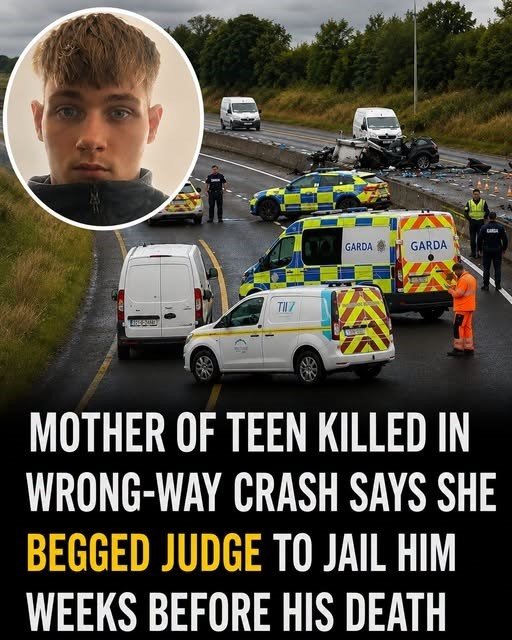
The fatal collision on Ireland’s M9 motorway on August 16, 2026, left five teenagers dead and four members of another family seriously injured. Gardaí said emergency services were alerted at approximately 3 a.m. to a vehicle travelling southbound on the northbound carriageway between Junctions 3 and 4 near Moone, County Kildare. The wrong-way vehicle then collided head-on with another car that was travelling in the correct direction.
Five teenage males travelling in the first vehicle died, while three women and a seven-year-old boy in the second vehicle were taken to hospitals with serious injuries. Investigators began examining the circumstances surrounding the collision immediately afterward. The five teenagers were subsequently named locally as Joe Carthy, 15, Jack Kennedy, 17, Kamil Pustkowski, 17, Alex McCarthy, 16, and Jeremy O’Brien, 18. The tragedy immediately produced grief across several families while also creating difficult questions about the circumstances that preceded the crash.RTÉ reported that the BMW carrying the teenagers had been driven south on the northbound carriageway before the head-on impact. Gardaí appointed family liaison officers to support relatives on both sides of the collision. Post-mortem examinations were also arranged as part of the formal investigation. Travelling in the second vehicle were sisters Alma and Niamh Kinsella, their younger sister Ella Hendricken, and Alma’s seven-year-old son, Yemi.
They were on their way to Dublin Airport when the collision occurred and had planned to travel to Britain for a family wedding. The three sisters and the child survived the impact but sustained serious injuries requiring hospital treatment. In the days afterward, reports indicated that their conditions remained serious and that recovery would take time. The family received extensive public support while relatives focused on their medical care.
Against that background, Kamil Pustkowski’s mother, Emilia Pustkowska, later spoke publicly about the months before her son’s death. Her account was not an official finding about why the crash occurred, but rather a bereaved mother’s description of her attempts to deal with a teenager whose behavior she believed had become increasingly difficult to control. She disputed descriptions portraying Kamil as the leader of the group. In her telling, he was himself struggling and easily influenced rather than directing other teenagers. Those comments should be understood as her own account of her son rather than an independently established conclusion about the relationships within the group.Pustkowska said she had first been contacted by Gardaí regarding possible car-related offenses involving Kamil in January 2025. According to her interview, his difficulties then escalated over the months that followed. She described attending repeated court proceedings with him in both Limerick and Dublin. Some cases, she said, were delayed or adjourned rather than reaching an immediate conclusion. Her frustration came partly from the feeling that she was repeatedly attending hearings without seeing the kind of intervention she believed her son needed.
She told reporters that she attended every court appearance she could. Pustkowska described travelling three times to Limerick and five times to Dublin. She said some proceedings concerned matters that had already been before the courts rather than new alleged incidents. According to her account, some hearings were postponed because of practical legal issues, including disputes affecting legal-aid solicitors and occasions when evidence was not ready. These explanations come from Pustkowska’s interview and should not be treated as a complete official court record unless separately confirmed through court documents.
Pustkowska also said that Kamil had pleaded guilty to some charges. She emphasized that, in her view, he had not tried to deny responsibility for everything he was accused of doing. More unusually, she said she had reached the point of asking a judge to place her own son in custody. For a parent, such a request would normally be extremely difficult, and she described it as a decision driven by fear rather than punishment. She believed that a period in a controlled environment might interrupt the behavior that she felt was becoming increasingly dangerous.
In the interview, she recalled telling a judge that she could no longer keep Kamil safely under control at home. She said she had spent a long period locking things away and trying to manage his behavior herself. Pustkowska stressed that wanting her son detained did not mean she wanted him to suffer. Instead, she said she had become convinced that some form of stronger intervention was necessary because the situation appeared to be moving beyond what she could manage as a parent. Her comments were made after his death and reflected both grief and frustration over what she believed might have been an opportunity for intervention.
She said she hoped detention might have given Kamil time to mature away from the influences and behaviors causing concern. At the same time, she acknowledged one painful limitation in imagining an alternative outcome. If Kamil had not been inside the car that morning, another person might have been. She said that possibility would not have made the tragedy acceptable or prevented harm to others. Her point was narrower and deeply personal: she had asked authorities for an intervention because she feared where her son’s behavior was leading.
Pustkowska also rejected claims circulating online that Kamil had been the dominant figure within the teenage group. She said he had struggled personally and was not capable of leading himself, much less controlling others. She described him as “lost,” a characterization that has been repeated in subsequent coverage of her interview. A podcast discussion of the Irish Mail interview also noted her account that Kamil had struggled socially and had experienced bullying. Those descriptions again represent the mother’s account and should not be converted into medical or psychological conclusions about the teenager without independent evidence.
The aftermath of the M9 crash has been unusually complicated because grief has existed alongside public anger over the circumstances surrounding the collision. Garda Commissioner Justin Kelly said the second vehicle had been struck while its occupants were travelling innocently. He also publicly condemned the danger of wrong-way motorway driving and expressed concern about reckless behavior being performed or shared for social-media attention. Because the incident was referred to Fiosrú, the Police Ombudsman, the commissioner said he was limited in what he could discuss about Garda actions immediately before the collision.
That referral is important because questions have also been raised about what happened before the BMW entered the motorway in the wrong direction. Gardaí are investigating the wider sequence of events, while the Police Ombudsman is examining the police-contact element. The existence of such investigations does not itself establish wrongdoing by any officer. Their purpose is to reconstruct events using evidence and determine what happened according to the relevant procedures. A full account should therefore avoid presenting incomplete early reports as final conclusions.
The crash occurred near Moone shortly before 3 a.m. According to official Garda statements, emergency services had been alerted to a vehicle travelling southbound on the northbound side of the motorway. The wrong-way BMW then struck the other vehicle head-on. The five teenage occupants were killed, while the four people in the Hyundai survived with serious injuries. These facts are among the clearest officially established elements of the case.The injured family’s journey had been entirely ordinary before the collision. Alma and Niamh Kinsella, Ella Hendricken and seven-year-old Yemi were heading toward Dublin Airport. They planned to travel for a family wedding rather than becoming part of a criminal investigation or road-safety controversy. Their Hyundai was travelling in the correct direction on the motorway when it was struck. This distinction has repeatedly been emphasized in reliable reporting because it explains why attention has focused strongly on their recovery.
Public concern for the family quickly produced practical assistance. A fundraising campaign was established to help with the costs and longer-term consequences of their injuries, and a vigil was held in Carlow. Hundreds of people gathered in support of the family while all four remained in hospital. Reports described their recovery as likely to be long and challenging. Such community responses became one part of the story separate from the investigations into the teenagers’ conduct.
By August 20, Tusla confirmed that one of the five teenagers had been in its care and that two others were known to the child and family agency. Tusla did not publicly provide detailed personal histories because of the sensitivity surrounding the deaths and the young ages of those involved. It said it was liaising with families, An Garda Síochána and relevant support organizations. The agency also said information would be provided to the National Review Panel in accordance with standard procedures where children known to Tusla die or experience serious incidents.
That information contributed to a broader public discussion about whether opportunities for earlier intervention had been missed. However, it would be inaccurate to conclude from Tusla involvement alone that one agency could necessarily have prevented the crash. Young people can interact with families, schools, social services, Gardaí, courts and community organizations simultaneously. Determining what intervention was possible in a particular case requires access to records that are not fully public. Pustkowska’s comments add one parent’s perspective to that discussion, but they do not by themselves establish institutional responsibility.
Her statement about asking a judge to detain Kamil is especially powerful because it challenges a common assumption that parents always resist custodial intervention for their children. Pustkowska said the opposite was true in her case. She had become frightened enough about what was happening that she believed detention could offer a chance for change. She later described feeling that nobody listened to the seriousness of her concerns. That is her interpretation of what happened and remains distinct from a formal judicial review of the decisions made in Kamil’s cases.
Court decisions involving minors can involve many factors that are not visible in a short newspaper interview. Judges may consider charges, guilty pleas, previous history, available placements, legal submissions and statutory requirements. Because the full records of Kamil’s proceedings are not included in the public material reviewed here, it would be misleading to claim that a specific judge simply ignored an obvious legal solution. What can accurately be reported is that his mother says she asked for custody because she believed she could no longer manage him safely. Her frustration became particularly painful in hindsight after his death.
Jeremy O’Brien’s mother, Margaret Berry, also spoke publicly after losing her son. Her message focused strongly on the family injured in the other vehicle. Berry said she wished Jeremy had never entered the BMW and made clear that she did not approve of what happened. She expressed sympathy for the injured sisters and child and said she hoped they would recover. Her remarks were notable because she acknowledged the consequences for innocent people while also grieving her own son.
Berry said she would apologize directly to the injured family if given the opportunity. She also said she had been praying for them and hoped that one day they might find some form of forgiveness. At the same time, she did not attempt to describe the teenagers’ actions as acceptable. Her statement explicitly rejected what happened and expressed regret that her son had become involved. Those words illustrate how a bereaved parent can mourn a child while still acknowledging that the circumstances of the death caused severe harm to others.
Her comments also highlight an important distinction between intention and consequence. Berry said she did not believe the young men set out with the purpose of injuring the Kinsella family. That is her belief about their intentions, not an investigative finding. Regardless of intent, however, the wrong-way driving ended in a head-on collision that killed five people and seriously injured four others. Responsibility for dangerous behavior does not depend on whether someone intended the final outcome.
That idea was echoed at Jeremy O’Brien’s funeral. RTÉ reported that mourners heard an acknowledgment that what the boys had done was wrong and that multiple families had been changed permanently. The service still remembered Jeremy as a young person whose life contained more than the final events on the motorway. This balance between mourning and acknowledging harmful behavior has appeared repeatedly in family and religious statements following the crash.
A similar message came from Jack Kennedy’s funeral. His mother, Sarah, publicly apologized to those injured and appealed directly to other young people to stop engaging in dangerous or criminal driving behavior. She said five boys had made a bad choice and paid the ultimate price, while innocent people remained in hospital recovering from serious injuries. Her appeal emphasized consequences not just for participants but also for families and others caught in their actions.
The message from Jack’s funeral is important because it avoids turning the deaths into a celebration of dangerous conduct. Remembering the deceased as loved family members does not require denying the circumstances of their deaths. Families can grieve someone deeply while condemning behavior connected with the incident. That distinction is particularly relevant when social-media content risks transforming reckless driving into spectacle or status.
Irish authorities have also focused attention on social media following the collision. Coimisiún na Meán contacted TikTok seeking information about how the platform was responding to reckless-driving content. The regulator said it wanted an account of what TikTok had seen and how it had dealt with material that could glorify dangerous behavior. This followed reports that content involving wrong-way driving and joyriding had circulated online.
The existence of such content does not automatically prove that social media caused the M9 crash. Human behavior rarely has a single cause, and investigators would need evidence to establish what motivated the people inside the BMW. However, policymakers and regulators are examining whether online attention can encourage some young users to take increasingly dangerous risks. That is a broader question extending beyond the five teenagers who died on August 16.
Transport Infrastructure Ireland data released after the crash showed that wrong-way motorway driving incidents had been recorded with concerning frequency. RTÉ reported a 32 percent rise in wrong-way driving detections, with seven incidents recorded in just the first two and a half weeks of August. Motorway operators respond to reports by issuing warnings through electronic signage and other network systems. The M9 tragedy gave new urgency to concerns that had already existed about this type of behavior.
Wrong-way driving is dangerous because vehicles may approach one another at combined speeds that leave almost no time for avoidance. Motorway users generally expect traffic in adjacent lanes to be moving in the same overall direction. A vehicle coming directly toward them violates that basic expectation and can create catastrophic consequences within seconds. The collision near Moone demonstrated that danger in the most severe way possible.
The public response after the crash also became difficult for the families of the teenagers. Pustkowska said she felt unable even to express sympathy without fearing an aggressive reaction from people online. Her comments reflected an environment in which grief, anger and moral judgment were occurring simultaneously. She was not asking people to approve of the events that preceded the collision. Instead, she was attempting to explain her own experience as a mother who believed she had been trying unsuccessfully to stop her son’s behavior before his death.
The families of those in the BMW and the family in the Hyundai experienced fundamentally different aspects of the tragedy. The Kinsella family was travelling normally and became the victim of a wrong-way collision. Their injuries required extensive medical treatment, and they did nothing to create the circumstances that placed them in danger. The families of the five teenagers, meanwhile, lost young relatives whose actions or involvement in the events before the crash became the subject of intense criticism.
Acknowledging that difference does not require denying anyone’s grief. A parent can mourn a child even when that child was involved in dangerous conduct. At the same time, sympathy for bereaved parents should never erase the suffering of people who were injured through no fault of their own. Responsible coverage should hold both realities without suggesting they are equivalent.
Pustkowska’s remarks are therefore most useful when understood as part of a larger question about prevention. She said she recognized that her son was becoming increasingly difficult to control. She attended court hearings. She says she asked for a stronger intervention. Looking backward after his death, she naturally wonders whether a different decision could have changed the outcome.
There is no way to know with certainty what would have happened if Kamil had been detained before August 16. He would not have been in that specific car if he had been physically in custody, but countless other variables would remain unknown. Pustkowska herself acknowledged that another person could have taken his place. Counterfactual questions can express grief and regret but cannot establish exactly how an alternative history would have unfolded.
What her account does establish is the depth of her concern before the tragedy. This was not, according to her, a parent who first learned after the crash that her son had been getting into trouble. She described repeated court attendance and an escalating sense that she could no longer manage the situation. That context adds complexity to public assumptions about parental responsibility.
It also raises broader questions about what options families have when teenagers become repeatedly involved in high-risk behavior. Custody is only one possible intervention and is not necessarily appropriate or legally available in every situation. Family support, youth services, education, mental-health services, diversion programs and community interventions can all form part of responses to young people in difficulty. Which approach is suitable depends on an individual case and professional assessment.
No single article can determine whether those systems worked adequately for Kamil Pustkowski. That would require far more evidence than a newspaper interview and a handful of public records. The appropriate approach is to report what his mother has said, identify what authorities have confirmed, and avoid claiming more than the evidence supports.
The same rule should apply to descriptions of the teenagers as a group. Some reports have used strong labels for them based on suspected criminal activity before the crash. Garda investigations and reliable journalism have reported that the BMW was stolen and that authorities were examining earlier incidents. However, legal and factual precision matters, particularly because all five young people died before any potential criminal proceedings arising from that night could occur.
The Irish Times reported that Gardaí obtained CCTV showing young males apparently attempting break-ins in County Kildare during the hours before the crash and were investigating whether the same BMW was involved. Because all five occupants later died, investigative findings about their actions would primarily inform inquest proceedings rather than result in criminal trials against them. This means some questions may eventually be addressed through coronial and investigative processes rather than court convictions.
The stolen status of the BMW has also been widely reported by reliable Irish media. What remains important is not to assign each alleged act to a specific teenager unless investigators establish who did what. Being a passenger in a vehicle and being the person responsible for a particular earlier incident are not automatically the same thing. Precision prevents collective assumptions from being presented as individual fact.
At Jeremy O’Brien’s funeral, reports indicated that he was understood to have been the driver of the BMW. That information has appeared in reliable coverage, but the broader Garda investigation into the collision has continued. Any final determination about vehicle operation should therefore rely on the conclusions of investigators and inquest proceedings.
The injured family’s recovery remains another important part of the story. Alma and Niamh Kinsella initially suffered particularly serious injuries, while Ella Hendricken and Yemi were also hospitalized. Later reporting indicated some improvement, but all four faced substantial recovery. Medical details have been released only partially, and their privacy should be respected.
Their mother later said the family’s focus was completely on the girls and their recovery. This is a reminder that media attention surrounding Garda policy, youth crime and social-media content exists alongside real people undergoing treatment. For relatives, political and legal debates are secondary to surgeries, rehabilitation and uncertainty about long-term health.
The family’s ordeal also prompted enormous public generosity. Fundraising efforts grew rapidly as people learned that they had simply been travelling to the airport when their vehicle was struck. Such donations can help with practical needs that accompany serious injuries, including travel, rehabilitation, time away from work and other expenses. The level of support reflected widespread sympathy for their circumstances.
Yet fundraising totals and vigils should not become a substitute for privacy. The injured family did not choose the attention created by the collision. Any continued reporting should avoid unnecessary speculation about individual medical prognoses unless relatives or reliable official sources choose to provide updates.
The same principle applies to the mothers who have spoken about their sons. Emilia Pustkowska and Margaret Berry chose to make public statements, but those comments occurred in the immediate aftermath of devastating loss. Their words should not be distorted into excuses for dangerous driving. Both women acknowledged the seriousness of what happened in different ways.
Berry explicitly said she did not condone the actions involved. Pustkowska described a son she had already been trying to control through family and legal channels. Neither mother claimed that the injured family was responsible for what occurred. Their statements instead focused on regret, remorse and questions about how events reached such an extreme outcome.
The tragedy therefore contains several separate issues that should not be collapsed into one simple explanation. There is the immediate road-safety issue of a car being driven the wrong way on a motorway. There is the criminal investigation into events before the crash. There are questions about youth services and court interventions. There is also an emerging debate about online content that may reward or glorify dangerous acts.
Each of these topics deserves evidence-based examination.
None is helped by misinformation.
Claims that one teenager was unquestionably a “leader,” for example, require evidence rather than social-media repetition. Pustkowska has challenged that characterization directly. Whether investigators possess information relevant to the group’s internal relationships is another question. Until such information is officially established, the mother’s denial and other claims should be attributed rather than stated as definitive fact.
Likewise, claims that a judge could definitely have prevented the crash are stronger than the evidence supports. Pustkowska believes detention might have changed Kamil’s path. That belief is understandable given what happened. But courts operate within legal frameworks, and the full reasons behind earlier decisions are not contained in the public accounts currently available.
Her interview is perhaps most powerful when it is not turned into a simple accusation. It shows the desperation of a mother who says she reached the point of asking others to remove her child from her own home because she feared she could no longer protect him from himself or his circumstances. Whether the system had an effective alternative available is a question that may require formal review.
Kamil’s death means that question can never be answered for him personally through a future intervention. His mother is now left examining earlier decisions through the knowledge of an outcome she could not have known with certainty at the time. That is one of the cruellest aspects of hindsight after sudden death.
She also has to grieve amid public controversy. The way a person dies can influence how strangers react to their family, even though bereaved relatives did not necessarily participate in the conduct being criticized. Pustkowska’s description of being afraid to apologize publicly reflects how difficult that position can become.
Margaret Berry expressed similar awareness. She did not ask the public to forget what happened. Instead, she said she wished Jeremy had never entered the car and offered prayers for the injured family. Her words demonstrated a parent trying to hold love for a deceased son alongside recognition that his involvement was connected to devastating consequences for strangers.
At Jack Kennedy’s funeral, his mother went even further by using her grief to address other young people. Her message was direct: stop. She said dangerous conduct can destroy not only the people participating but also their families and innocent people nearby. The fact that this warning came from a mother burying her 17-year-old son gave it particular weight.
The funeral appeals also demonstrate that mourning does not have to involve glorification. Families can celebrate the positive memories they have of a loved one while publicly recognizing serious mistakes. That approach may be especially important when other young people are watching social-media clips or narratives that present dangerous driving as exciting.
Ireland’s media regulator has already indicated that online platforms may face scrutiny over their handling of such content. TikTok said it was monitoring material connected with the deaths, while Coimisiún na Meán requested further information. These regulatory questions are ongoing and should not be interpreted as a finding that one company caused the crash.
What is clear is that wrong-way motorway driving has caused repeated concern. Transport authorities use motorway-control systems to warn other road users when such events are detected. The rise in reported incidents has led to renewed discussion about prevention, barriers, signage, policing and driver behavior.
No technical system can completely remove the need for people to avoid deliberate high-risk driving. Motorway design assumes drivers generally follow traffic direction, speed rules and entry restrictions. When someone deliberately drives against traffic, they create a situation for which other motorists may have only seconds to react.
The Kinsella family experienced exactly that danger.
They had no meaningful role in creating the situation.
They were simply travelling.
That fact should remain central to any account of the collision.
It is also why the expressions of regret from the teenagers’ mothers matter. They acknowledge that innocent people were harmed and that sympathy for deceased teenagers should not erase responsibility for the consequences of dangerous behavior.
At the same time, prevention requires more than condemnation after people are dead. Pustkowska’s story raises the harder question of what should happen before a teenager reaches the point where a fatal event becomes possible. She says she was already asking for intervention.
Whether the correct intervention would have been detention, intensive supervision, youth support or something else cannot be decided retrospectively in a newspaper article. What her experience demonstrates is that some families may recognize danger while still lacking the ability to control what happens outside the home.
That challenge is not unique to one family.
Parents do not have unlimited authority over teenagers, particularly as young people become more independent. Courts, schools, Gardaí, social services and communities can all become involved when serious behavior develops. Coordination between those systems is often difficult, and no single intervention guarantees a good outcome.
The M9 crash has now forced those questions into public discussion under the worst possible circumstances.
Five teenagers are dead.
Three sisters and a young child continue recovering.
Multiple families are grieving.
Investigators are still reconstructing what occurred.
The appropriate response is therefore not to transform the event into simple heroes and villains without regard for evidence. The injured family deserves recognition as innocent victims of the collision. Dangerous wrong-way driving deserves clear condemnation. The families of the deceased are also entitled to mourn without being held personally responsible for every choice made by their children.
These points can all be true simultaneously.
Pustkowska’s interview does not erase Kamil’s earlier legal difficulties.
It does not erase the wrong-way collision.
It does not reduce the suffering of the Kinsella family.
What it adds is information about a parent who says she had already realized her son was in serious trouble.
That information may eventually become relevant to wider reviews of how young people involved in repeated offending are managed.
Any such review should rely on court records, agency records and professional evidence rather than emotional claims alone.
But emotional testimony can still reveal where families felt systems were failing them.
In Pustkowska’s case, her message is devastatingly simple.
She says she asked for help strong enough to physically stop her son.
Weeks later, he was dead.
That does not prove what would have happened under a different court decision.
It explains why she is now asking what might have been different.
The question will likely remain with her for the rest of her life.
For Margaret Berry, the enduring thought is different but equally painful.
She wishes Jeremy had never entered the BMW.
For Jack Kennedy’s mother, the response has become a warning to others not to repeat the same kind of behavior.
For Alma, Niamh, Ella and Yemi, the focus remains recovery.
Those different perspectives form a more complete account of the tragedy than any one headline.
They reveal grief from different directions.
They reveal regret.
They reveal anger.
They also reveal the consequences of choices made on a motorway in the early hours of August 16.
The Garda investigation and the separate Police Ombudsman process remain important because they can establish facts that families and journalists cannot determine themselves. Their findings may answer questions about the period before the collision and the response by police. Until then, responsible reporting should describe the investigation rather than anticipate its conclusions.
The official facts remain stark.
A vehicle travelled in the wrong direction on the M9.
It collided head-on with a car travelling correctly.
Five teenagers died.
Four members of one family suffered serious injuries.
Everything else must be understood around those facts.
The story of Emilia Pustkowska does not change them.
Instead, it adds another painful chapter.
She says she watched her son’s behavior deteriorate.
She attended court repeatedly.
She believed she could no longer control him.
She says she asked a judge to place him in custody.
And now, after the collision, she is left wondering whether an intervention she once feared but requested could have saved his life.
There is no responsible way to answer that question with certainty.
There is only the record of what happened and the testimony of a mother trying to understand it afterward.
The same uncertainty surrounds many tragedies involving young people and dangerous behavior. Hindsight can make one earlier moment look like the obvious point when everything could have changed. Real life is rarely that predictable.
What can be learned without speculation is much simpler.
Driving against motorway traffic can have catastrophic consequences.
Young people repeatedly engaging in dangerous activity may need meaningful intervention before behavior escalates.
Parents who say they cannot safely manage a situation deserve to be taken seriously and assessed appropriately.
Social-media attention should never be treated as more valuable than human safety.
And innocent road users should not have to pay the price for someone else’s attempt to take extreme risks.
For the families involved, these lessons have come at an unbearable cost.
Five funerals have taken place.
A family of four continues to recover.
Parents are now speaking publicly about regrets that cannot be undone.
The investigation continues.
The future will determine whether Ireland makes policy or institutional changes in response.
But the central human reality does not require any political interpretation.
A mother who says she once begged for her son to be detained is now grieving him.
Another mother wishes her son had never entered the car.
Three sisters and a seven-year-old boy are recovering from injuries they never expected to suffer.
And a few minutes of dangerous driving altered all of their lives permanently.
That is enough to explain why the M9 collision has generated so much grief and attention.
It does not need exaggeration.
It does not need invented motives.
It does not need misinformation.
The verified facts, together with the families’ own attributed words, already tell a devastating story about loss, responsibility and the consequences of decisions that could not be reversed once the vehicles met on the motorway.