I never kept track. I never asked anyone for gas money. I believed kindness was something you offered without keeping a tally. Then one rainy morning, my ten-year-old stood on the curb, trying to hide her muddy shoe behind the other, and I finally realized what I had been teaching her all this time.
Part One: The Favor That Became a Routine
For two years, I drove my daughter Emma and her classmate Sophie to school every weekday without fail.
It was never something Vanessa and I formally discussed. There was no handshake, no written arrangement, and no actual schedule. It simply happened, the way so many neighborly favors do—one small act at a time, until suddenly you realize it has become part of your daily life.
Vanessa and Sophie lived four houses away from us. One morning, while I stood at the kitchen counter squeezing a juice box into Emma’s lunch bag, I heard a quick knock at the front door. When I opened it, Vanessa stood there wearing leggings and a cropped jacket, holding her car keys in one hand and her phone in the other.
“Would you mind taking Sophie this morning?” she asked, already turning halfway toward the street. “My Pilates class got moved earlier, and I’m running really late.”
“Of course,” I replied. “We’re going there anyway.”
She gave me a grateful smile before hurrying back down the sidewalk.
The following morning, she asked again.
Two days later, she asked a third time.
Then, at some point I can’t even identify, she simply stopped asking.
Sophie began appearing on our porch every morning at 7:20, backpack over her shoulders and hair still damp from her shower. She would knock twice, quietly, and Emma would yell, “Sophie’s here!” as though it were a surprise every single day.
I honestly didn’t mind.
Sophie was a sweet kid. At first, she was quiet—the kind of child who whispered “thank you” and fastened her seatbelt before you even reminded her. But once she became comfortable, I discovered she was hilarious. She did impressions of their music teacher that made Emma laugh until she snorted, and she had very strong opinions about which cereal mascots deserved to be trusted.
Emma loved having someone to talk with during the drive. Their school was only about five miles away, and those fifteen minutes in the car became their own little world filled with spelling tests, playground gossip, and discussions about which boy in their class had eaten a crayon on a dare.
Besides, I had always been the parent people called.
When my neighbor Greg had to work late, I drove his daughter Mia to soccer practice and waited in the bleachers until he could get there. When Rachel from across the street broke her ankle, I handled school pickups for her two boys for nearly three weeks. I had turned around for forgotten lunches, overdue library books, gym bags, permission slips, and even once for a science project involving a miserable-looking bean plant that Emma’s friend insisted absolutely could not miss its presentation.
I never kept track of any of it. It simply never occurred to me.
If I was already going in the same direction, helping someone seemed far easier than watching them struggle.
Part Two: The Little Signs I Chose to Ignore
Looking back, there were clues that Vanessa viewed our arrangement very differently from the way I did. I just chose not to examine them too closely.
One Friday, Sophie didn’t appear at 7:20.
I sat in the driveway with the engine running. Five minutes passed. I sent Vanessa a message asking whether Sophie was coming.
Another five minutes passed before she answered.
“Running behind. Can you wait?”
That was all. No apology. No “please.” Not even a “sorry about this.”
I sat there tapping my fingers against the steering wheel while Emma kicked the back of the passenger seat and dramatically complained about being late. I could have left. Part of me wanted to. But leaving would have meant punishing Sophie, and Sophie had done nothing wrong.
Eventually, she came running down the sidewalk, red-faced and out of breath. She climbed into the back seat without really looking at me.
“Sorry,” she whispered. “Mom couldn’t find her yoga mat.”
I remember thinking it was a strange reason for four people to be late.
But then traffic began moving, Emma started telling me about her spelling test, and the thought disappeared just as easily as it always did.
To be fair, Vanessa always sounded appreciative.
“You’re a lifesaver, Sarah,” she would call from her driveway, waving her coffee cup at me.
She never offered gas money. Not once in those two years. And I never requested it because asking felt petty. It felt as though I would be turning something kind into a transaction.
One afternoon, while we waited outside Vanessa’s house for Sophie, who was late yet again, Emma leaned forward between the seats.
“Mom, why doesn’t Sophie’s mom ever drive us?”
I looked at her through the rearview mirror. “Because we help people when we can, sweetheart.”
She frowned in that particular way she does whenever something doesn’t make sense.
“But you always help. Why doesn’t anybody ever help you?”
I laughed. I actually laughed.
“I don’t need help getting you to school, silly. We’re already in the car.”
She leaned back without saying anything else, but I could tell my answer hadn’t satisfied her.
At the time, I believed I was teaching her generosity. I thought I was showing her what good people were supposed to do.
Now, when I look back, I realize I was teaching her something else, too.
I was teaching her that her mother didn’t know when to stop giving.
Part Three: The White SUV and the Rainy Morning
Then Vanessa bought the SUV.
It was huge, pearl white, and so immaculate that it looked like it had come straight from a showroom rather than being parked on our ordinary street with its cracked sidewalks and mismatched mailboxes. Even the floor mats looked expensive.
She drove it over to my house the very afternoon she brought it home.
“Look at this,” she said, opening the driver’s door as though she were revealing the grand prize on a game show.
I leaned inside and noticed the cream-colored leather, polished dashboard, and faint scent of new plastic and money.
“Vanessa,” I said, “those cream-colored seats are the worst decision you’ve ever made.”
She laughed. “Why?”
“You have a ten-year-old.”
“Sophie knows better.”
From the passenger seat, Sophie rolled her eyes so dramatically that I worried they might get stuck.
“I’m not even allowed to eat crackers in here.”
Vanessa pointed at her. “Because crumbs get everywhere.”
Sophie looked at me, then lowered her voice.
“She made me take my shoes off yesterday because they had dirt on them.”
Vanessa groaned. “It happened once.”
“They were barely dirty.”
“They were dirty enough.”
I laughed along with Sophie and told myself Vanessa was simply experiencing new-car excitement. Everyone gets a little obsessive over a new vehicle for the first few weeks.
But it was the first time I had ever seen Sophie look embarrassed by something her mother was so proud of, and for some reason, that stayed with me.
For the next week, Vanessa talked about that SUV constantly. The backup cameras. The heated steering wheel. The special ceramic coating. Some interior protection package that sounded important enough to need its own insurance policy.
I joked that she had started loving the SUV more than her own daughter.
“Well,” she replied, “the SUV doesn’t leave granola bar wrappers in the back seat.”
We both laughed.
It still felt friendly.
It still felt like us.
Then came Thursday.
I woke to rain pounding against the bedroom windows so loudly that it sounded like handfuls of gravel were being thrown against the glass. By the time I reached the kitchen, Emma was already dressed, standing by the window with her nose pressed against it.
“Mom, it’s flooding outside.”
“It’s raining.”
“The street is a river.”
“The street is wet.”
She dramatically pulled the curtain aside.
“Look at Mrs. Carter’s driveway.”
I had to admit, Mrs. Carter’s driveway looked like a small lake.
I grabbed my keys from the hook.
“Get your raincoat. Let’s go. We’ll pick up Sophie on the way so she doesn’t have to walk over here in this.”
I ran through the downpour, climbed into my Honda, and turned the key.
Nothing.
I tried again.
Still nothing. Not even a click.
I stared at the steering wheel, then checked the clock on my phone.
School started in twenty-five minutes.
The Honda was fourteen years old, and I had known for weeks that its battery was weakening. Some mornings it groaned before finally starting. I had been hoping it would survive until payday.
And I needed that car for far more than school runs. I worked across town, and there wasn’t a bus route that would get me there on time. Even a few days of rideshares would eat into the small amount of money I had been putting aside for exactly this kind of repair.
I pulled out my portable jump starter, connected it while rain ran down the back of my neck, and tried again.
Nothing.
For the first time that morning, being late wasn’t what frightened me.
If this was more than a battery problem, I had no idea how I was going to get Emma to school—or myself to work—for the rest of the week.
Emma stood beneath the porch roof in her yellow raincoat, watching me.
“Are we going to be late?”
“Maybe.”
Then I remembered Vanessa.
Four houses away.
Brand-new SUV.
Same school.
Same morning.
Of course.
I called her. She answered on the fourth ring.
“Hey.”
“Vanessa, my car’s dead. Could Emma ride with you and Sophie, just this once? I’ll get the car fixed today.”
There was a pause.
It wasn’t long, but it was long enough for me to notice.
“Fine,” she said. “Have her ready.”
“Thank you so much.”
I ended the call and turned toward Emma.
“Vanessa’s going to take you.”
Emma blinked.
“Really?”
“Why do you sound so surprised?”
She only shrugged and reached for her backpack.
Part Four: “Someone Else’s Kid”
By the time Vanessa’s SUV came rolling down the street, the rain was coming down even harder.
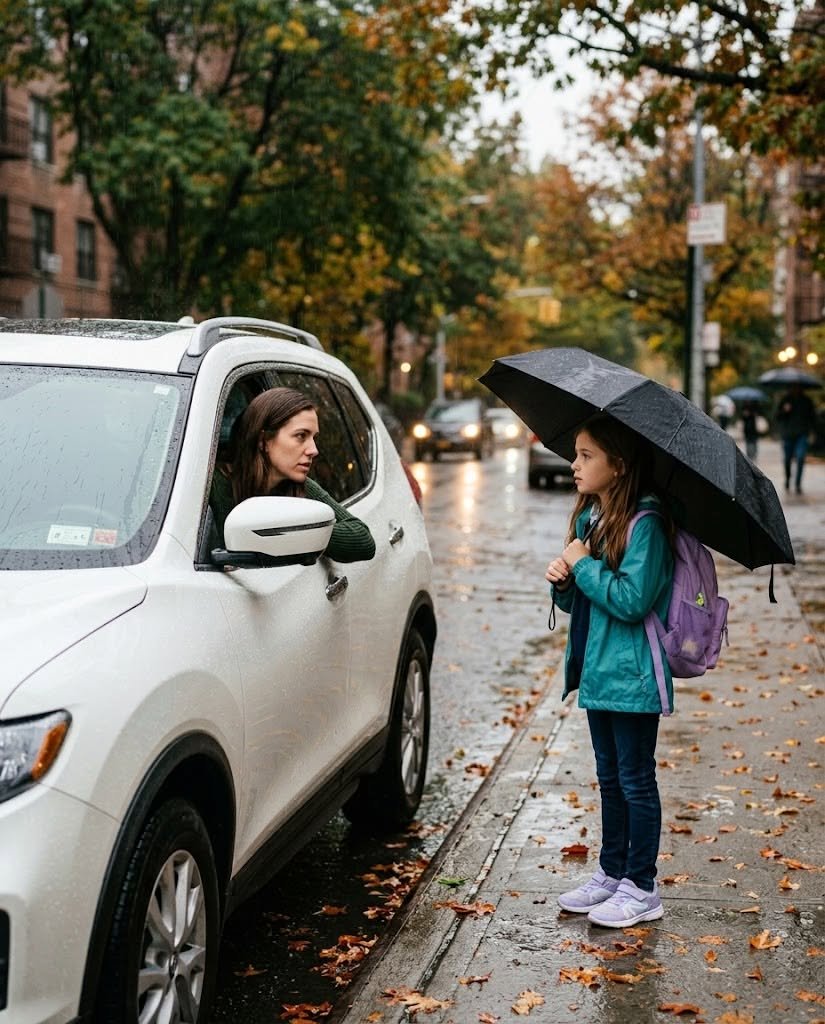
Emma stood at the curb beneath our large umbrella, but the wind kept driving the rain sideways underneath it. Her jeans were soaked from the knees down. When she stepped off the porch, one of her sneakers landed directly in a puddle, leaving the shoe streaked with muddy water.
Vanessa pulled beside us and stopped. The passenger window lowered.
“Thank you so much!” I called through the rain.
Vanessa gave me a thin smile.
Then her eyes dropped to Emma’s shoes, and her entire expression changed.
“Oh. No. She’s soaked.”
Her gaze shifted toward the cream-colored leather inside the SUV.
“I just got this car, Sarah. I can’t have mud all over the seats.”
Beside me, Emma quietly tucked one foot behind the other, as though hiding the muddy sneaker could make it disappear.
I stepped closer to the window.
“Vanessa, I’ve driven Sophie every morning for two years. I’m asking you for one ride.”
She sighed in the way people do when they believe someone else is being unreasonable.
“Sarah, please don’t make this into some huge thing. I didn’t spend this much on a car to have someone else’s kid ruin it.”
Someone else’s kid.
From the back seat, Sophie leaned forward.
“Mom—”
“Sophie, stay out of it.”
Emma’s cheeks turned bright red.
“Mom, it’s okay. Really.”
That hurt more than anything Vanessa had said.
My ten-year-old daughter was standing in the rain, trying to make herself smaller, practically apologizing with her entire body because her shoes were wet.
“Okay,” I said softly.
I put my hand on Emma’s shoulder.
“Come on, honey. Let’s go inside.”
Vanessa’s window rolled back up. The SUV pulled away, its tires hissing through the rainwater.
In the back seat, Sophie had turned completely around and stared at us through the rear window until the vehicle disappeared around the corner.
Inside, Emma removed her wet sneakers by the front door and placed them neatly beside each other on the mat.
“I’m sorry,” she said without looking at me. “If I hadn’t stepped in that puddle—”
“Emma.”
I knelt in front of her.
“You did nothing wrong. Do you hear me? Nothing.”
Her eyes filled with tears anyway.
A moment later, her phone buzzed. She glanced at the screen, then silently handed it to me.
It was a message from Sophie.
I’m sorry. I told my mom you could sit on my jacket. She said stop arguing.
I read it twice.
So Sophie hadn’t simply sat there and watched.
She had tried.
Even after they drove away, she had tried again.
Something inside me shifted.
Until that moment, part of me had still been trying to explain Vanessa’s behavior away. Maybe it was a stupid, panicked reaction to having a brand-new car. Maybe it was simply a bad moment. Everyone has bad moments.
But Vanessa had been given another chance.
Her own daughter had offered an easy solution.
She could have turned around at the end of the street.
She could have called me back.
She chose not to.
I ordered a rideshare. When I saw the price, my stomach sank. Money was already tight, and now I had a dead car sitting in the driveway on top of everything else.
Emma arrived at school twenty minutes late.
That evening, after she went to sleep, I sat at the kitchen table with my laptop open to repair estimates. Even the cheapest prices made my chest tighten.
Then my phone buzzed.
Vanessa.
Car fixed? Sophie needs picking up at 7:20 tomorrow. I have Pilates.
I read the message two, three, four times.
Not “Did Emma make it to school okay?”
Not “How bad is the car?”
Not “I’m sorry about this morning.”
Just whether I would still be available to drive her daughter.
I turned the phone face down on the table and didn’t respond.
But for the first time in two years, I made a decision about the following morning.
Even if the Honda miraculously started, I was not going to be waiting outside Vanessa’s house at 7:20.
I hated the idea of Sophie getting caught in the middle. But that was exactly how I had convinced myself to keep saying yes for two entire years.
Every inconvenience always seemed to fall on a child unless I stepped in first and carried it myself.
Not anymore.
Vanessa would have to handle her own morning.
I expected an angry message when she realized what was happening.
I did not expect her to come knocking on my porch.
Part Five: The Protest in the Rain
The next morning, just before seven, someone began pounding on my front door.
Not knocking.
Pounding.
When I opened it, Vanessa stood on my porch, soaked from head to toe. Her hair was plastered against her face, mascara was beginning to run, and her eyes were blazing.
“What the hell have you done?”
I stared at her.
“What are you talking about?”
She pointed toward the street.
I stepped outside, and my mouth fell open.
Around fifteen children had gathered around Vanessa’s white SUV, while half a dozen parents stood behind them holding umbrellas. Handmade cardboard signs bounced above a sea of raincoats and backpacks. Several backpacks had been dropped onto the wet grass, and two cars were idling at the curb, ready to take children to school.
And right in the middle of everything sat Vanessa’s perfect white SUV.
The rain had already begun soaking through the cardboard, causing the marker ink to run.
EMMA CAN RIDE WITH US.
IT WAS JUST RAIN!
One sign written in smeared blue marker said SEATS CAN DRY, and the boy holding it kept lifting it back up whenever it began to sag.
Vanessa stood there dripping while the cream-colored leather seats she had guarded so fiercely remained completely dry behind the tinted windows.
Sophie wasn’t standing beside her mother.
She had stopped several feet away from everyone, twisting one backpack strap tighter and tighter around her hand.
I recognized nearly every child in that small protest.
Mia from soccer.
Rachel’s two boys.
Children I had driven home, picked up, waited with, or squeezed into my old Honda whenever someone else’s plans fell apart.
Rachel leaned out from beneath her umbrella.
“Emma can ride with us this morning.”
Greg lifted his coffee cup.
“Us too.”
I covered my face with both hands.
“Oh my God.”
Vanessa spun toward me.
“Don’t you dare pretend you didn’t organize this.”
“I didn’t!”
Behind me, the front door creaked open.
Emma stepped onto the porch, took one look at the crowd, and immediately went pale.
“Oh, no.”
I turned toward her.
“Emma, what happened at school yesterday?”
She swallowed.
“People asked why I was late. I told them our car broke down and Mrs. Vanessa wouldn’t let me ride with them because my shoes were wet.”
A boy standing near the mailbox shouted, “They weren’t even that muddy!”
Sophie slowly moved closer to the front of the crowd. Her eyes were red and swollen, as though she had been crying since the previous night.
One of the girls muttered, “Her mom is so horrible.”
Emma immediately turned around.
“Don’t.”
The girl stared at her in surprise.
Another child spoke.
“She gets rides from your mom every single day. That’s not fair either.”
Sophie lowered her eyes toward her shoes.
Emma turned sharply toward him.
“She didn’t ask her mom to do that.”
Nobody responded.
“You told her yesterday she shouldn’t be allowed in our car anymore,” Emma continued, her voice trembling. “That was mean.”
“But her mom—”
“Her mom did it. Sophie didn’t.”
Then my daughter walked straight across the wet lawn and took Sophie’s hand.
Sophie looked up at Vanessa.
“I told you Emma could sit with me, Mom.”
Vanessa’s face tightened.
So did my throat.
I clapped my hands once to get everyone’s attention.
“Okay. Listen, everyone. I love that you all wanted to stand up for Emma. I really do. But nobody gangs up on Mrs. Vanessa, and nobody—absolutely nobody—blames Sophie. Understood?”
Slowly, one after another, the soggy signs lowered.
Part Six: The Favor Was Never a Debt
Greg stepped forward, shaking rainwater from his umbrella.
“For what it’s worth, Sarah, the kids came up with this themselves. Mia came home furious yesterday. Rachel’s boys were talking about it at dinner, and by bedtime, the parents’ group chat had completely taken off.”
Rachel crossed her arms.
“My boys rode in Sarah’s car for nineteen school days when I broke my ankle. Do you know how many times she checked whether their shoes were clean?”
She held up her hand.
“Zero.”
Vanessa looked around at everyone, her jaw tight.
“This is being completely blown out of proportion.”
Rachel shook her head.
“Sarah never made a big deal about helping any of us.”
“Exactly!” Vanessa replied, grabbing onto that point. “Sarah never complained about driving Sophie. Not once in two years.”
I nearly laughed.
“Because it was a favor, Vanessa. The fact that I never complained didn’t mean you were entitled to it.”
Greg tilted his head.
“Did you refuse to drive Emma yesterday?”
“It’s not that simple.”
I looked directly at Vanessa.
“You left my ten-year-old standing in the rain because you didn’t want her wet shoes inside your car.”
Vanessa looked away.
Then Sophie’s quiet voice broke through the silence.
“Am I not riding with you anymore? Is Emma mad at me?”
Emma squeezed her hand.
“No. I’m not mad at you.”
I crouched down in front of Sophie until we were eye to eye.
“Sweetheart, you didn’t do anything wrong. Not one thing. If you ever truly need a ride, if there’s an emergency, I’ll help you. I promise. But the everyday rides need to stop.”
Sophie’s lip trembled, but she nodded.
Vanessa, meanwhile, looked as though she was about to explode.
“Sarah, I have Pilates at seven. On Tuesdays I go straight to work, and Thursdays I have a client call. I can’t just rearrange my entire morning.”
“You’ll figure something out,” I said.
“Fine. Then what about Mondays, Wednesdays, and Fridays?”
For half a second, my mind did exactly what it had always done.
It began rearranging my schedule around hers.
Monday could work.
Maybe Friday too, if I left a little earlier.
Then I stopped myself.
“That,” I said, “is exactly the problem. For two years, I did you a favor. Somewhere along the way, you stopped seeing it as one.”
Vanessa’s lips pressed into a hard line.
“So now you’re punishing Sophie because you’re angry at me?”
“No. Sophie isn’t being punished. You’re being asked to drive your own daughter to school. The daily rides are over.”
For once, Vanessa had no response.
She turned, climbed into her spotless SUV, and after a long pause, Sophie got into the back seat beside her.
Before the door shut, Sophie gave Emma a small wave.
Emma waved back.
As the crowd began dispersing, Greg glanced toward my Honda, which sat dead in the driveway with rainwater running down its windshield.
“So what happened to it?”
“Battery,” I replied. “Maybe the alternator too.”
Before I could say anything else, Rachel offered to pay for the battery, while Greg already had his phone out, calling a mechanic he trusted.
“No,” I said. “I can’t let you do that.”
“Yes, you can,” Rachel said firmly. “You helped every one of us for free, Sarah. We’re simply returning the favor.”
Before I could stop them, several other parents began contributing too, pressing folded bills into my hand and refusing to take them back.
Standing there in the drizzle, I suddenly remembered Emma’s question from months earlier, asked from the back seat of a car that was already running.
Why doesn’t anybody ever help you?
Two days later, my Honda was back in the driveway with a brand-new battery and a repaired alternator.
It started on the first try.
It was running again because at least some of the people I had helped over the years had never taken my kindness for granted.
That night, while I tucked Emma into bed, she looked up at me.
“Mom? Are you still going to help people?”
I thought about it for a moment.
“Yes,” I said. “Always. But I’m going to be a little more careful about who is actually grateful for it.”
She smiled and pulled the blanket up beneath her chin.
“Good. Because Sophie’s still my best friend.”
“I know, baby,” I said. “And she always will be, if you want her to be.”
What This Story Taught Me
I once believed kindness meant never saying no. If I was already heading in the same direction, I thought the right thing was always to make room for one more person.
But kindness without boundaries doesn’t remain kindness forever. Little by little, it becomes an expectation, and eventually it turns into something people believe they are entitled to. The person receiving it stops recognizing the gift, while the person giving it gradually stops recognizing herself.
The hardest part wasn’t losing Vanessa’s friendship. It was realizing my daughter had been watching everything all along, learning that her mother’s generosity had no limits.
I don’t want to teach her to stop helping others. I want to teach her that she is allowed to need help, too, and that the people truly worth giving to are the ones who would turn the car around for you when you’re standing in the rain.
[This story is a work of fiction inspired by real events. Names, places, and details have been changed, and any resemblance to real people is coincidental.]