The man with the walker stopped a few feet from me. His face was thinner than it had been in the newspaper photograph, and there was a scar running from beneath his jaw toward his collar.
Behind him, the big man in the leather vest kept his hands in his pockets.
“I know Caleb was driving,” Frank said quietly. “And I know what happened that night.”
My knees nearly gave out.
Frank looked toward the barn.
“I also know you covered that truck and kept it hidden.”
I started crying before I could stop myself.
“I was scared,” I whispered. “My son was scared. I thought you were dead.”
Frank nodded.
“I know.”
Then he reached into his jacket and pulled out a folded piece of paper.
“My wife wanted me to give this to the sheriff. She still does.”
My heart stopped.
“But I’m not here to turn your boy in.”
I stared at him.
“Then why are you here?”
Frank took a long breath.
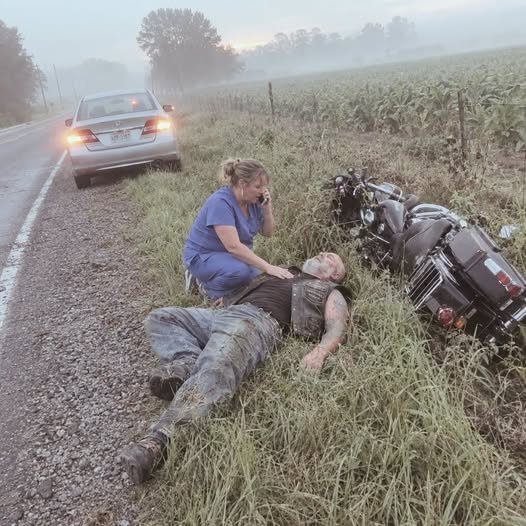
“Because I spent four hours in that ditch thinking I was going to die. And during those four hours, I kept thinking about my own son.”
He looked down at his walker.
“He died when he was twenty-two. Drunk driver. The man who hit him ran.”
The words hit harder than any accusation could have.
Frank continued.
“I spent years wishing somebody had stopped. Wishing somebody had called for help instead of leaving my boy alone.”
He looked directly at me.
“So when I woke up in that hospital and found out someone had left me there, I was furious.”
I lowered my head.
“I’m sorry.”
“I know.”
He paused.
“But then I heard the nurse say whoever found me had saved my life. Four more hours and I probably wouldn’t have made it.”
He looked toward the barn again.
“Your boy made a terrible mistake. You made one too.”
I couldn’t argue.
Frank held out the paper.
“There’s one thing I need from you.”
“What?”
“Open that barn.”
My hands shook as I unlocked the padlock.
When the doors swung open, Caleb’s old pickup sat beneath the tobacco tarp exactly where we’d left it.
Frank stared at the damaged grille.
Then he said something I never expected.
“Call the sheriff.”
Caleb came running from the house.
He looked at Frank, then at me.
“Mama…”
I put my hand on his shoulder.
“It’s time.”
Caleb broke down.
He told the whole story.
He told them how he had been driving too fast, how Frank appeared in the road, how he panicked, and how instead of stopping, he drove home.
He also told them everything I had done afterward.
I thought that was the end of my family.
It wasn’t.
Frank had already spoken to the sheriff.
Because Caleb had finally confessed, because Frank survived, and because we cooperated instead of continuing the lie, the case was handled through the courts rather than becoming the nightmare I had imagined.
Caleb received punishment.
But Frank never asked for revenge.
He asked for something else.
Every Saturday for the next year, Caleb drove to Frank’s house.
He helped with groceries. He repaired things around the house. He sat with Frank when his pain was bad.
And eventually, Frank taught him how to weld.
Two years later, I watched them standing beside an old motorcycle in Frank’s garage.
Caleb was laughing.
Frank was showing him how to repair a piece of metal.
I realized then that forgiveness doesn’t erase what happened.
It doesn’t make the mistake disappear.
And it certainly doesn’t mean there shouldn’t be consequences.
Sometimes forgiveness simply means giving someone the chance to become better than the worst thing they’ve ever done.
That night, I thought opening the barn door would destroy my family.
Instead, it opened another door—one none of us knew was there.