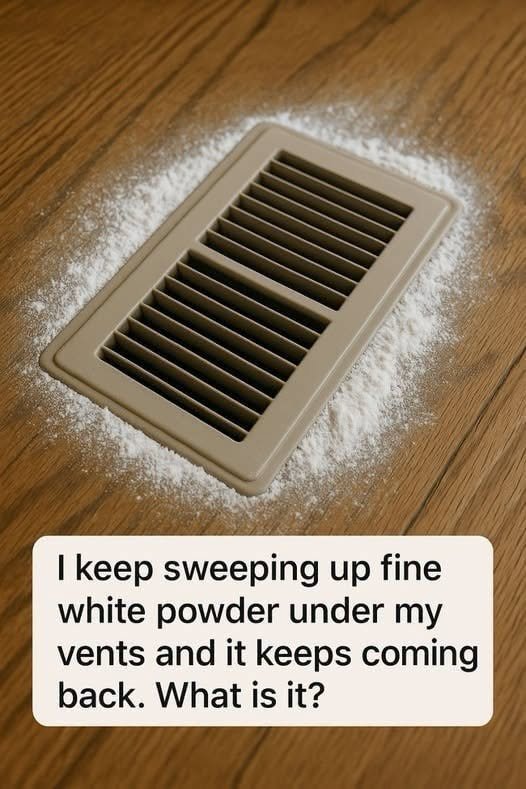
Over time, however, these materials can deteriorate. If the duct liner becomes damaged, loose, or brittle, tiny particles may enter the airflow and settle around supply vents. You might notice a recurring white or gray powder even after cleaning the surrounding area.
If the dust appears shortly after the heating or cooling system runs, damaged duct insulation may be worth investigating. A qualified HVAC technician can inspect the ductwork and determine whether any material needs repair or replacement.
Other Possible Causes of White Dust
Deteriorating duct liners are not the only explanation. Several other factors can contribute to the problem.
1. Drywall Dust From Recent Renovations
If you’ve recently drilled holes, repaired walls, sanded surfaces, or renovated a room, fine drywall dust may circulate through your home. This powder often looks bright white and can settle around vents, furniture, and nearby surfaces.
Check whether the dust is concentrated near recently repaired areas. Covering renovation areas and keeping dust away from HVAC returns can help prevent further circulation.
2. Mineral Dust From a Humidifier
Some ultrasonic humidifiers release minerals from tap water into the air. These minerals can settle as a fine white powder on furniture, floors, and ventilation grilles.
If you use a humidifier regularly, try distilled or demineralized water and clean the unit according to its manufacturer’s instructions.
3. Ordinary Household Dust
Every home contains airborne particles from fabric fibers, skin cells, outdoor dirt, and other everyday sources. Strong airflow around vents can cause these particles to accumulate in visible patterns.
A dirty air filter may allow more particles to circulate, although a properly fitted filter cannot capture every type of airborne contaminant.
4. Leaking or Damaged Ductwork
Gaps in duct connections can allow dust from attics, wall cavities, or other unconditioned spaces to enter the system. Damaged insulation near ductwork may also contribute to unusual debris.
If dust keeps returning to the same vents, an inspection can help identify leaks, poor connections, or damaged materials.
Could White Dust Be Harmful?
The appearance of white dust alone cannot tell you whether it is dangerous. Ordinary household dust is generally different from particles released by deteriorating insulation or renovation materials.
Avoid assuming that all white powder is harmless. If you notice fluffy or fibrous material, experience unexplained irritation, or suspect damaged insulation, avoid disturbing it until the material has been identified.
If the home is older, some building materials may contain asbestos. Asbestos-containing materials should not be disturbed, brushed, or vacuumed with an ordinary household vacuum. A qualified professional can assess suspected materials safely.
How to Stop White Dust From Coming Back
The best solution depends on the source. Start with these practical steps:
-
Inspect your air filter: Replace it when needed and make sure it fits securely.
-
Clean vent covers carefully: Remove loose dust with a damp cloth when the material appears to be ordinary household dust.
-
Check for recent construction: Look for nearby sanding, drilling, or drywall repairs.
-
Review humidifier use: Consider distilled water if you use an ultrasonic humidifier.
-
Arrange an HVAC inspection: If the dust returns repeatedly, ask a technician to check duct liners, connections, insulation, and the system’s filter fit.
Avoid using compressed air to blow dust out of vents, as this can spread particles throughout the home.
When Should You Be Concerned?
Pay closer attention if the powder appears in large quantities, returns quickly after cleaning, contains visible fibers, or is accompanied by unusual odors or respiratory irritation. These signs do not establish a specific hazard, but they justify further investigation.
If anyone experiences significant breathing difficulty, seek urgent medical care.
The Bottom Line
White dust around your vents is often caused by ordinary household particles, construction residue, humidifier minerals, or problems with ductwork. Although the issue is frequently manageable, repeatedly cleaning the vents without identifying the source may only provide temporary relief.
The smartest approach is to observe where the dust appears, consider recent changes in your home, and have the HVAC system inspected if the problem persists. A clean vent is helpful, but finding the source of the dust is what helps keep it from coming back.