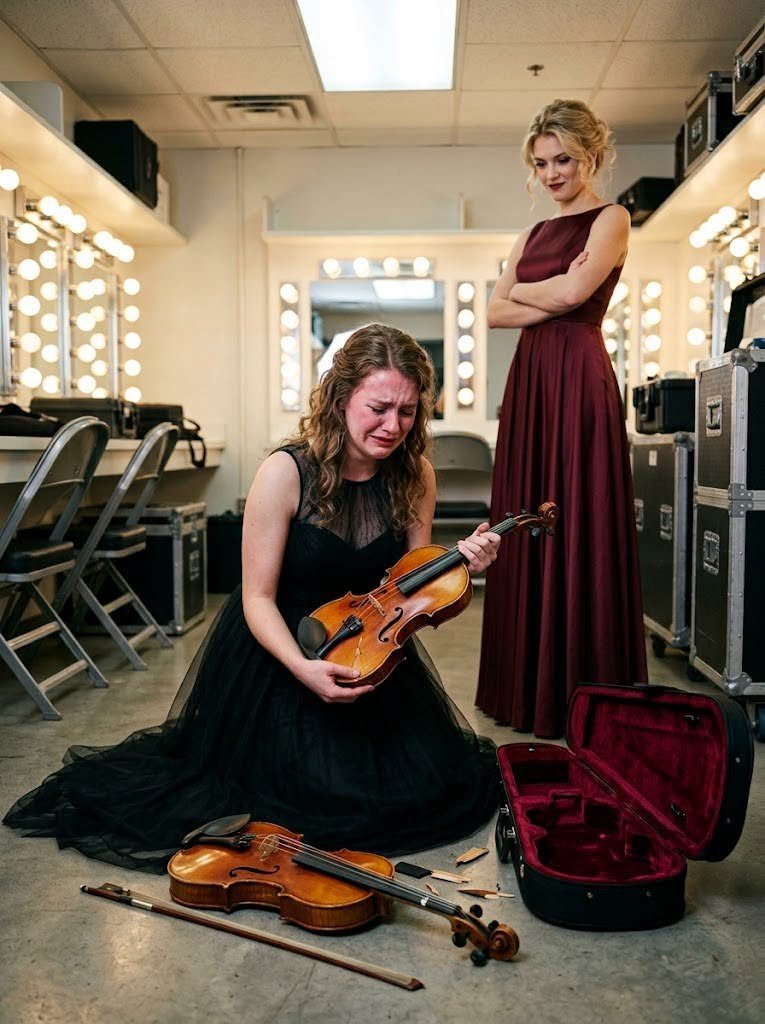
My sister broke my violin in half less than twenty minutes before the most important performance of my life, all because I refused to give her my new dress.
She looked at the broken pieces and said, “Guess your big night is over.”
She thought she had destroyed my future.
But twenty minutes later, she was standing backstage in tears, begging me to save hers.
To understand why that violin mattered so much, you have to understand my grandfather.
His name was Arthur Bennett, and he was the first person who ever believed I could become a professional violinist. When I was seven, he found me sitting on the living room floor, trying to play a song I had heard on television. The notes were terrible, the bow squeaked, and I was so frustrated that I wanted to quit.
Grandpa didn’t laugh.
Instead, he sat beside me and said, “Talent isn’t about playing perfectly on your first try, sweetheart. It’s about loving something enough to keep trying when it sounds terrible.”
The following week, he took me to a music shop and bought me my first violin.
It was an inexpensive student instrument, but to me, it was priceless.
Every Saturday, Grandpa sat beside me while I practiced. He taught me how to hold the bow, how to listen carefully, and how to turn mistakes into lessons. Whenever I felt discouraged, he reminded me that the greatest musicians weren’t the ones who never failed. They were the ones who refused to give up.
When I turned thirteen, he surprised me with a different violin.
It was an old, beautifully crafted instrument that had belonged to his own father. The wood had darkened with age, and the varnish showed tiny marks from years of use. Grandpa explained that his father had played it at family gatherings and small community concerts decades earlier.
Then he placed it in my hands.
“This violin has carried our family’s music for generations,” he told me. “If you take care of it, maybe one day you’ll pass it on to someone who loves music as much as you do.”
I promised him I would.
That violin became my closest companion. I practiced with it before school, after dinner, and sometimes late into the evening when everyone else was asleep.
Then Grandpa became ill.
During his final weeks, he asked me to play his favorite song whenever I visited. Even when he was too weak to speak much, his fingers tapped softly against the blanket as I played.
On the day before he died, he squeezed my hand and whispered, “Whatever happens in life, don’t let anyone convince you that something you love isn’t worth fighting for.”
Those were the last words he ever said to me.
After his funeral, I couldn’t bring myself to play for several weeks. Eventually, I opened the violin case, ran my fingers over the familiar wood, and began practicing again.
Music became the way I kept him close.
Two years later, I earned a place in a prestigious young musicians’ competition. The winner would receive a scholarship to a respected music conservatory, an opportunity that could change my entire future.
For the first time, I believed I might actually become the musician Grandpa had always imagined.
My older sister, Vanessa, didn’t share my excitement.
Vanessa had always been the center of attention in our family. She was charming when she wanted something, dramatic when she didn’t get it, and accustomed to our parents giving in whenever she complained.
She wasn’t interested in music, but she was very interested in appearances.
When I bought a beautiful blue dress for the competition reception with money I’d saved from tutoring younger students, Vanessa immediately decided she wanted it.
“Let me wear it tonight,” she demanded as I prepared my violin case.
“No,” I said. “I’ve been saving for this dress for months. I need it for the reception.”
“You never wear anything nice anyway. What makes you think you deserve it more than me?”
“Because I bought it with my own money.”
Her expression hardened.
“You’ve become so selfish since everyone started treating you like some little musical genius.”
I tried to ignore her and returned to checking my sheet music.
That was when everything went wrong.
Vanessa grabbed the dress from my bed and held it against herself in front of the mirror.
“I’m borrowing it.”
“Put it back.”
She turned toward me. “Make me.”
I reached for the dress, and she pulled it away. We argued for several seconds before I finally managed to take it from her hands.
I thought the argument was over.
Then Vanessa looked toward the open violin case on my desk.
I saw the anger in her face, but I never imagined what she would do next.
She snatched the violin out of the case.
“Vanessa, don’t!”
She lifted it, then brought it down hard against the edge of the desk.
The crack was sickening.
For a moment, I couldn’t understand what I was seeing. The violin had split apart, its wooden body broken, the bridge displaced, and the strings hanging uselessly.
I dropped to my knees.
“No. No, no, no.”
I picked up the pieces with trembling hands, afraid that even touching them would cause more damage.
Vanessa stood over me, breathing heavily.
“Guess your big night is over,” she said.
Then she tossed the dress onto my bed and walked out.
I couldn’t even cry at first.
All I could think about was Grandpa’s hands placing that violin in mine. I remembered his stories about the generations who had played it, the evenings we had spent practicing together, and the promise I had made beside his hospital bed.
Now, because I had refused to lend my sister a dress, it was broken.
I looked at the clock.
Seventeen minutes until I was supposed to report backstage.
My hands shook as I tried to fit the broken pieces together, as though the violin might somehow become whole again if I wanted it badly enough.
It wouldn’t.
I called my mother, but she was already on her way to the venue. My father was at work and wouldn’t arrive in time.
For the first time in years, I felt completely alone.
Then I remembered something Grandpa had once told me.
When I was younger, I had asked him what he would do if his violin ever broke beyond repair.
He had smiled and said, “I’d find another way to make music. The wood is precious, but the music lives in you.”
I wiped my face, carefully gathered the broken instrument into its case, and ran downstairs.
Our neighbor, Mr. Collins, had been a professional violinist before retiring. He had known Grandpa for decades and had occasionally helped me with difficult passages.
I banged on his door.
When he saw my face, he immediately let me inside.
Between sobs, I explained what had happened.
He examined the broken violin, his expression growing increasingly serious.
“I’m sorry,” he said quietly. “This cannot be safely repaired in a few minutes.”
My heart sank.
Then he disappeared into another room and returned carrying a black violin case.
“This belonged to my wife,” he explained. “She played professionally for years. She passed away five years ago, but I’ve kept her instrument carefully stored.”
He opened the case.
Inside was a beautiful violin, polished and ready to play.
“I can’t promise it will feel exactly like yours,” he said. “But it’s a good instrument. If you’re willing to take the risk, you can use it tonight.”
I stared at him.
“I don’t know how to thank you.”
“Don’t thank me yet,” he replied with a small smile. “Go play.”
I borrowed the violin, thanked him, and hurried to the venue.
I arrived with barely five minutes to spare.
Backstage, the other competitors were warming up. My hands were still trembling, and the borrowed instrument felt unfamiliar beneath my chin.
I wanted to go home.
I wanted to crawl into bed and pretend the entire day had never happened.
Then I imagined Grandpa sitting in the front row, smiling at me.
I took a deep breath.
When my name was announced, I walked onto the stage.
The auditorium seemed enormous beneath the lights. Several judges sat behind a long table, their expressions unreadable. In the audience, I spotted my parents hurrying into their seats.
Vanessa wasn’t there.
I raised the bow.
For the first few notes, I was terrified. The violin responded differently from Grandpa’s instrument, and I had to adjust my touch. But as the melody unfolded, something inside me settled.
I stopped thinking about the broken violin.
I stopped thinking about Vanessa.
I thought about Grandpa.
I played the song he had taught me when I was seven, the one he used to hum while making breakfast on Saturday mornings. Then I moved into the more demanding piece I had practiced for months, letting every note carry the grief, anger, and love I had been holding inside me.
By the final passage, my hands were steady.
When the last note faded, the auditorium remained silent for a heartbeat.
Then the audience rose to its feet.
I stood there, overwhelmed, with tears streaming down my cheeks.
For the first time that evening, I felt as though Grandpa was still beside me.
But the biggest surprise was waiting backstage.
As I stepped away from the stage, a stage assistant hurried toward me.
“Your sister is looking for you,” she said. “She’s crying.”
I frowned.
Vanessa appeared at the end of the corridor, her makeup streaked and her hands shaking.
She rushed toward me.
“Please,” she whispered. “You have to help me.”
I stared at her in disbelief.
“What are you talking about?”
She looked down at the borrowed violin in my hands, then back at me.
“I didn’t know what I was doing. I was angry, and I wanted to hurt you. I never thought you’d find another violin and perform anyway.”
“That doesn’t explain why you’re crying.”
She swallowed hard.
“Mom and Dad found out what I did. They’re furious. Dad says I have to pay for the damage, and Mom says she’s done making excuses for me.”
I waited.
Then Vanessa finally admitted the truth.
She had been scheduled to perform a short vocal solo during the evening’s closing reception. It was an opportunity she had been talking about for weeks, and she had planned to use it to impress a talent agent who would be attending.
But after my performance, the organizers had learned what happened to Grandpa’s violin. My parents hadn’t concealed the truth when the competition coordinator asked why I had arrived with a different instrument.
The story had spread backstage.
Vanessa feared that the talent agent would hear about her behavior and refuse to work with her.
“I need you to tell everyone it was an accident,” she pleaded. “Please. Just say I knocked it over. You don’t have to tell them I broke it on purpose.”
I looked at my sister for a long moment.
Less than an hour earlier, she had destroyed something I could never truly replace. Now she wanted me to protect her from the consequences.
“Vanessa,” I said quietly, “you didn’t just break a violin. You tried to take away something that mattered more to me than anything you could wear.”
Her eyes filled with tears.
“I know. I’m sorry.”
“Are you sorry because you hurt me, or because you’re afraid of losing your opportunity?”
She opened her mouth but couldn’t answer.
And that silence told me more than her apology had.
I wasn’t going to lie for her.
But I also wasn’t going to stand there and destroy her future out of revenge.
“I won’t tell anyone a story that isn’t true,” I said. “If you want people to believe you’ve changed, you have to start by telling the truth yourself.”
Vanessa looked down at the floor.
For once, she didn’t argue.
She walked away slowly, leaving me alone in the corridor.
A few minutes later, I learned that she had gone to our parents and admitted exactly what she had done. She apologized to the competition coordinator and withdrew from her scheduled solo, saying she couldn’t stand onstage and pretend everything was fine while refusing to take responsibility for her actions.
The talent agent eventually left without meeting her.
Vanessa didn’t get the opportunity she had hoped for that night.
And I didn’t ask anyone to change that.
The following morning, she came to my room.
She wasn’t wearing makeup or trying to look impressive. She held a small envelope in her hands.
Inside was a handwritten letter.
She admitted that she had spent years resenting the attention I received for my music. She said she had convinced herself that my achievements somehow made hers less important. Instead of working toward her own goals, she had tried to diminish mine.
Then she apologized for breaking the violin and for asking me to lie afterward.
“I know saying sorry won’t put it back together,” she wrote. “I don’t expect you to forgive me right away. I just want you to know that I finally understand how selfish I’ve been.”
I read the letter twice.
I wasn’t ready to forgive her completely, and I told her so.
But I agreed to let her begin earning back my trust.
She used her savings to pay for a professional assessment of the violin. The damage was extensive, and restoring it would require a specialist. Even if the instrument could be repaired, it would never be quite the same.
Still, we arranged to have it examined properly.
Months later, I received the news I had been hoping for: a specialist believed the violin could be restored, although the work would take time and considerable care.
It would never erase what Vanessa had done, but it meant that Grandpa’s instrument might one day sing again.
And there was another surprise.
I won second place in the competition.
The scholarship wasn’t the largest award available, but it was enough to help me pursue the next stage of my musical education. The judges told me they had been moved by the emotion in my performance, particularly the way I adapted to an unfamiliar instrument without losing the feeling behind the music.
I knew the real reason I had managed to finish.
Grandpa had taught me that music wasn’t simply something I played. It was something I carried.
Years later, I still keep the broken pieces of his violin in a small wooden box beside my sheet music. When the restoration is complete, I intend to preserve its history and pass it on someday, just as he asked me to.
Vanessa and I are slowly rebuilding our relationship. Forgiveness hasn’t meant pretending nothing happened, and trust hasn’t returned overnight. She still has to live with the consequences of that evening, just as I had to learn how to move forward without the instrument I loved.
But she has changed in ways I never expected. She has started pursuing her own ambitions instead of measuring her worth against mine, and she no longer assumes that loving someone means they must protect her from every mistake.
Sometimes, when I play, I remember that terrible crack and the way my heart seemed to stop.
Then I remember the borrowed violin, the applause, and the words Grandpa whispered to me before he died.
“Don’t let anyone convince you that something you love isn’t worth fighting for.”
My sister thought she had broken my future that night.
She hadn’t.
She had broken a violin.
And in the process, she had forced both of us to learn a lesson that a beautiful dress, a prestigious opportunity, or even a family name could never teach us:
You can lose something precious without losing who you are. But if you hurt someone you love, the hardest thing to repair may not be what you broke. It may be the trust you can never demand back.