I almost didn’t go. I stood at my kitchen counter that Tuesday morning, the flowers already wrapped in paper on the table, and I told myself for the tenth time that maybe my husband was right. Maybe this was unnecessary. Maybe some things were better left alone. But the feeling wouldn’t leave me. It hadn’t left me in months.
So I picked up the flowers, got in my car, and drove to the cemetery. By the time I got home that afternoon, my life would never be the same.
When Marcus and I first met, he told me the truth about his past—or what I believed was the truth.
He’d been married before. Her name was Elena. She had died three years earlier in a car accident on a mountain road, late at night, in bad weather. He said the grief had nearly broken him. That for a long time, he hadn’t been able to imagine loving anyone again. He told me all of this on our third date, quietly, over dinner, with the kind of careful honesty that made me trust him completely.
I never questioned his story. Why would I? Marcus was a kind, attentive husband who remembered the smallest details about me. He knew how I liked my coffee, which songs made me cry, and how I needed silence whenever I felt overwhelmed. When he spoke about Elena, his voice grew distant, and I learned not to push him.
We married a year later.
For a while, I believed we had built something beautiful out of two imperfect pasts. Then, about six months into our marriage, I found a photograph tucked inside an old book in his study.
It showed Marcus standing beside a woman with dark hair, her arm wrapped around his waist. They were smiling at the camera, but it wasn’t their smiles that caught my attention. It was the date written on the back.
The photograph had been taken only eight months before Marcus and I met.
I brought it to him that evening.
He glanced at it, and for the briefest moment, his expression changed. Then he explained that it was an old photograph he had never gotten around to throwing away. The date, he said, must have been written incorrectly.
I wanted to believe him, so I did.
But the photograph planted a small seed of doubt, and over the following months, I began noticing things I couldn’t explain. Sometimes Marcus received calls late at night and stepped outside to answer them. Occasionally, I would catch him staring at his phone with an expression that looked less like grief and more like fear.
Whenever I asked if something was wrong, he would smile and tell me he was tired.
Then, one rainy evening, I found a receipt inside his jacket pocket. It was from a flower shop in a town nearly two hours away. The purchase date was the anniversary of Elena’s supposed death.
I asked him about it.
He said he’d bought flowers for her grave.
That answer should have comforted me. Instead, it made me wonder why he had never once invited me to visit her resting place.
“I think I’d like to meet her,” I told him gently. “Not in the way you mean. I just want to understand the woman who was such an important part of your life.”
Marcus went completely still.
“You don’t need to do that,” he replied.
“Why not?”
“Because she’s gone. And visiting her won’t change anything.”
His answer was so sharp that I apologized, even though I hadn’t done anything wrong.
After that, I stopped asking questions aloud. But the questions continued growing inside me.
I began searching for an obituary, an old newspaper report, anything that might confirm the story of the accident. I knew Elena’s full name, the approximate date of her death, and the mountain road where Marcus claimed it had happened.
Yet every search left me with the same unsettling result.
Nothing.
No obituary. No report of a fatal accident matching the details he had given me. No public record I could find that connected Elena to the tragedy Marcus had described.
I told myself that not every death made the newspapers. Records could be incomplete. Names could be misspelled. There were a hundred innocent explanations.
Still, I couldn’t shake the feeling that something was terribly wrong.
Finally, I found an old address for Elena’s family in a photograph Marcus had accidentally left on the printer. I wrote it down, then spent three days arguing with myself about whether I should use it.
When I mentioned visiting Elena’s grave, Marcus’s reaction had frightened me more than I wanted to admit.
But I needed to know.
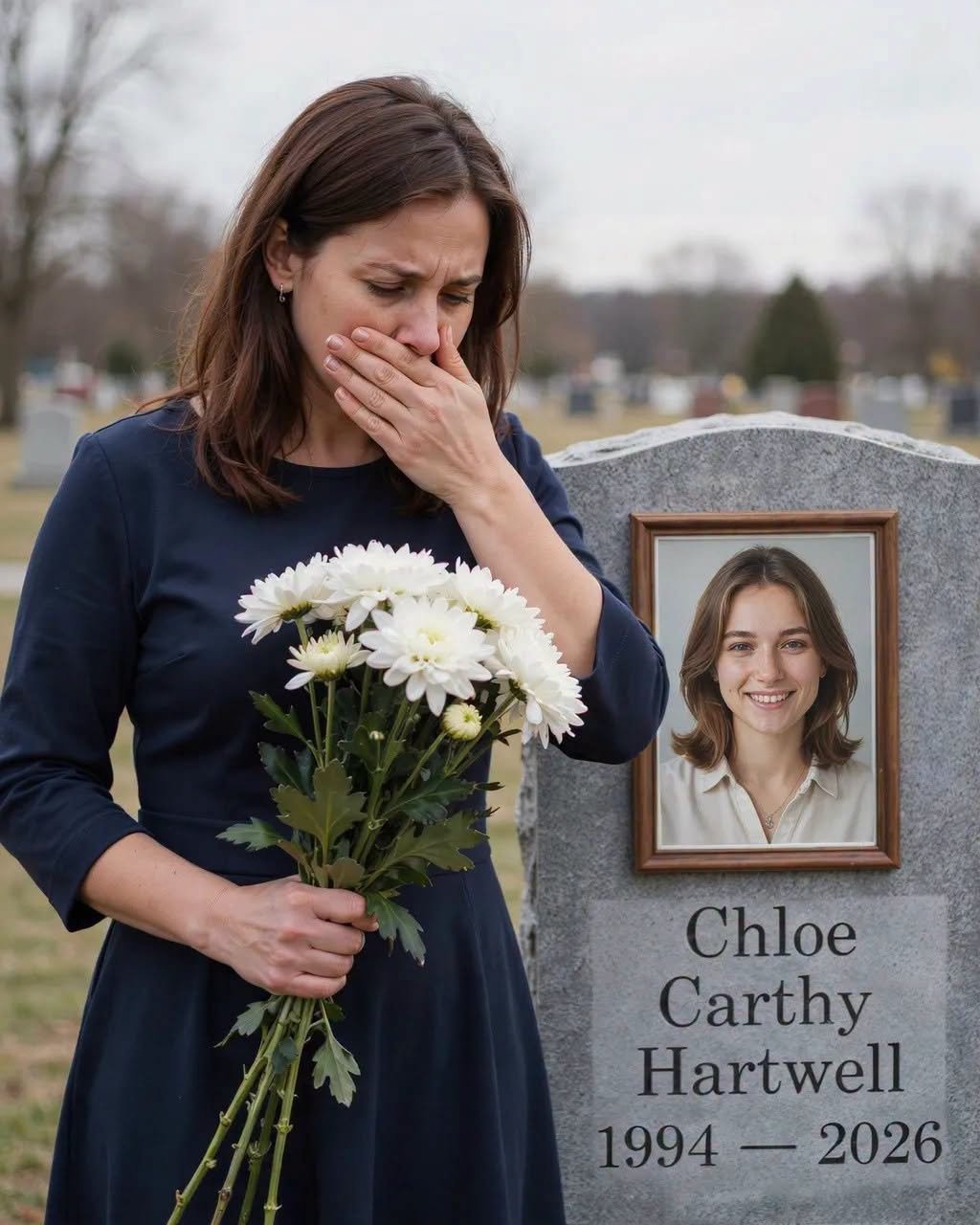
That Tuesday morning, I bought a bouquet of white lilies and drove to the cemetery listed in an old family notice I’d eventually located. I expected to find a headstone, perhaps a few faded flowers, and the quiet sadness of a life that had ended too soon.
Instead, I found a groundskeeper who listened carefully when I told him Elena’s name.
He frowned.
“Elena what?” he asked.
I gave him her full name.
He looked at me for a long moment before pointing toward a small office near the entrance.
“You might want to speak to the woman inside,” he said.
My hands had begun to tremble by the time I reached the office. An elderly woman sat behind a desk, sorting through paperwork. When I introduced myself and explained that I was looking for Elena’s grave, she stopped what she was doing.
“Are you related to her?” she asked.
“I’m her husband’s wife,” I replied. “Marcus was married to her before she died.”
The woman slowly removed her glasses.
“Her husband?” she repeated.
Something in her voice made my stomach tighten.
“Yes. Marcus.”
She leaned back in her chair, looking at me with an expression I couldn’t understand.
“Sweetheart,” she said quietly, “Elena never had a husband named Marcus.”
For a moment, I couldn’t breathe.
I told her she must be mistaken. I explained the wedding, the photograph, the accident, and the story Marcus had repeated so many times that I could still hear his voice saying the words.
The woman listened without interrupting.
Then she opened a drawer and pulled out a folder.
“I’ve worked here for twenty-two years,” she said. “I remember Elena. Her family buried her here after she died. She was engaged to someone, but they never married.”
She paused before continuing.
“His name was Daniel.”
I stared at her.
Daniel.
I had never heard that name before.
The woman turned a page in the folder and showed me a photograph attached to an old memorial notice. It was Elena, smiling beside a young man with his arm around her shoulders.
I recognized Elena immediately.
And I recognized the man standing beside her.
It was Marcus.
Except the name beneath the photograph wasn’t Marcus.
It was Daniel.
My knees nearly gave way.
I asked the woman if she was certain. She nodded and explained that Daniel had been Elena’s fiancé. After Elena’s death, he had disappeared from her family’s life. Her parents had tried contacting him, but their letters went unanswered.
I looked again at the photograph.
The face was unmistakable. The man I had married had once been known by another name.
But why?
And why had he invented an entire marriage that never existed?
The woman gave me an address from an old record, belonging to Elena’s mother. Before I left, she asked if I wanted to see the memorial garden where Elena’s family sometimes gathered.
I followed her outside.
There, beneath a large oak tree, stood a small stone bearing Elena’s name. Someone had recently placed fresh flowers beside it.
Tucked beneath the ribbon around the bouquet was a folded note.
I hesitated before opening it.
The handwriting was unfamiliar, but the message made my blood run cold.
“I haven’t forgotten what happened. I know the truth, and one day, someone else will know it too.”
There was no signature.
I took a photograph of the note and drove straight to Elena’s mother’s address.
I nearly turned around twice before knocking on the door.
A woman in her seventies answered. When I said Elena’s name, her face softened with a sadness that seemed to have lived there for years.
Then I mentioned Daniel.
Her expression changed.
“How do you know that name?” she asked.
I told her everything.
She invited me inside, made tea that neither of us touched, and listened as I explained how I had met Marcus, how he had described his past, and how I had discovered the photograph.
When I finished, she sat silently for several seconds.
Then she said something I will never forget.
“Daniel didn’t die with Elena, but the man he was before that night certainly disappeared.”
She explained that Daniel and Elena had been planning their wedding when their relationship began to fall apart. Elena had discovered that he had been hiding serious financial problems and lying about his circumstances. She had called off their engagement shortly before her death.
On the night of the accident, Daniel had been the last person known to have spoken to her.
Her mother had never believed the entire story surrounding Elena’s death, but without clear evidence of wrongdoing, she had been left with unanswered questions.
“Daniel changed his name after she died,” she told me. “We heard rumors that he moved away and started over. We never knew where he went.”
I sat frozen in the chair.
Marcus had never told me about financial trouble, a broken engagement, or a different name. He had told me that he was a grieving widower who had lost the love of his life.
Instead, I was beginning to understand that he might have built our marriage on a carefully constructed lie.
I asked Elena’s mother whether she had any proof that Marcus and Daniel were the same person.
She went to another room and returned with a box of photographs and old letters. Among them was a letter Daniel had written to Elena shortly before their engagement ended.
His signature was different from the name Marcus used now, but the handwriting was unmistakably similar to the writing on a birthday card he had given me the previous year.
I felt sick.
Before I left, Elena’s mother placed a hand over mine.
“I don’t know what happened between them that night,” she said. “And I won’t pretend I do. But if the man you’re married to is Daniel, please be careful. Whatever his reasons for changing his name, he never gave us an explanation.”
I drove home with the flowers still on the passenger seat.
Marcus was waiting in the kitchen when I walked through the door. He looked at the empty wrapping paper in my hand and immediately understood where I had been.
“Where did you go?” he asked.
I placed the photograph on the table.
For several seconds, he didn’t move.
Then his face went pale.
“Who gave you that?” he whispered.
“Elena’s mother.”
He stared at me, and for the first time since I had known him, I saw no attempt to smile, no carefully chosen words, and no comforting explanation waiting behind his eyes.
Only fear.
“Your name wasn’t Marcus, was it?” I asked.
He lowered himself into a chair.
“No,” he finally admitted.
I waited for him to explain. I wanted him to tell me there was some reasonable explanation for everything I had discovered. I wanted him to deny that he had deceived me about his past.
Instead, he covered his face with both hands.
“My name was Daniel,” he said. “And I should have told you before we ever got married.”
“Why did you lie to me?”
He looked up, his eyes wet.
“Because I was afraid that if you knew who I used to be, you’d never love me.”
I shook my head.
“You didn’t just hide your past. You invented a dead wife. You told me you had been married to a woman who was actually your former fiancée. You made me feel sorry for you, Marcus. You made me trust you because I thought you had been honest about the worst thing that had ever happened to you.”
He began to cry.
He told me that after Elena’s death, he had left town and started using his middle name, Marcus. He claimed that he had wanted to escape the memories and the questions surrounding their broken engagement. Over time, he had allowed the story to change until he was presenting himself as a widower rather than a man whose relationship had ended before Elena died.
He insisted that he had not caused her accident.
I asked him why he had never told me the truth after we fell in love.
He had no answer that could repair what he had broken.
Then I asked the question that mattered most.
“Did you love me, or did you marry me because you wanted someone who would believe your story?”
He reached for my hand.
I pulled it away.
“I love you,” he said. “That part was never a lie.”
But I no longer knew which parts of our life together were real and which parts had been shaped by the person he had pretended to be.
I went upstairs that night and slept in the guest room. The next morning, I called a close friend and told her what I had discovered. I also began making plans to protect myself financially and to understand what else Marcus might have concealed.
I didn’t immediately file for divorce, and I didn’t immediately forgive him. I needed time, facts, and distance from the man whose words I had once accepted without question.
Over the following weeks, I learned that some details of his account could be verified, while others remained uncertain. I had no proof that he had been responsible for Elena’s death, and I refused to turn suspicion into an accusation without evidence.
But I no longer needed to prove that he had lied about his identity and his relationship with Elena. He had admitted those things himself.
The marriage I thought I understood had changed forever.
Eventually, I returned to the cemetery alone. I brought another bouquet of white lilies and placed them beside Elena’s memorial stone.
I didn’t go there to compete with her memory or to blame a woman I had never known. I went because I finally understood that she had been a real person, not a character in the tragic love story Marcus had told me.
I stood beneath the oak tree for a long time, thinking about the years I had spent trusting someone without knowing the whole truth.
Then I whispered a promise to myself.
I would never again confuse someone’s sadness with honesty, or someone’s vulnerability with proof of good character.
When I returned home, Marcus was waiting at the kitchen table. He had written me a letter explaining everything he could remember about his past, including the details he had been too ashamed to share.
I took the letter, but I didn’t promise to stay.
Trust, I had learned, wasn’t restored simply because someone finally confessed. It required accountability, honesty, and time—and even then, forgiveness didn’t mean pretending the damage had never happened.
I still don’t know whether our marriage will survive.
What I do know is that the trip I almost canceled changed everything. I went to the cemetery believing I was honoring my husband’s lost love. I came home realizing that the person I needed to protect most was myself.
And sometimes, the truth doesn’t arrive with a dramatic confession or a single piece of undeniable evidence.
Sometimes, it begins with a photograph, an unanswered question, and the quiet courage to look where someone has spent years telling you not to look.