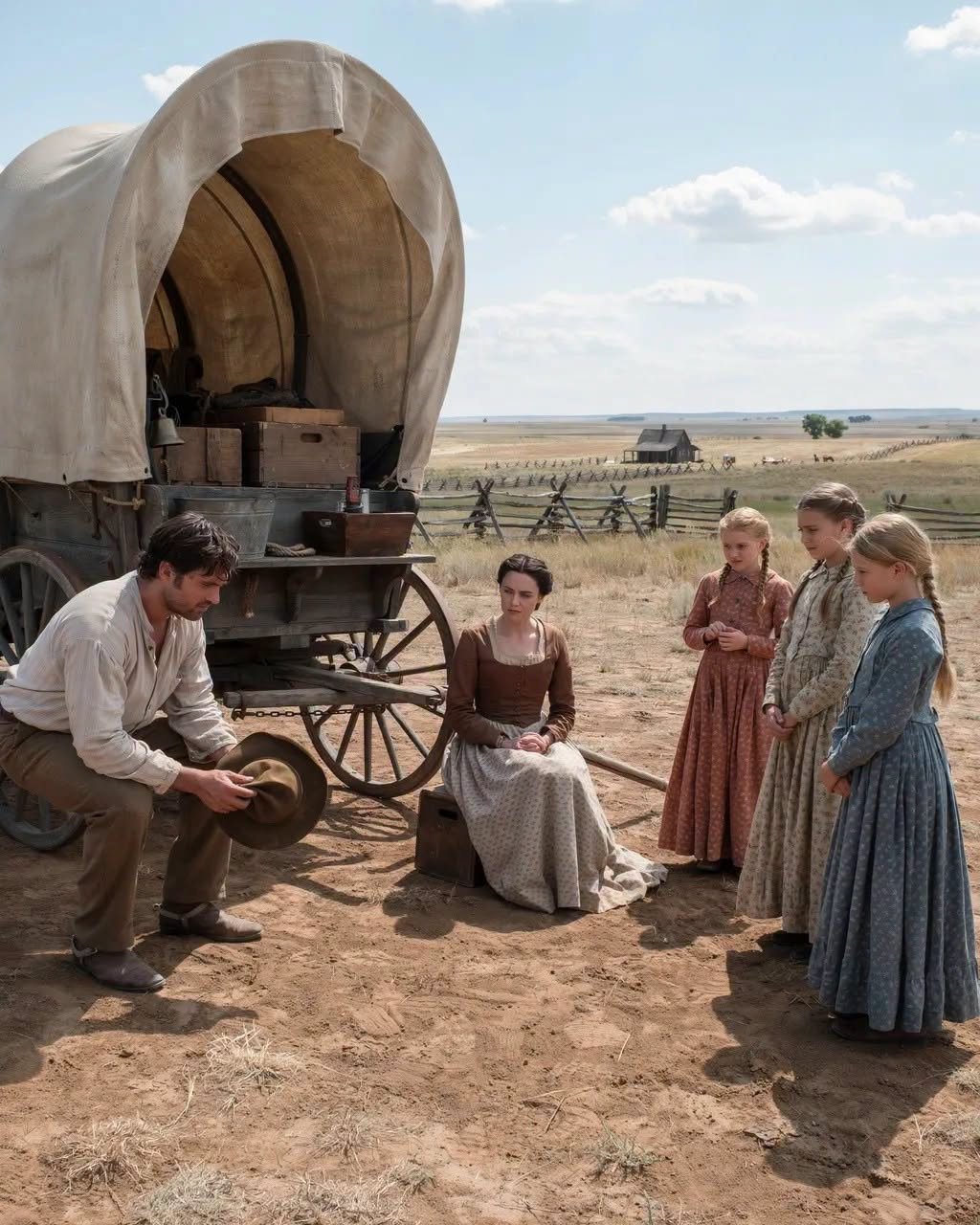
For three years, Benjamin had learned how to live with the absence of Sarah Quincy. He had learned to cook for one, to sleep on one side of the bed, and to stop turning toward the empty chair beside the window when something happened that he would once have told her about. He had learned that grief did not always arrive as tears. Sometimes it was simply the habit of setting two cups on the table before remembering there was only one person left to drink from them.
Their little farmhouse stood on eighty acres of Oklahoma Territory land that Sarah had loved despite its harshness. She had called the prairie beautiful in every season, even when the winter winds rattled the windows and the summer heat made the kitchen unbearable. Benjamin had never understood how she could find so much beauty in a place that demanded so much work, but he had loved the way her face brightened when she looked across the open fields.
After she died, the house became a place of practical necessities. Benjamin repaired the roof, tended the livestock, planted crops, and kept the well in working order. He rarely visited town unless supplies were needed. The neighbors had tried, at first, to persuade him to join their Sunday dinners or attend the occasional social gathering at the church, but he always found some reason to decline.
It was easier to be alone than to explain why he felt lonely even when surrounded by people.
On that particular afternoon in April, Benjamin was driving the last fence post into the hard ground when he heard something unusual beyond the eastern boundary of his property.
At first, he thought it was the sound of a wagon wheel catching on a stone. Then came a second noise, a faint scrape followed by what sounded unmistakably like a human voice.
He straightened, resting both hands on the wooden handle of his post driver.
The nearest road was nearly half a mile away. Travelers sometimes passed through the territory, but few had any reason to come this far east unless they were lost or looking for land.
Benjamin listened.
There it was again.
A woman’s voice.
He set the tool against the fence and walked toward the shallow depression where the land dipped into a narrow creek bed. The creek had nearly dried up, leaving only patches of muddy earth beneath the cottonwoods. As he approached, he saw a dark shape beside a fallen branch.
It was a woman.
She was sitting on the ground with her back against the tree, one hand pressed to her ankle. A small leather suitcase lay beside her, its handle broken. Her brown traveling dress was covered in dust, and loose strands of dark hair clung to her forehead. She looked exhausted, but when Benjamin stepped into view, she lifted her chin with the stubborn determination of someone who had already decided she would not beg for help.
“Are you hurt?” he asked.
“My ankle,” she replied. “I believe I twisted it when I came down the embankment.”
“How long have you been sitting here?”
“Long enough to discover that pride is not particularly useful when a person cannot stand.”
Despite himself, Benjamin almost smiled.
He crouched a few feet away. “Can you put any weight on it?”
“I tried. It was a mistake.”
“Then don’t try again.”
She studied him carefully, as though deciding whether he was a man she could trust. Benjamin recognized that look. The territory was full of strangers, and a woman traveling alone had good reason to be cautious.
“My name is Benjamin Quincy,” he said. “I live just over that rise. I can take you to my house, where you can rest and have something to eat. In the morning, if you can walk, I’ll help you get wherever you’re going.”
The woman’s expression softened slightly.
“Clara Whitmore,” she said. “And I would be grateful for your help, Mr. Quincy.”
Benjamin returned to the farmhouse for his horse and wagon. When he came back, Clara was still sitting beneath the cottonwood, her face pale beneath the dust. He helped her onto the wagon seat, then carefully lifted her suitcase into the back.
The journey to the house took less than ten minutes, but the silence between them felt longer. Clara watched the open fields as they passed, while Benjamin kept his attention on the uneven track.
Finally, she spoke.
“Do you live here alone?”
“Yes.”
“Have you always?”
“No.”
He offered nothing more, and she seemed to understand that the subject was closed.
When they reached the farmhouse, Benjamin helped her inside and settled her in the chair beside the kitchen window. He fetched clean water, a cloth, and the small medical kit he kept in the cupboard. Clara winced as he examined her swollen ankle, but she did not complain.
“It doesn’t appear to be broken,” he said. “You’ll need to keep it elevated and stay off it for a day or two.”
“A day or two?” she repeated with dismay. “I cannot afford to lose that much time.”
“An injured ankle won’t care what you can afford.”
For the first time, Clara laughed.
It was a small, surprised sound, but it changed something in the room. Benjamin had not heard a woman laugh in his kitchen for a very long time. For a moment, the house seemed less like a place where someone had died and more like a place where life might still happen.
He turned away before the feeling could unsettle him.
While Clara rested, Benjamin prepared beans, cornbread, and the last of the smoked beef he had saved for the following week. He expected her to eat politely and retreat into silence, but she approached the meal with the gratitude of someone who had spent too many hours worrying about where her next meal would come from.
“You’re a good cook,” she said after her first few bites.
“I’m a man who has to eat.”
“Those are not necessarily the same thing.”
This time, Benjamin did smile.
Over supper, he learned that Clara was twenty-eight and had been traveling from Missouri. She had spent several years working as a schoolteacher, but after her father’s death, she had discovered that the family farm had been mortgaged far beyond what she could repay. Her brother had sold what remained of their belongings and moved west without her, leaving Clara with a small amount of money and a letter from a woman in Oklahoma who had once offered her a teaching position.
Unfortunately, the address had been incomplete, the stagecoach had dropped her several miles from where she expected to be, and the wagon driver who had promised to take her farther had refused to continue when his horses went lame.
She had walked until her ankle gave way.
“Do you know the woman’s name?” Benjamin asked.
“Mrs. Eleanor Price. She lives somewhere near the settlement of Red Rock. She wrote that the school needed a teacher before the next term.”
Benjamin considered this.
“Red Rock is about twelve miles west of here. I know the settlement.”
Clara’s shoulders relaxed with relief. “Then perhaps my journey hasn’t been entirely wasted.”
“I can take you there when your ankle improves.”
She looked at him for a long moment.
“Why would you do that for a stranger?”
Benjamin had no easy answer. He could have told her it was the decent thing to do, or that no one should be left stranded beside a dry creek. Both would have been true.
Instead, he said, “Because someone ought to.”
That night, Benjamin gave Clara the bedroom and made up a bed for himself near the kitchen stove. He lay awake longer than usual, listening to the house settle around him. From the bedroom came the occasional sound of Clara shifting beneath the blankets.
He found himself thinking about Sarah.
She would have welcomed the stranger without hesitation. She would have made extra food, asked a hundred questions, and insisted that Clara stay as long as necessary. Sarah had possessed a gift for making people feel that they belonged somewhere.
Benjamin had once believed that gift was part of what made their marriage happy. After her death, he began to wonder whether it had been something he had simply borrowed from her.
The thought troubled him.
The next morning, he rose before sunrise, fed the animals, and checked the sky. A line of clouds had appeared on the western horizon, though the air remained dry and still. When he entered the kitchen, Clara was already awake, sitting at the table with her injured foot resting on a folded blanket.
“I hope you don’t mind,” she said. “I was looking for paper and found some in the drawer.”
Benjamin glanced at the sheets before her. She had been writing a letter.
“To Mrs. Price?”
“Yes. I thought I should let her know I may be delayed.”
“That’s sensible.”
He poured coffee into two cups before realizing what he had done.
For a brief second, he stared at the second cup.
Clara noticed, but she said nothing. She simply drew the cup toward herself and wrapped both hands around it.
Benjamin sat across from her.
For the next two days, Clara remained at the farmhouse. Her ankle improved slowly, and she repaid Benjamin’s kindness by doing what she could without standing for long. She mended a tear in one of his work shirts, organized the scattered papers on his desk, and prepared a simple stew using vegetables from the root cellar.
She never tried to make herself indispensable. She never asked him to explain the sadness that sometimes crossed his face without warning.
Instead, she talked about ordinary things.
She told him about the children she had taught in Missouri, about the little girl who had learned to read by sounding out words on flour sacks, and about the old man who had once brought an entire basket of apples to the schoolhouse because his grandson had finally mastered his letters.
Benjamin found himself listening more closely than he intended.
On the third morning, rain finally came.
It began as a faint patter against the roof, so light that Benjamin thought he had imagined it. Then the drops grew heavier, striking the windows and darkening the dust outside. Water ran from the eaves in silver streams, and the dry earth released a deep, rich smell that filled the kitchen.
Clara stood by the window, smiling.
“Listen to that,” she whispered.
Benjamin came to stand beside her.
The rain continued falling over the fields, soaking the fence posts he had driven into the ground and settling the dust that had covered the world for weeks. He watched Clara’s face as she looked out at the prairie, and for the first time in three years, he understood something Sarah had always known.
Beauty was not the absence of hardship.
Sometimes it was the promise that hardship would not last forever.
By the following afternoon, Clara could walk with only a slight limp. Benjamin hitched the wagon, packed a small basket of food, and prepared to take her to Red Rock.
The drive was quieter than their first journey together. Neither seemed eager to speak about the fact that Clara would soon be leaving.
At the edge of the settlement, they found a modest schoolhouse beside a whitewashed church. A woman in her fifties stood outside, speaking with a young boy. When she saw Clara, she hurried toward the wagon.
“Miss Whitmore? I had begun to fear you weren’t coming!”
Clara’s face brightened. “Mrs. Price. I’m sorry for the delay. I had an unfortunate accident on the road.”
Mrs. Price helped her down and immediately began asking about her ankle, her journey, and whether she had eaten. Within minutes, Clara was surrounded by the practical warmth of someone who had been waiting for her.
Benjamin should have felt satisfied. He had brought Clara safely to her destination, and she had found the opportunity she had traveled so far to seek.
Instead, he felt the familiar emptiness beginning to gather around him.
Clara turned back before entering the schoolhouse.
“Mr. Quincy?”
He lifted his head.
“Thank you,” she said. “Not only for the food and shelter, but for treating me as though I wasn’t a burden.”
“You weren’t.”
“I know you may not believe this, but kindness can be a rare thing when a person has nowhere to turn.”
Benjamin shifted in his seat, uncomfortable with the emotion in her voice.
“You’ll do well here, Miss Whitmore.”
“I hope so.”
She hesitated, then added, “Would it trouble you if I wrote to thank you properly? I would like to know how your farm fares after the rain.”
“No trouble at all.”
He gave her the directions to his property and drove away before either of them could say anything more.
For the next several weeks, Benjamin returned to his routine. He repaired the fence, prepared the fields, and watched the young grass emerge from the damp soil. The rain had transformed the land, but it was the letters that began arriving every few days that changed his life.
Clara wrote about the schoolchildren, the difficult lessons, and the small victories that made the work worthwhile. She described the town’s spring festival and the church ladies who had tried to teach her a local recipe that, according to Clara, required more patience than any classroom full of children.
Benjamin answered cautiously at first. His letters were short, mostly about the weather, the livestock, and the progress of his crops.
But gradually, he began telling her things he had not spoken aloud in years.
He wrote about Sarah’s love of wildflowers and how she used to gather them along the creek in early summer. He described the way she sang while kneading bread and how she had once convinced him to plant a row of apple trees, insisting that a man should always leave something growing for the future.
He told Clara that he had not been able to look at those trees for a long time.
Her reply came a week later.
You do not have to stop loving someone in order to allow life to continue, she wrote. If anything, the love they left behind may be the very reason you should.
Benjamin read the sentence several times.
Then he folded the letter carefully and placed it in the drawer beside Sarah’s old recipe book.
Summer arrived, bringing warm evenings, tall grass, and the sound of insects rising from the fields at dusk. Benjamin found himself looking forward to the post rider’s arrival. He began keeping the kitchen table cleared, not because he expected company, but because Clara’s letters made the house feel less abandoned.
In August, he received an invitation to attend the school’s harvest gathering. Clara had written that the children would perform a short play, and Mrs. Price had insisted that the schoolteacher invite someone who had helped her when she needed it most.
Benjamin nearly declined.
He had not attended a social gathering in years, and the thought of standing among families, laughing children, and couples who still had the future Benjamin believed he had lost filled him with unease.
But that evening, as he sat beside the window, he found himself remembering Sarah’s apple trees.
He had planted them because she had believed there would always be another season.
The next morning, he cleaned his best boots, brushed the dust from his dark coat, and hitched the wagon.
When he arrived at the schoolhouse, Clara was arranging benches beneath the cottonwoods. She wore a simple blue dress, and her hair was pinned neatly away from her face. When she saw Benjamin step down from the wagon, her expression changed from surprise to unmistakable happiness.
“You came.”
“I said I might.”
“You said you would consider it.”
“I considered it.”
She laughed, and Benjamin discovered that the sound no longer hurt.
The gathering was simple and imperfect. The children forgot their lines, one little boy knocked over a basket of apples, and the wind nearly carried away the paper decorations. Yet the afternoon was filled with warmth, and Benjamin found himself talking with neighbors he had avoided for years.
When the sun began to set, Clara walked with him toward the wagon.
“I was glad you came,” she said.
“So was I.”
For a moment, neither moved.
Benjamin wanted to tell her that he had begun measuring his weeks by her letters. He wanted to tell her that the farmhouse no longer felt quite so empty, even when she was miles away. But the words frightened him because they seemed to belong to a future he had not allowed himself to imagine.
Clara looked at him with quiet understanding.
“You don’t have to decide anything today, Benjamin.”
It was the first time she had called him by his first name.
He looked at her.
“I’ve spent three years believing that moving forward meant leaving Sarah behind,” he admitted. “I thought that if I ever felt happy again, it would somehow diminish what she meant to me.”
Clara shook her head gently.
“Love isn’t a room with only one chair, Benjamin. Making space for someone new doesn’t erase the person who sat beside you before.”
He lowered his eyes, struggling to find words.
“I don’t know how to begin again.”
“Neither do I,” she said. “But perhaps neither of us has to know everything before taking the first step.”
The autumn that followed brought a good harvest. Benjamin’s fields produced more than he had expected, and the apple trees Sarah had planted years earlier finally bore enough fruit to fill several baskets. He carried the first basket to the schoolhouse, where Clara accepted it with a smile.
“For Sarah,” he told her.
Clara understood without asking.
Together, they used some of the apples to make pies for the children, and Benjamin found himself telling stories about his late wife while Clara listened. For the first time, remembering Sarah did not feel like reopening a wound. It felt like allowing someone else to know the person who had shaped so much of his life.
As the months passed, Clara began visiting the farm on Sundays. She helped Benjamin sort the household accounts, and he repaired the loose boards on the schoolhouse porch. Neither hurried the friendship that had grown between them. They understood the value of patience, having each learned in different ways what it meant to lose something precious.
One evening, as winter approached and the first frost silvered the grass, Clara stood beside the apple trees and watched Benjamin finish closing the barn.
“Have you ever thought about what you want your life to look like five years from now?” she asked.
He considered the question.
For years, the future had seemed like a road that ended where Sarah’s life had ended. He had planned only as far ahead as the next fence repair, the next planting, and the next winter.
Now, for the first time, he could imagine something beyond the immediate demands of survival.
“I’d like to see those trees grow tall enough to shade the whole yard,” he said. “I’d like the house to have more laughter in it. And I’d like to stop pretending that being alone is the same thing as being strong.”
Clara’s eyes softened.
“That sounds like a good beginning.”
Benjamin reached for her hand, giving her time to draw away if she wished. She did not.
“I don’t want to ask you to replace anything in my life,” he said. “I couldn’t do that, even if I tried. But I would like you to be part of whatever comes next, if you want the same thing.”
Clara looked down at their joined hands, then back at him.
“I came to Oklahoma looking for a place where I could build a future,” she said. “I didn’t expect to find it beside a man who had forgotten he was allowed to have one.”
He smiled.
“And now?”
“Now I think I may have found it.”
They married the following spring in the little church at Red Rock, with the schoolchildren sitting in the front pews and neighbors gathered beneath the cottonwoods afterward. There were no grand speeches or expensive decorations. Mrs. Price baked the wedding cake, the children scattered wildflowers along the path, and Benjamin wore the same dark coat he had worn to the harvest gathering.
Before leaving the church, he paused beside a small vase of flowers Clara had placed near the window.
They were wildflowers from the creek bed, the same kind Sarah had loved.
Benjamin stood quietly for a moment, remembering the woman who had shared the first years of his life and whose absence had once seemed to divide his world into everything before and everything after.
He did not feel that he was betraying her.
He felt grateful.
Sarah had taught him how to love someone. Clara had helped him understand that love did not have to end with loss.
That summer, the farmhouse was no longer silent. Clara’s books appeared on the shelves, children’s drawings from the schoolhouse found their way onto the kitchen wall, and the table that had once held a single cup was regularly crowded with dishes when neighbors came to visit.
Benjamin continued working the land, one fence post, one field, and one season at a time. He still missed Sarah, especially when the wind moved through the apple trees or the first spring flowers appeared beside the creek. Some evenings, grief returned without warning, and he allowed himself to sit quietly with it.
But he no longer mistook sorrow for a command to remain alone.
Years later, when people asked Benjamin how he and Clara had met, he told them about the dry spring of 1887, the broken suitcase, and the woman who had twisted her ankle in a creek bed.
He rarely mentioned that he had nearly driven past her without hearing her voice.
Instead, he told them that the land had been thirsty that year, that the rain had arrived just when it was needed, and that sometimes the smallest interruption could change the direction of an entire life.
He had once believed that the hardest part of losing Sarah was learning how to live without her.
In time, he discovered that the harder lesson was learning how to live again without feeling guilty for doing so.
The prairie had taught him that dry seasons could last longer than anyone expected, but they did not last forever. Beneath the dust, the earth kept its seeds. Beneath the silence, the heart could keep its capacity for tenderness.
And beneath the grief that Benjamin had carried for three long years, there had always been a life waiting for him to return to it.
He had only needed the courage to take the next step.
Because sometimes, a person does not come into your life to replace what you have lost. Sometimes, they arrive to remind you that even after the longest drought, the world can still surprise you with rain.