At 10:00 that morning, I was sitting in a conference room on the third floor of Meridian Distribution in Des Moines, Iowa, when my manager slid a white envelope across the table.
Sixteen years.
That was how long I had given that company. Sixteen years of early mornings, late nights, missed family dinners, and answering phone calls while everyone else was celebrating holidays. I had helped open two distribution centers, trained dozens of supervisors, and spent more weekends fixing operational problems than I could count.
And now, at forty-seven, I was being told that my position had been eliminated.
The explanation was delivered in the careful language companies use when they want to make a painful decision sound like a weather event.
“Organizational restructuring.”
“Operational efficiencies.”
“Changes in regional leadership.”
My manager, Paul, kept his eyes on the papers in front of him. He had worked with me for eleven years. I had once stayed in the office until nearly midnight helping him prepare a presentation that saved his department from being cut.
Now he couldn’t look me in the eye.
“Is there anything I can do?” he asked.
I wanted to laugh.
“You could give me my job back.”
He swallowed.
“I’m sorry.”
Two words.
Sixteen years reduced to two words.
I collected my personal belongings from my office: a framed photograph of my wife, a coffee mug my daughter had made in elementary school, a small desk calendar, and a pen I had received after completing a major warehouse expansion.
I packed everything into a cardboard box.
Nobody stopped me in the hallway.
Nobody asked where I was going.
By 11:30, I was sitting in my car in the parking lot, staring at the steering wheel.
My wife, Linda, had died three years earlier after a long battle with cancer. Our daughter, Emily, was twenty-one and studying nursing at a university two hours away. I had worked so hard to keep our lives stable after losing Linda that I had convinced myself my job was more than employment.
It was security.
It was the mortgage payment, the health insurance, Emily’s tuition, and the promise that I could keep moving forward even when the person I had planned to grow old with was no longer beside me.
Now, in less than two hours, I had lost the one thing I thought I could still depend on.
I didn’t call Emily.
I couldn’t bear to hear the worry in her voice.
I didn’t call my friends, either. Most of them had families, mortgages, and their own problems. I had spent years telling everyone I was doing fine.
I wasn’t sure how to tell them I wasn’t.
Instead, I drove home.
The house was quiet when I arrived. Linda’s favorite blue vase still sat on the kitchen counter. Her gardening gloves remained in the drawer beneath the sink because I had never found a reason to move them.
I stood in the kitchen for several minutes, holding the cardboard box against my chest.
Then I put it on the floor and sat at the table.
I opened the envelope from Meridian.
The severance package was smaller than I had expected. My health insurance would end soon, and the documents listed deadlines for filing claims and returning company property.
There was no personal message from the people who had worked beside me for more than a decade.
Just paperwork.
I calculated my expenses on the back of an old utility bill.
Mortgage.
Electricity.
Insurance.
Groceries.
Emily’s tuition contribution.
Even after cutting everything unnecessary, the numbers made my stomach tighten.
I had savings, but not enough to pretend the situation didn’t matter. At forty-seven, I had imagined I was building toward retirement. Instead, I was calculating how long I could survive without another paycheck.
That afternoon, I updated my résumé.
I sent it to three companies.
Then five more.
By early evening, I had received two automated acknowledgments and one rejection.
The rejection came so quickly that I wondered whether anyone had actually read my application.
At 7:30, Emily called.
“Dad! How was your day?”
I looked at the empty chair across the kitchen table.
“Busy,” I said.
“Are you still coming to my pinning ceremony next month?”
“Of course.”
“And don’t forget, I need to talk to you about my clinical placement. The schedule might change.”
“That’s fine, sweetheart. We’ll work it out.”
She told me about a difficult exam, a friend who had started dating someone new, and a patient she had encountered during clinical practice who reminded her of her grandmother.
I listened, asked questions, and laughed when she laughed.
I didn’t tell her I had lost my job.
When we hung up, I felt worse than before.
I had spent three years trying to be both parents, trying to make sure Linda’s absence never became the reason Emily felt unsupported.
Now I was afraid that telling her the truth would make her worry about me when she should have been concentrating on her future.
By 9:00, I couldn’t stand the silence of the house.
I put on my jacket, grabbed my keys, and drove without deciding where I was going.
I passed the distribution center where I had worked for years. The parking lot lights were still on, and trucks moved steadily through the loading bays.
Somewhere inside, people were doing the work I had helped organize.
Life had continued without me.
I kept driving.
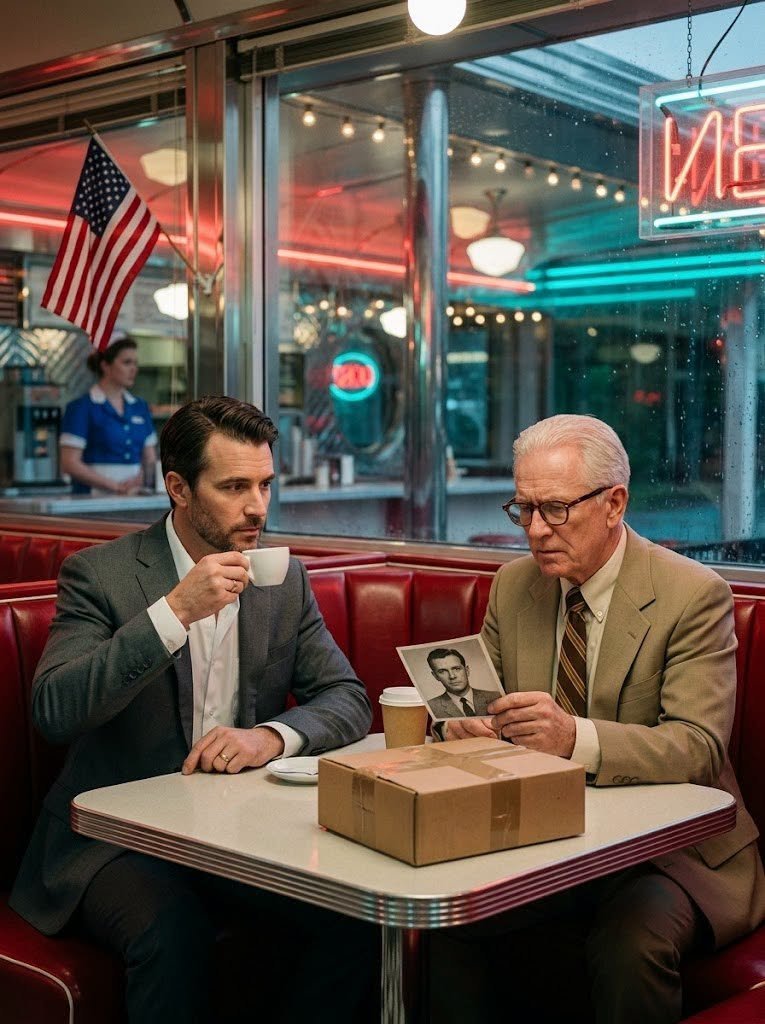
At 10:47 p.m. on Tuesday, October 14, 2025, I pulled into a diner on Fleur Drive in Des Moines.
It was the sort of place that never seemed to change. The booths were covered in cracked red vinyl, the coffee was strong enough to wake the dead, and a little bell above the door announced every customer.
I ordered coffee and a grilled cheese sandwich I wasn’t sure I wanted.
The waitress set the mug in front of me.
“You doing okay, hon?”
“Fine,” I answered automatically.
She gave me a look that suggested she had heard that word from a thousand people who weren’t fine, then walked away.
I stared into my coffee.
That’s when the old man entered.
He was small and thin, perhaps in his late seventies, wearing a brown jacket that looked two sizes too large. His silver hair was carefully combed, and he carried a worn leather wallet in one hand.
He ordered tea, glanced around the diner, and began walking toward the empty booth across from mine.
Then he saw me.
He stopped.
For several seconds, he stood completely still.
I assumed he recognized me from somewhere. Des Moines wasn’t a small town, but it wasn’t so large that people never crossed paths twice.
Instead of asking whether we had met, he gripped the back of the booth and whispered something I couldn’t understand.
“Sir?” I asked. “Are you all right?”
He nodded, although his hands were shaking.
Then he sat down across from me.
He didn’t ask permission.
He didn’t introduce himself.
He simply looked at my face as if he had discovered something he had spent years searching for.
Finally, he spoke.
“Your name is Daniel, isn’t it?”
My stomach tightened.
“Yes. Daniel Mercer. Do I know you?”
His eyes filled with tears.
“I don’t know if you’ll remember me,” he said. “But sixteen years ago, you saved my son’s life.”
I stared at him.
Sixteen years ago.
The number struck me before the words did.
I searched my memory, trying to connect his face to an event, a conversation, or a name.
“I think you have me confused with someone else.”
He shook his head.
“No. You worked at Meridian Distribution. You were a warehouse supervisor then. Your company was receiving shipments from a supplier outside Cedar Rapids.”
Slowly, something began to return.
A stormy afternoon.
A truck that had arrived late.
A young driver who had climbed down from his cab looking pale and unsteady.
I remembered a man collapsing near the loading dock.
I remembered calling emergency services, clearing the area, and staying beside him until the ambulance arrived.
The man had been conscious but confused. I had learned later that he had suffered a serious medical episode while driving. He had pulled over before losing consciousness completely.
I had never learned what happened to him afterward.
“Your son was the driver?” I asked.
The old man nodded.
“His name was Michael.”
He took a folded photograph from his wallet and placed it on the table.
It showed a young man standing beside a red pickup truck, smiling at the camera. He looked to be in his twenties, with dark hair and a broad, easy grin.
“That was Michael before the accident,” the old man said. “He was twenty-nine. He had a wife and a little boy.”
He paused, struggling to continue.
“He had an undiagnosed heart condition. The doctors told us that if he’d stayed behind the wheel much longer, he might not have survived.”
I remembered the ambulance lights reflecting off the wet pavement.
I remembered the fear in the young man’s eyes.
But I had never thought of myself as a hero. I had done what anyone should do when another person needed help.
“I only called for an ambulance,” I said quietly.
“You did more than that.”
The old man explained that the emergency responders had later told his family how quickly I had acted. I had made sure the loading dock was clear, directed someone to meet the ambulance at the gate, and stayed with Michael until help arrived.
Those details had mattered because the delay between a medical emergency and treatment could be critical.
Michael had survived.
He underwent surgery, recovered gradually, and eventually returned to work in a different role. He was still alive, the old man told me, and had recently celebrated his forty-fifth birthday.
I felt a strange mixture of relief and disbelief.
“I’m glad he’s doing well,” I said.
The old man nodded.
“His boy is twenty now. He’s studying engineering. Michael has been able to watch him grow up.”
He wiped his eyes with a paper napkin.
“For years, I wanted to find you. Michael remembered your name, but we never knew how to contact you. Then, last month, he found an old employment record and a note about the incident. We searched for you.”
He looked at the cardboard box beside my feet.
“Tonight, I saw you sitting here, and I recognized you from a photograph Michael had kept.”
I glanced at the box.
I’d forgotten I was still carrying it.
The old man followed my gaze.
“Were you leaving work?”
I hesitated.
Then, for the first time all day, I stopped pretending.
“I lost my job this morning,” I said. “After sixteen years.”
He looked at me with an expression that made me feel strangely exposed.
“I’m sorry.”
I shrugged, trying to make the words sound unimportant.
“Companies change. People get replaced. That’s how it goes.”
But my voice cracked on the last sentence.
The old man leaned forward.
“No, Daniel. That’s how companies work. It isn’t how a person’s worth is measured.”
I looked away.
He continued gently.
“You spent sixteen years helping people do their jobs. You raised a daughter. You survived losing your wife. And sixteen years ago, you helped my son live long enough to see his own child grow up.”
He paused.
“Don’t let one terrible day convince you that none of those things matter.”
For several seconds, I couldn’t speak.
It was the first kind thing anyone had said to me all day.
Not because it offered me a job.
Not because it solved my financial problems.
But because the old man had reminded me that my life was bigger than the envelope sitting in my cardboard box.
He reached across the table and placed his hand over mine.
“My name is Robert Hayes,” he said. “And I want you to know something. My family has never forgotten you.”
I looked at him, and something inside me finally broke.
I began to cry.
Not loudly. Not dramatically.
I simply lowered my head and let the tears come.
Robert didn’t tell me to be strong. He didn’t rush to fill the silence with advice. He sat across from me while I cried, occasionally squeezing my hand as if he understood that some kinds of pain needed room before they could be explained.
When I finally looked up, he pushed the photograph toward me.
“Would you keep this for a little while?” he asked. “I’d like you to remember what you did.”
I shook my head.
“You should keep it. That’s your family.”
He smiled.
“Then let me give you something else.”
He took a small card from his wallet and wrote down a phone number.
“Michael owns a transportation company now. He hires experienced operations managers. He told me that if I ever found you, I should ask whether you’d be willing to talk to him.”
I stared at the card.
“Your son wants to hire me?”
“He wants to meet you,” Robert replied. “What happens after that is up to both of you.”
I didn’t know what to say.
I had spent the entire day feeling as though sixteen years of experience had suddenly become worthless.
Now a stranger was telling me that the person whose life I had helped save remembered me—and wanted to speak with me.
It wasn’t a guarantee.
It wasn’t a rescue.
But it was a door I hadn’t known existed.
We sat together for another half hour, talking about Michael’s recovery, Robert’s grandchildren, and the small ways people remember kindness long after the person who offered it has moved on.
Before he left, Robert stood beside the booth and buttoned his jacket.
“Daniel,” he said, “I don’t know what tomorrow will bring for you. But I know my son got to have sixteen more years with his family because someone took his emergency seriously.”
He held out his hand.
“Thank you.”
I shook it.
Then he walked out into the October night.
I remained in the booth long after my coffee had gone cold.
For the first time that day, I didn’t think about the severance package, the mortgage, or the job applications waiting on my laptop.
I thought about a young man I had helped in a warehouse sixteen years earlier.
I thought about the child who had grown up with his father.
And I thought about how little I had understood the consequences of that afternoon.
The next morning, I called Michael Hayes.
We spoke for nearly an hour.
He remembered the incident clearly, though he admitted that much of the afternoon had been a blur. He told me about his recovery, his decision to leave long-haul driving, and the business he had built over the past decade.
Then he asked about my experience at Meridian.
I explained the distribution centers I had helped manage, the teams I had trained, and the operational systems I had developed.
He listened carefully.
At the end of the conversation, he invited me to visit his office the following week.
I went.
We talked for two hours, toured the facility, and discussed the challenges his company was facing as it expanded into new markets.
Three weeks later, he offered me a position overseeing regional operations.
The salary was fair. The responsibilities were challenging. And, most importantly, he wanted me there because of my experience, not because he felt indebted to me.
I accepted.
I won’t pretend that everything became perfect after that diner conversation. Losing my job still hurt. Starting over at forty-seven required adjustments I hadn’t anticipated. There were difficult days, unfamiliar systems, and moments when I missed the routines I’d known for sixteen years.
But the new job gave me something I hadn’t expected to find again so soon.
A reason to look forward to Monday morning.
And when I finally told Emily what had happened, she was quiet for a moment.
Then she said, “Dad, Mom would have been so proud of you.”
That sentence stayed with me longer than any job offer.
Because the truth was, I hadn’t needed someone to tell me I was a good employee.
I had needed someone to remind me that I was still a person with something valuable to offer.
Months later, I returned to the diner on Fleur Drive.
I ordered coffee and a grilled cheese sandwich, then sat in the same booth where Robert had found me.
I didn’t know whether he would ever come back. I hadn’t asked him to, and I didn’t have his number.
But I hoped he was enjoying time with his son and grandchildren.
I hoped Michael was doing well.
And I hoped that somewhere, in a small way, the kindness I had offered sixteen years earlier had come back to the man who needed it most.
I still have the card Michael gave me after I accepted the job.
I keep it in the same desk drawer where I store Linda’s old letters.
Not because I need a reminder of how I found employment.
But because I need a reminder of something much more important.
You never know which ordinary moment in your life will become extraordinary in someone else’s.
You might help a stranger without ever learning their name. You might offer patience when someone is frightened, or take a few minutes to do the right thing when everyone else is rushing past.
You may never see the result.
You may never receive a thank-you.
But the kindness can continue long after you’ve forgotten the moment that started it.
That October night, I thought I had reached the end of something.
I had lost my job, my confidence, and the comfortable future I believed I was building.
Then an old man sat across from me and reminded me that my life had mattered to someone in ways I couldn’t have imagined.
He didn’t erase my grief.
He didn’t pay my bills.
He didn’t promise that tomorrow would be easy.
He simply told me the truth about a moment I had forgotten.
And sometimes, that’s enough to help a person take the next step.
I went to that diner believing I had lost sixteen years of my life.
I left understanding that those years had not disappeared.
They had shaped the person I was, the people I had helped, and the opportunities that might still be waiting ahead.
Never assume that a chapter ending means your story has lost its value. You may have changed someone’s life without knowing it—and one day, when you least expect it, that truth may find its way back to you.