For a long time, Daniel tried to handle his mother gently. He reminded her that Emma was part of our family, that he loved her as his own, and that I would never tolerate anyone making my daughter feel unwanted in her own home.
Carol would smile, change the subject, and behave as though the conversation had never happened.
I wanted to believe she would eventually accept Emma. I told myself that perhaps she needed time, that seeing Daniel care for a child who wasn’t biologically his was simply unfamiliar to her.
Then Emma turned eleven.
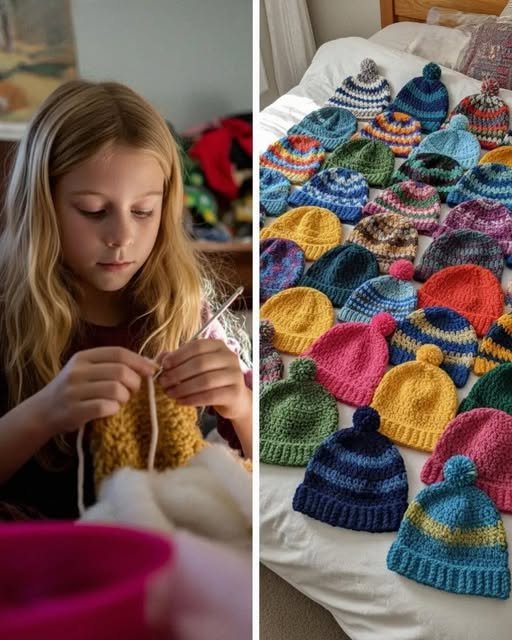
For her birthday, Daniel bought her a crochet kit after she mentioned wanting to learn how to make things with her hands. She spent hours watching tutorials, practicing stitches, unraveling mistakes, and starting again.
At first, she made little flowers and uneven squares. Then she learned to make hats.
One afternoon, she came running into the kitchen holding a small pink hat, her face glowing with pride.
“Mom! What if I make hats for children who are in the hospital? They get cold, and some of them don’t get to go home for a long time.”
I hugged her so tightly that she laughed.
“That sounds wonderful, sweetheart.”
From that day forward, crocheting became her mission.
After school, she sat on the living-room sofa with yarn spread around her feet. She worked while watching television, during quiet weekends, and sometimes for a few minutes before bed. She chose bright colors, soft yarn, and simple patterns that would be comfortable for children receiving treatment.
Every hat was different.
Some were blue with little yellow stripes. Others were pink, purple, green, or decorated with tiny crocheted flowers. She even made a collection of neutral-colored hats for children who might prefer something less colorful.
Whenever she finished one, she placed it carefully in a clean storage box.
She counted them every few days.
“Twenty-three,” she announced one evening.
A week later, she reached forty.
By the time she finished the eightieth hat, she had spent weeks turning her free time into something meaningful for children she had never met.
I watched her place the last hat on top of the others.
“Eighty,” she whispered, smiling. “Mom, do you think they’ll like them?”
“I think they’ll love them.”
She had already spoken with a local children’s hospital about donating them. We still needed to confirm the delivery arrangements, but she could barely contain her excitement.
For Emma, it wasn’t about receiving praise. She wanted another child to have something soft and warm to hold when everything else felt frightening.
Then Daniel had to leave for a three-day business trip.
The morning he departed, he kissed me goodbye, hugged Emma, and promised to call that evening.
“Take care of your mother,” he told her.
Emma grinned. “I always do.”
Neither of us imagined that those three days would change the way our family dealt with Carol forever.
On the first afternoon, Carol stopped by unexpectedly.
She had a spare key because Daniel had given her one years earlier for emergencies. I had never thought much about it. She was his mother, and I assumed she understood that having a key did not mean she could do whatever she pleased in our home.
I was upstairs folding laundry when Emma called out that Grandma Carol had arrived.
A few minutes later, I heard Carol’s voice from the living room.
“What on earth is all this mess?”
I hurried downstairs.
Carol stood beside the storage boxes, holding one of Emma’s crocheted hats between two fingers.
“Emma made those,” I explained. “She’s donating them to children at the hospital.”
Carol looked at the pile with open disapproval.
“All of these?”
“Yes. Eighty of them.”
She gave a short, humorless laugh.
“And you let her waste all this time making things for strangers?”
Emma was standing near the sofa, her hands clasped together.
“They’re not a waste,” she said quietly. “The children might need them.”
Carol looked at her.
“Sweetheart, you need to learn that the world doesn’t revolve around your feelings. And frankly, Daniel has enough responsibilities without pretending to be the father of someone else’s child.”
The room went silent.
I stepped between them.
“That’s enough, Carol.”
She waved her hand dismissively.
“I am simply being realistic. Daniel works hard. He deserves to build a family of his own, not spend his life trying to replace a man who died years ago.”
Emma’s eyes filled with tears.
She didn’t argue. She didn’t shout.
She simply turned around and walked upstairs.
That hurt more than anything Carol had said.
I followed Emma to her bedroom and found her sitting on the edge of her bed, staring at the crochet hook in her hands.
“Maybe Grandma is right,” she whispered. “Maybe Daniel only does these things because he feels sorry for me.”
I knelt in front of her.
“No, sweetheart. Daniel loves you because you’re you. Nobody gets to decide that your place in this family is less important.”
She nodded, but I could see that my words hadn’t erased the damage.
When I returned downstairs, Carol was gathering her purse.
“She’ll get over it,” she said. “Children are sensitive.”
I asked her to leave.
She did, muttering that I had become far too defensive since marrying her son.
I thought the worst part of the visit was over.
I was wrong.
The following morning, I took Emma to school before heading to work. The boxes of hats were stacked neatly in the spare room, ready for the hospital donation.
When I returned home that afternoon, I noticed the spare-room door was open.
The boxes were gone.
At first, I thought Daniel might have arranged for someone to collect them. Then I saw the empty shelves, the loose strands of yarn on the floor, and a small piece of pink wool caught beneath the door.
My stomach dropped.
I searched the closets, the garage, and the hallway.
Nothing.
I called Carol.
She answered on the fourth ring.
“Where are Emma’s hats?”
There was a pause.
“Oh, those things.”
My grip tightened around the phone.
“What did you do with them?”
“I threw them away.”
For a moment, I couldn’t speak.
“You did what?”
“They were cluttering the room. Eighty little hats made from cheap yarn. It’s not as though she was saving the world.”
I felt the blood rush to my face.
“Those hats were made for sick children. Emma spent weeks making them.”
“Then perhaps she should spend her time on something more useful.”
I ended the call before I said something I couldn’t take back.
I drove to the garbage collection area behind our house, searching through the bins until I found the bags Carol had apparently discarded. Several had already been collected, and the remaining bags were torn and wet. The hats I found were mixed with household rubbish.
I brought home what I could recover.
Some were still usable after careful washing. Others were stained, stretched, or damaged beyond repair.
When Emma arrived home, she saw the boxes on the kitchen floor.
She stopped in the doorway.
“Mom?”
I wished I could have hidden everything until I knew what to say.
But she saw the damaged yarn, the soiled hats, and my tearful face.
“Where are the others?”
I pulled her into my arms.
“Grandma threw them away, sweetheart.”
Emma stared at me.
Then she looked down at the pink hat she had been working on the night before.
She didn’t cry immediately. She just stood there, as if her mind couldn’t make sense of what I had told her.
“But I told her they were for the hospital.”
“I know.”
“I told her.”
“I know, baby.”
Her face crumpled.
“Why would she do that?”
I had no answer that could make sense to an eleven-year-old who had spent weeks doing something kind.
She sat on the floor and began crying. Not the loud, angry crying of a child throwing a tantrum, but the quiet, broken kind that comes when someone realizes that another person has deliberately hurt them.
That was the moment something inside me changed.
I had spent years trying to keep peace with Carol. I had tolerated her remarks about Emma’s father, her suggestions that Daniel would eventually regret marrying a woman with a child, and her constant reminders that Emma wasn’t related to him by blood.
I had hoped patience would eventually lead to acceptance.
But I finally understood that protecting my daughter’s peace was more important than preserving a relationship with someone who repeatedly tried to take it away.
I called Daniel.
He was between meetings when he answered.
“Hey, love. Everything okay?”
“No,” I said. “You need to hear what happened.”
I told him everything, from Carol’s cruel comments to the missing boxes and the telephone call in which she admitted throwing away Emma’s hats.
He didn’t interrupt.
When I finished, he was silent for several seconds.
Then he asked one question.
“Did Mom really throw away all eighty hats Emma made for those children?”
“Yes.”
His voice changed.
“Put Emma on the phone, please.”
I carried the phone upstairs.
Emma was still sitting on her bed, holding the damaged pink hat.
“Daniel wants to talk to you,” I told her.
She wiped her eyes and took the phone.
“Hi, Daniel.”
I heard his voice soften immediately.
“Hey, kiddo. Your mom told me what happened.”
Emma began crying again.
“I’m sorry. I should have put them somewhere else.”
“No,” Daniel said firmly. “You have absolutely nothing to apologize for.”
“But Grandma said—”
“I don’t care what Grandma said. You made eighty hats because you wanted to help children who were sick. That was an incredibly kind thing to do, and nobody gets to make you feel ashamed of it.”
Emma sniffled.
“Are you mad at me?”
“Never for this. Not ever.”
He spoke to her for several more minutes, reminding her that she was loved and that her work mattered.
Then he asked to speak with me again.
“I’m coming home tomorrow morning,” he said. “And we’re going to fix this.”
I thought he meant the hats.
I had no idea how completely he intended to change our family’s boundaries.
Daniel arrived home earlier than expected the following morning. He hugged Emma first, holding her for a long time without saying anything. Then he sat with her at the kitchen table and examined the surviving hats.
He asked about the colors, the patterns, and how long each one had taken to make.
For the first time since the incident, Emma began talking excitedly about her project again.
When she finished, Daniel kissed the top of her head.
“We’re going to make sure these get to the children who need them.”
He contacted the hospital, explained what had happened, and asked whether they could still accept the surviving hats. The staff agreed to help us determine which items were suitable for donation, subject to their hygiene and safety requirements.
Then Daniel made another call.
He called his mother.
I couldn’t hear every word, but I heard enough.
“You had no right to enter our home and destroy something Emma worked so hard to make.”
A pause.
“No, Mom. This isn’t about yarn. It’s about a child who trusted you, and you deliberately hurt her.”
Another pause.
“She is my daughter in every way that matters. I chose this family, and I will not let you keep treating her as though she doesn’t belong.”
Carol apparently tried to defend herself.
Daniel’s answer was immediate.
“You don’t have to agree with every decision we make. But you do have to respect our family. Until you can do that, you won’t have a key to our home, and you won’t be coming over whenever you please.”
When he ended the call, he looked exhausted but certain.
He contacted a locksmith that afternoon and arranged to have our locks changed. He also made it clear that his mother would need an invitation before visiting and that any future relationship with Emma would require genuine respect.
I had expected him to be angry.
I hadn’t expected him to be so decisive.
“She’s going to say I’m choosing you over her,” he told me later.
I looked at him. “Aren’t you?”
He shook his head.
“I’m choosing not to let someone hurt my daughter and then demand that we pretend it didn’t happen.”
Those words stayed with me.
That evening, Daniel sat beside Emma while she crocheted another hat. He asked her to teach him how to make one, and she laughed when he struggled to hold the hook correctly.
His first attempt looked more like a tangled ball of yarn than anything a child could wear.
Emma giggled.
“You’re doing it wrong!”
“Then I guess I’ll need a very patient teacher.”
For the first time in days, I heard her laugh without sadness behind it.
We didn’t replace all eighty hats overnight. We couldn’t undo what Carol had done, and we didn’t pretend that a few comforting words could erase the hurt.
But we could begin again.
Daniel shared Emma’s story with a few friends and coworkers, without turning her pain into a spectacle. Several people offered to donate yarn, and a local crafting group volunteered to help her make more hats.
Within weeks, Emma had more supplies than she could have imagined.
She eventually completed another collection, and we arranged a proper donation with the hospital.
When the day came, she packed the hats carefully into boxes, checking each one before placing it inside.
At the hospital, a staff member thanked her for the work she had done and explained how the donations would be handled for young patients.
Emma stood a little taller as she listened.
On the drive home, she held Daniel’s hand from the back seat.
“I’m glad we didn’t give up,” she said.
Daniel smiled at her in the rearview mirror.
“Me too, kiddo.”
Carol eventually reached out, but the relationship did not return to what it had been before. Daniel insisted that any reconciliation begin with accountability, not excuses. Whether she could accept that responsibility was up to her.
We stopped waiting for her approval.
And that, more than anything, changed our lives.
For years, I had believed that keeping a family together meant overlooking hurtful behavior, making excuses for relatives, and asking the person who had been wounded to be the bigger person.
Daniel helped me understand that family isn’t measured by blood alone, and love isn’t proven by how much cruelty someone is willing to tolerate.
Emma had made eighty hats for children she would probably never meet.
Her grandmother had seen clutter.
We saw compassion.
And when Daniel returned home, he made one thing unmistakably clear: no one would be allowed to make his daughter feel like an outsider in her own family again.
Because the people who truly love a child don’t ask that child to earn a place in the family. They make sure the child knows that place was never in question.