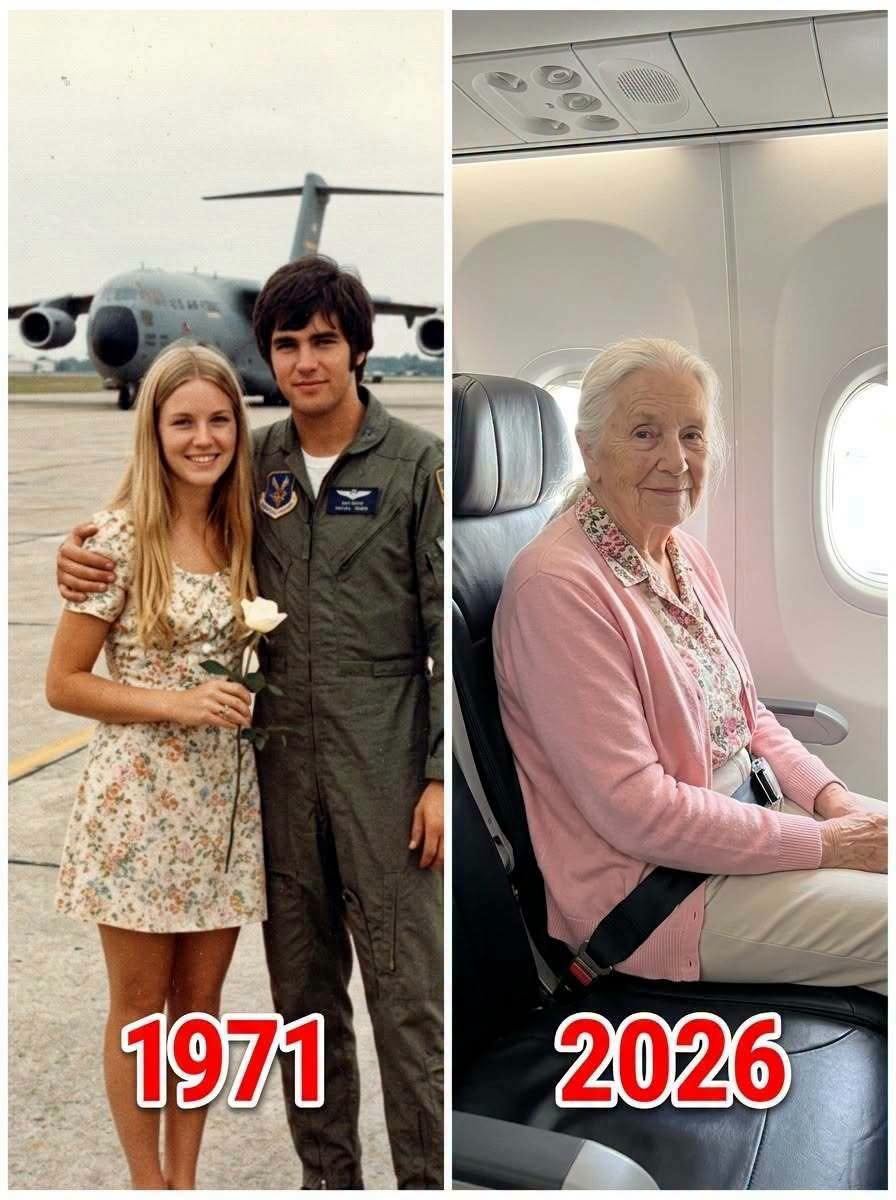
For fifty-five years, I mourned a man who was still alive. Then, at seventy-six, a stranger stopped me at the airport with our college photograph and a message from the sweetheart I thought the Vietnam War had taken. But finding Thomas meant confronting something far crueler than loss, and his explanation would force me to make one final choice: whether to forgive the man who had broken my heart or finally let him go.
My name is Margaret, and I was twenty-one when Thomas Whitmore promised he would marry me.
We met in college in the spring of 1968. He was studying engineering, and I was preparing to become a teacher. He had a crooked smile, an infectious laugh, and a habit of bringing me white roses whenever he thought I needed cheering up. We dreamed about a little house with a front porch, children running through the yard, and a lifetime of ordinary happiness.
Then the Vietnam War took him away.
His letters arrived regularly at first. He wrote about missing home, about the future we would build together, and about how he counted the days until he could hold me again. I kept every letter in a wooden box beneath my bed.
Then, in late 1969, the letters stopped.
Weeks became months. I contacted the military, wrote to his commanding officers, and searched every list of missing and presumed-dead soldiers I could find. Eventually, I received a notice informing me that Thomas was missing and that his fate remained uncertain.
There was no body to bury. No final goodbye. Just a terrible emptiness that followed me everywhere.
My parents urged me to move on. My friends told me I was too young to spend my life waiting for someone who might never return. But how could I stop loving a man when I didn’t even know whether he was alive?
I never married.
I became an elementary school teacher, devoted myself to my students, and built a life that looked perfectly respectable from the outside. Every year on Thomas’s birthday, I bought white roses and visited the Vietnam Veterans Memorial. I would stand quietly, remembering the boy who had promised to come home.
Sometimes, I brought one of his letters and read it beside the names carved into the stone.
I never stopped wondering what had happened to him.
Fifty-five years passed that way.
I was seventy-six when everything changed.
I had just arrived at the airport after visiting an old friend when a young man approached me. He introduced himself as Daniel Whitmore and asked whether I had once known a man named Thomas.
My heart seemed to stop.
Daniel pulled an old photograph from his coat pocket. It showed Thomas and me standing together outside our college library, his arm around my shoulders and my head resting against him.
I recognized the photograph instantly. I had taken it myself and given him a copy before he left for the war.
“Where did you get this?” I whispered.
Daniel swallowed hard.
“From my grandfather. He asked me to find you.”
I stared at him, unable to understand.
“Your grandfather?”
“Thomas is alive,” he said gently. “He’s eighty years old now. He’s been living in Oregon for decades. He knows what happened between you, and he wants to explain.”
For the first time in fifty-five years, I felt something I had almost forgotten: hope.
But it was mixed with anger, disbelief, and a fear I couldn’t name.
The next morning, Daniel drove me to a small house surrounded by tall trees and a garden filled with autumn flowers. I sat in the passenger seat with trembling hands, wondering what I would say to the man I had mourned for more than half a century.
Then the front door opened.
Thomas stood in the doorway.
His hair had turned silver. His shoulders were bent, and his face was marked by the years. But his eyes were unmistakable.
For a moment, neither of us spoke.
Then he whispered, “Margaret.”
I wanted to run toward him. I wanted to slap him. I wanted to ask why he had let me spend my entire life believing he was dead.
Instead, I stood perfectly still.
“You were alive,” I finally said.
He lowered his eyes.
“Yes.”
“All those years, Thomas. All those birthdays. All those prayers. I thought you were dead.”
Tears gathered in his eyes, but I could not bring myself to comfort him.
“Why?” I asked. “Why didn’t you come back to me?”
He invited me inside, and we sat across from each other in a quiet living room filled with family photographs. There were pictures of children, grandchildren, birthdays, and holidays. A lifetime of memories I had never been part of.
Thomas took a long breath.
He told me that he had been wounded during the war and evacuated to a military hospital. After months of treatment and recovery, he eventually returned to the United States in 1973.
By then, he said, he had changed. The experiences of war had left him frightened, restless, and uncertain about the future. During his recovery, he had grown close to a nurse named Evelyn. She had helped him through his darkest days, and eventually, their friendship became a relationship.
He married her.
They built a life together and raised two children.
I listened in silence, struggling to reconcile the man before me with the young man whose letters I had treasured.
“But you knew how to find me,” I said.
He nodded.
“Yes.”
“Did you ever write to me?”
“No.”
“Did you ever ask someone to tell me you were alive?”
He looked down at his hands.
“No.”
I felt the room grow smaller.
Then came the truth that hurt more than anything else.
Thomas explained that he had contacted his parents after returning home. He had told them he was married and had begun a new life. When they asked about me, he told them that I knew he was alive and had chosen not to contact him.
He had made me the reason for his silence.
His parents believed him. They never reached out to me because they thought I had moved on and wanted nothing to do with him.
Meanwhile, I spent decades mourning a man who was living only a few states away from the life he had abandoned.
“You let me believe you were dead,” I said, my voice shaking. “You allowed me to waste years wondering whether I should have waited longer, whether I should have done more, whether I had somehow failed you.”
“I know,” he whispered.
“No, Thomas. You don’t know. You had a wife. You had children. You had birthdays and holidays and people who loved you. I had a grave that wasn’t even yours.”
He began to cry.
He told me he had been ashamed. At first, he thought he would contact me once he had recovered. Then he became involved with Evelyn. He worried that contacting me would reopen old wounds, complicate his new relationship, and hurt the woman who had cared for him.
So he delayed.
One month became a year. A year became a decade. Eventually, he convinced himself that silence was kinder than the truth.
But he admitted that he had known all along that what he was doing was wrong.
“I was a coward,” he said. “And every year that passed made it harder to face what I’d done.”
I looked at him and saw an old man who had spent decades avoiding a difficult conversation.
“I didn’t ask you to love me forever,” I told him. “I only deserved to know that you were alive.”
He had no answer.
We sat together for nearly two hours. He showed me photographs of his family and told me about his children. Evelyn had died several years earlier, and Daniel had discovered the old letters and photographs while helping his grandfather organize his belongings.
When Daniel asked about the young woman in the pictures, Thomas finally told him the truth.
Daniel had been the one to insist that his grandfather contact me.
“He said you deserved to hear it from me,” Thomas explained. “He said I couldn’t take back what I’d done, but I could stop hiding from it.”
I was grateful to Daniel, though I wondered how a grandson could understand something his grandfather had avoided for fifty-five years.
Before I left, Thomas reached into a drawer and took out a small, worn envelope.
Inside was a white rose pressed between two sheets of paper.
“I kept this from the last bouquet you gave me,” he said. “I thought about you more times than I can explain.”
I stared at the fragile flower.
For a brief moment, I remembered the young man who had once held my hand beneath the college library’s old oak tree. I remembered his laughter, his promises, and the future we had imagined.
But memories could not erase the truth.
“You may have thought about me,” I said softly. “But you chose not to find me.”
He nodded, accepting the words without defending himself.
Then he asked the question I had been dreading.
“Can you ever forgive me?”
I looked through the window at the garden. The white roses growing outside reminded me of all the years I had carried my grief, believing it was proof of my loyalty to someone who had never given me the truth.
For most of my life, I had imagined that seeing Thomas again would heal the wound. I had thought that if he returned, even after decades, I might finally feel whole.
But the man sitting before me was not the young soldier I had loved. He was a stranger who shared his face and memories, someone who had made choices I could neither change nor excuse.
And I finally understood something I should have learned years earlier.
Forgiveness was not the same as pretending nothing had happened.
“I don’t know if I can forgive you today,” I told him. “Maybe someday I will. But I won’t spend the rest of my life trying to make your choices easier for you to live with.”
He nodded, tears running down his cheeks.
“I understand.”
“I hope you do,” I replied. “Because I spent fifty-five years carrying the consequences of a decision I never made.”
When I stood to leave, Thomas asked whether he could see me again.
I paused at the door.
“I’ll think about it,” I said honestly.
Then I walked outside, where Daniel was waiting beside the car.
He asked whether I was all right.
For the first time that day, I realized I was breathing freely.
“No,” I said. “But I think I’m going to be.”
On the drive home, I thought about the years I had spent visiting the memorial, placing white roses among the names of men who never returned. I thought about the birthdays I had mourned and the life I had built around an absence.
For years, I had believed that staying faithful to Thomas meant keeping my heart closed to the possibility of another life.
Now I wondered whether I had been faithful to a memory rather than to myself.
The following week, I returned to the memorial one final time.
I brought white roses, as I had done for decades, and stood quietly before the names carved into the dark stone.
But this time, I wasn’t there to mourn Thomas.
I was there to say goodbye to the young woman I had been—the girl who had waited for a promise to be fulfilled, who had blamed herself for a silence she could not understand, and who had mistaken uncertainty for a lifetime obligation.
I placed the roses on the ground and whispered, “You can stop waiting now.”
Then I walked away.
I didn’t know whether I would ever see Thomas again. I didn’t know whether forgiveness would come with time or whether some wounds would always leave a scar.
But I knew this: I was seventy-six years old, and my life was still mine to live.
I began meeting friends for lunch, joined a local book club, and accepted an invitation to visit a former student and her family. I even bought myself a small bouquet of white roses one afternoon—not for Thomas, not for the past, but simply because I loved them.
A month later, a letter arrived from Thomas.
He apologized again. This time, he made no excuses. He acknowledged that he had taken away my chance to make my own decisions and that his fear had caused me decades of unnecessary pain.
He didn’t ask me to forgive him.
He simply thanked me for listening.
I placed the letter in a drawer, beside the old college photograph. I no longer needed to destroy our memories to move forward, but I no longer needed to live inside them, either.
Sometimes I still think about the life Thomas and I might have shared. I suppose a part of me always will.
But I no longer ask myself what I could have done differently. I was young, I was sincere, and I loved someone who made a choice without giving me the truth.
That was never my failure.
Thomas returned from the war in 1973. I returned to my own life fifty-five years later.
And although we could never recover the years we had lost, I finally understood that the last choice belonged to me.
I could let his silence define the rest of my life, or I could allow the truth to set me free.
I chose freedom.
Because sometimes, the hardest goodbye isn’t to the person you loved. It’s to the future you spent a lifetime believing you would have together.