“grandma tax.”
That’s what the memo line said on the first payment. Three hundred dollars, sent from my son’s family to my phone on a Friday night, with two lowercase words that were meant to sting.
The next week: “babysitting fee lol.”
Then: “for your cruise.”
Then: “sharon’s shoe fund.”
Then my favorite: “another week of family love, billed.”
I’m 66 years old. I’ve never been on a cruise. I wear the same two pairs of shoes. And I’m the grandmother who watched those kids from 6:40 in the morning until 6:15 at night, five days a week, for fourteen months, without being paid a single cent.
So how did I end up with a Venmo memo calling me a tax?
Rewind. My daughter-in-law, Whitney, went back to work after my granddaughter was born. She asked me to help out “just until a spot opens at Little Acorns.” I was a widow, retired from 34 years as a payroll clerk at a lumber yard in Fort Wayne, Indiana, and lonely. I said yes on the spot. My husband, Stuart, had been gone a little over a year, and the house was so quiet I’d started leaving the radio on in empty rooms just to hear somebody talk.
The daycare spot opened that fall. My son, Tyler, turned it down. Too expensive, he said, “when Mom’s right here.”
So I was right here. Diapers, breakfast, lunch, naps, potty training, library story time. All paid for out of my pension. I quit my Wednesday watercolor class. I kept the kids six days straight while they went to Cancun, and my daughter-in-law posted that Grandma was “living her best life.” I found a note on my own fridge titled Things Sharon Forgets.
Then, at Tyler’s birthday cookout, a friend asked what I do now that I’m retired.
“Mom’s got her retirement hobby,” Tyler said. “Our kids.”
Laughter. Whitney added: “It’s basically free daycare, and she loves it.”
His friend said he paid $1,400 a month for his one kid. Tyler shook his head and said, “Can you imagine?”
A week later I asked my son for two hours a week on Wednesday afternoons for my painting class.
“It’s not like you have a job, Mom. It’s your hobby. Be reasonable.”
So I got reasonable. Payroll-clerk reasonable.
I called Little Acorns. $2,460 a month for both kids. Late pickup: one dollar per minute. I typed up a one-page childcare agreement. $300 a week. Late fee to match. Parents bring diapers and food. Closed on holidays. I signed it and handed it to him at pickup.
He read it under my porch light and came back with his face red to the ears. “You’re charging us? Grandmas don’t charge!”
“I’m charging less than half of daycare,” I said. “Buy your own diapers.”
Little Acorns had a seven-month wait now. Every place nearby was full. So Monday morning the kids came in with a fresh box of diapers, and Friday night came the first memo.
Then Sunday dinners stopped. Whitney’s mother called from Arizona to tell me she was “shocked” I’d charge family. Facebook got quiet. On the Fourth of July I watched the fireworks from my front step by myself.
I didn’t answer a single memo. I logged each payment in a green ledger, word for word, the way I logged thirty-four years of paychecks. Then I put the money in a separate account and left it alone.
On Christmas Eve, at my son’s house, in front of eleven people, Tyler held up my present and announced, “Careful, she’ll send a bill for opening it! Grandma’s billing department, everybody. Mom, how was the cruise? Twelve grand of our money by now?”
People laughed. My daughter-in-law said his name quietly.
I picked up the manila envelope I’d brought, and I stood up. 👇
Read Part 2 in the comments. The receipts are in there, and so is the person who really paid.
The man asking was a friend of my son’s from work, a tall fellow named Shane with a sunburned neck and a paper plate sagging under three bratwursts. It was Tyler’s thirty-eighth birthday cookout, and I had been standing by the cooler for twenty minutes holding my granddaughter on my hip because she would not let anyone else hold her.
“So, Mrs. Tolbert,” he said, friendly enough. “What do you do with yourself now that you’re retired?”
I opened my mouth. My son got there first.
A note from Daily Positive
Want to finish this story without interruptions?Subscribers read every story ad-free, and every subscription helps us publish more of them. First month is $0.99, then $1.99. Cancel anytime.
“Mom’s got her retirement hobby,” Tyler said, and pointed at Zinnia with his beer. “Our kids.”
Everybody on the patio laughed. My daughter-in-law, Whitney, laughed and added, “Honestly it’s basically free daycare, and she loves it. Right, Sharon?”
Shane whistled. “Must be nice. We pay fourteen hundred a month for our little guy, and they call us if he sneezes.”
“Fourteen hundred,” Tyler said, shaking his head like a man who had found a twenty on the sidewalk. “Can you imagine?”
I could imagine. I’d been imagining it for fourteen months, every morning at 6:40, when his headlights swung into my driveway.
Zinnia put her sticky hand on my cheek. I smiled at Shane and said, “It keeps me young,” because that is what you say. Then I went inside to find a wet wipe and stood in my son’s laundry room for a full minute with the door shut.
Just Until a Spot Opens
I’m sixty-six. I worked thirty-four years as the payroll clerk at a lumber yard in Fort Wayne, Indiana, which means I spent most of my adult life making sure that people got paid exactly what they were owed, on time, with nothing taken out that shouldn’t be. I retired at sixty-four. My husband, Stuart, had died the winter before. He coached high school wrestling for thirty years and he used to say that I was the only person in Allen County who could make a grown man apologize just by sliding a time card across a counter.
When Whitney’s maternity leave ended after Zinnia was born, she sat at my kitchen table with the baby in a car seat at her feet and asked if I could “help out for a few months.”
“Just until a spot opens up at Little Acorns,” she said. “They’ve got a waiting list, but it’s a good place. It’s close to the highway.”
I said yes before she finished the sentence. Of course I did. Sawyer was three then, and I’d been rattling around my house since Stuart passed, eating supper standing up. A few months with my grandbabies sounded like a gift.
A spot opened up at Little Acorns in the fall. I know because Whitney mentioned it in passing while she was buckling Sawyer into his booster seat.
“They called,” she said. “But it’s twenty-four hundred something for both of them. Tyler said that’s crazy when you’re right here.”
“Oh,” I said.
“You don’t mind, do you?” She was already backing out of the driveway.
I didn’t say I minded. I didn’t say anything. I waved at Sawyer, who was making his stuffed giraffe wave back at me through the window.
6:40 to 6:15
Still reading?
You’re halfway in. Finish it without another interruption.Subscribers get every story on Daily Positive with no ads, no pop-ups, no “watch an ad to continue.” $0.99 for your first month, or $9.99 for the whole year.
Go ad-free for $0.99 →
Let me tell you what my hobby looked like.
Tyler’s truck pulled in at 6:40 every weekday morning. He sells commercial heating and air conditioning systems and he likes to beat the traffic. Whitney manages three mattress stores on the south side and works until six. So the kids were mine from 6:40 in the morning until 6:15 at night, and sometimes 6:45, and twice that first winter, 8:10.
Sawyer came half asleep in his pajamas with his clothes in a grocery bag. Zinnia came in a wet diaper. I made breakfast. I made lunch. I potty trained a three-year-old boy who had firm feelings against it. I taught him his letters at my kitchen table with magnetic letters that I bought at the dollar store. I took them to the library on Tuesdays for story time and to the park on Thursdays. I learned all the words to a cartoon song about a dog who is also a police officer.
The diapers came out of my pension. The pull-ups, the wipes, the apple pouches, the little cheese crackers shaped like fish, the spare outfits for when somebody had an accident in the car seat. Whitney sent a bag of diapers maybe once a month. I didn’t keep track. That’s not true. I kept track. I’m a payroll clerk. I just didn’t say anything.
I also gave up my Wednesday watercolor class at the Tecumseh branch library. I had signed up the spring before Zinnia was born. It was eight women and one retired mailman, and the teacher was a gentle man who called everybody “friend.” I had painted exactly three pictures. One of them, a red barn outside Huntertown, I thought was pretty good. I left a voicemail saying I wouldn’t be back.
Things Sharon Forgets
I want to be fair. My son is not a monster, and neither is Whitney. They were tired. Two jobs, two little kids, a mortgage on a house a bit bigger than they needed. I remember that kind of tired.
But tired people still make choices.
The first Saturday drop-off came in January. My doorbell rang at 7:05 in the morning and there was Tyler with both kids and a bag. “Concert in Indy,” he said. “You’re the best. Back tomorrow by noon.” He was back by four.
In March they went to Cancun for six days for a friend’s wedding. I kept the kids. Whitney posted a picture on Facebook of the two of them on a beach, and under it she wrote, “Grandma’s living her best life with the littles!” with a little heart. Forty-one people liked it. My sister in Tucson called to ask if I was all right.
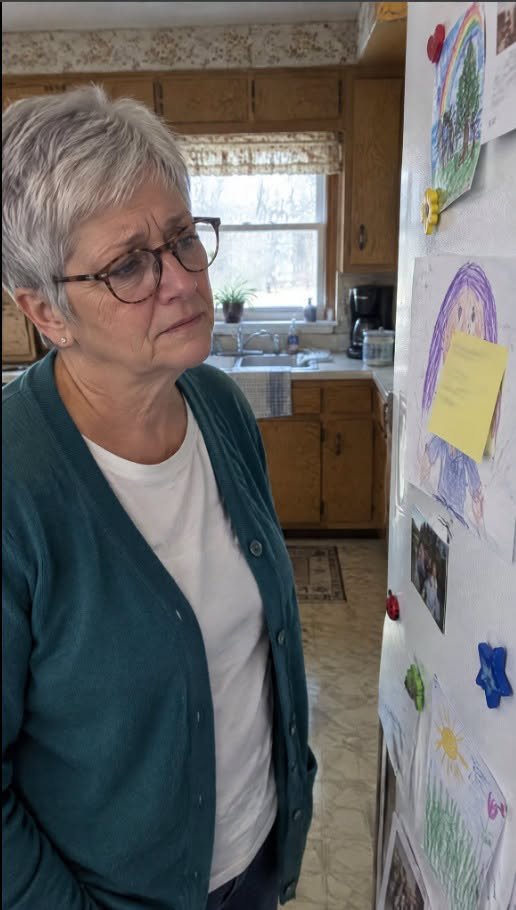
In May I found a sticky note on my refrigerator in Whitney’s handwriting. At the top it said Things Sharon Forgets. Underneath: Zinnia’s sunscreen. Sawyer’s library book. Don’t give him juice after 3. Nap by 1 NOT 1:30.
She had stuck it right over a picture Sawyer drew of me with purple hair.
I left the note up. I don’t know why. I think I wanted to see how long it took for anybody to notice that it was rude.
Nobody ever did.
“It’s Not Like You Have a Job”
The week after Tyler’s cookout, the library mailed out its fall schedule. The watercolor class was starting again. Wednesday afternoons, one to three, eight weeks, fifty-five dollars.
I sat with that schedule for two days. Then on Friday evening, when Tyler came to pick up the kids, I stopped him at the door.
“Honey, I want to ask you something,” I said. “There’s a class I’d like to take. Wednesday afternoons, one to three. Could you or Whitney work something out for those two hours? Just eight weeks.”
Tyler looked at me the way you look at a dog that has asked to drive.
“Mom,” he said. “Come on. It’s not like you have a job.”
“I know that.”
“This is your hobby. You’ve told us a hundred times you love it.” He was hoisting Zinnia onto his shoulder, already turning toward the truck. “We can’t just take off work for a painting class. Be reasonable.”
Sawyer called “Bye, Grandma!” from the back seat. I waved. Then I went back inside and stood in front of my refrigerator, and I read Things Sharon Forgets one more time.
Be reasonable, he’d said.
All right, I thought. I’ll be very reasonable.
The Invoice
That weekend I did what I did for thirty-four years. I sat down at the desk in my spare room with a legal pad, a calculator with a paper tape, and a cup of coffee, and I did the math.
I called Little Acorns on Monday while the kids napped. A woman named Una Szymanski, the director, picked up. She had a voice like a kindergarten teacher who has seen it all. I told her I was a grandmother looking into options. She told me their rates: $1,380 a month for a toddler, $1,080 for a four-year-old. Together, $2,460 a month. Registration was $150 a child. Late pickup after 6:00 was a dollar a minute.
“A dollar a minute,” I said.
“Parents hate that one,” she said. “It works.”
I hung up and looked at my legal pad. Fourteen months of free care at those rates came to $34,440. I wrote that number down and drew a box around it.
Then I typed up a one-page agreement on my old computer. I used the same plain font I used for twenty years of payroll memos. It said:
Childcare provided by Sharon Tolbert. Monday through Friday, 7:00 a.m. to 6:00 p.m. Rate: $300 per week for both children, payable Fridays. Late pickup after 6:00 p.m.: $1 per minute. Weekends by request, at least 48 hours notice, $10 per hour. Closed on federal holidays and two weeks of the provider’s choosing, unpaid. Parents provide diapers, wipes, and food.
Three hundred dollars a week. A little more than half of what Little Acorns charged. Less than I’d have charged a stranger. I printed two copies, signed both, and put them in an envelope.
On Friday, when Tyler came at 6:12, I handed it to him with the diaper bag.
“What’s this?”
“Read it at home,” I said. “With Whitney.”
Grandmas Don’t Charge
He read it in the driveway. I watched him through the front window. He read it, then he turned it over to see if there was more on the back, then he read it again. Then he came back up the walk with Zinnia still on his hip.
“Is this a joke?”
“No.”
“You’re charging us? To watch your own grandkids?”
“I’m charging you less than half of what Little Acorns charges,” I said. “And I’m asking you to buy your own diapers.”
“Grandmas don’t charge, Mom.” His face had gone red from the collar up, the way Stuart’s used to before a match. “Whitney’s mom would never do this.”
“Whitney’s mom lives in Scottsdale.”
“That’s not the point!”
“Then what is the point, Tyler?”
He didn’t have one. He just stood there breathing. Zinnia patted his face with both hands, saying, “Daddy, Daddy,” and he finally turned around and left without saying goodbye.
Whitney called me that night. She was crying, or close to it. She said I’d blindsided them. She said they had budgeted around me. She said, “I thought you wanted to do this,” and I said, “I did. I still do. But I’m sixty-six, and I’d like a Wednesday afternoon, and I’d like not to buy the diapers.”
She hung up.
On Monday at 6:52, Tyler’s truck pulled into my driveway. Little Acorns, it turned out, had a seven-month waiting list now. Every other place within twenty minutes was worse or full. The kids came in with a fresh box of diapers.
On Friday, my phone buzzed. A payment of $300.00 had arrived. In the little memo line, it said: grandma tax.
Grandma Tax
The memos got better. Or worse, depending on how you look at it.
grandma tax.
babysitting fee lol.
for your cruise.
sharon’s shoe fund.
another week of family love, billed.
I didn’t answer any of them. I wrote each payment down in a green ledger book I bought at the office supply store, with the date, the amount, and the memo, word for word, because that’s how I was trained. Then I drove to my credit union and deposited the money in a separate savings account I’d opened just for it. I didn’t touch it. I didn’t move it. I didn’t even look at the balance online.
I signed up for the watercolor class. Tyler grumbled, but on Wednesdays from 12:45 to 3:15 Whitney’s assistant manager covered for her, and she came and got the kids, and then dropped them back after. The first Wednesday I painted a coffee cup. It looked like a bucket. I didn’t care.
The family heard about it, of course. Whitney’s mother, Wendy Yost, called me from Arizona in June, which she had never once done in eleven years.
“Sharon, I’ll be honest, I was shocked,” she said. “Charging your own family. I just don’t know what kind of grandmother does that.”
“The kind who’s there at 6:40 in the morning,” I said. “How’s the weather in Scottsdale?”
She hung up too. There was a lot of that going around.
Sunday dinners stopped. For years we had eaten together at Tyler and Whitney’s on Sunday nights. Nobody called to cancel. There just stopped being any invitations. On the Fourth of July I sat on my own front step and watched the fireworks over the neighbor’s roof and listened to the Wolinskis two doors down argue about lighter fluid.
I still had the kids every weekday. I still loved them. Sawyer learned to write his name that summer, with the S backwards. Zinnia started calling me “Mo-mo” for reasons nobody understood. Those hours were never the problem. I want that understood.
What Sawyer Said in the Car
In late September, the memos changed.
The first one I noticed just said: week 31. Then: week 32. Then, one Friday, nothing at all. Just $300.00, and an empty memo line.
I figured Tyler had gotten bored of being clever.
Then, in October, I was driving Sawyer home from the library, and he was kicking the back of my seat and narrating a book about a whale, and right in the middle of it he said, “Mommy cried in the car because of the money for you.”
I looked at him in the rearview mirror. “What, honey?”
“Mommy cried. In the car. Daddy said it’s her problem because she wanted to go back to work.” He went right back to his whale. “And whales can hold their breath for one hour.”
I pulled into a gas station parking lot and sat there with the engine running, and Sawyer asked if we were getting gas, and I said no, Grandma was just thinking.
When Whitney came to get the kids that night, I looked at her properly, which I’m ashamed to say I hadn’t done in a while. She’d lost weight. Not the good kind. She had a cardigan on over her work blouse, and the cuffs were pulled down over her hands.
“Whitney,” I said. “Who’s been paying me?”
She went stiff. “What do you mean?”
“Those payments. Whose account do they come from?”
She looked at the floor of my front hall for a long time. Then she said, “Mine.”
“All of them?”
“Tyler says since I’m the one who wanted to keep working, the childcare is my expense.” She laughed, but nothing about it was funny. “He wrote the memos, though. He thinks he’s hilarious. I changed the password in September.”
“Are you eating lunch?”
She didn’t answer that, which was an answer.
I had spent eleven months angry at the wrong person. Or not the wrong person. Just not the only one.
Grandma’s Billing Department
Christmas Eve that year was at Tyler and Whitney’s, because Wendy had flown in from Scottsdale and wanted to see “her babies” in their own home. I was invited by group text, the first invitation in months. It said “Xmas Eve 5pm bring your famous potatoes.” I brought my potatoes. I also brought a large manila envelope.
There were eleven of us. Tyler and Whitney, the kids, Wendy, Whitney’s brother and his wife, Tyler’s buddy Shane and his wife, and an older neighbor couple I’d never met. The house smelled like ham and pine candles. Zinnia ran at my knees and yelled “Mo-mo!” and I picked her up and held on longer than she wanted.
It went fine for about an hour.
Then Tyler, three beers in, stood up by the tree to hand out presents, and when he got to the one that was for me, he held it up and said, “And this one’s for Grandma Sharon. Careful, everybody, she’ll probably send us a bill for opening it.”
Shane laughed. Wendy laughed. A couple of other people did that half-laugh where you’re not sure if you’re supposed to.
“Seriously, though,” Tyler went on, enjoying himself. “Mom, how was the cruise? You’ve got to have, what, ten, twelve grand of our money by now? Grandma’s billing department. Big business.”
Whitney said, “Tyler,” quietly.
“What? It’s a joke. She’s a businesswoman now.”
I set Zinnia down and picked up my manila envelope from beside my chair.
“It’s twelve thousand dollars exactly,” I said. “Forty payments of three hundred dollars. I can show you, if you’d like. I didn’t go on a cruise.”
The room went quieter. Tyler’s grin stayed on his face a second too long.
“Mom, I was kidding.”
“I know,” I said. “I’m not.”
Three Envelopes
I had put three smaller envelopes inside the big one, the way I used to sort pay stubs. I took out the first one and handed it to Tyler.
“That’s from Little Acorns,” I said. “Una Szymanski sends her regards. It’s a receipt for registration for both children, $300, and full prepaid tuition for January, February and March, $7,380. Total, $7,680. Sawyer and Zinnia start there on January sixth. Una held their spots in October. I paid for it with your money.”
Tyler stared at the receipt. “You…”
“I bought my own replacement,” I said. “Or you did. I just did the paperwork.”
I handed him the second envelope, which was thin. “That’s the four hundred and twelve dollars I spent on myself. The watercolor class, fifty-five dollars. A set of good brushes and paper, ninety-one dollars. A bus ticket and a hotel to visit my old friend from the lumber yard in Indianapolis for two nights in October, two hundred sixty-six. The receipts are stapled. You can check my math. Everybody always could.”
Wendy Yost was looking at the floor.
Then I took out the third envelope, and I didn’t hand it to Tyler. I walked across the living room and handed it to Whitney.
“That’s a cashier’s check for $3,908,” I said. “It’s the rest. It’s made out to you, not to him, because you’re the one who paid it. Every week. Out of your own check.”
Whitney opened the envelope and looked at the check and then put her hand over her mouth.
Tyler turned around and looked at his wife. Her brother looked at Tyler. Shane, to his credit, put his beer down very carefully on a coaster.
“You told her that?” Tyler said.
“Sawyer did,” I said. “In the car. He also told me that whales can hold their breath for an hour.”
Year One
There was one more piece of paper in the big envelope. I’d thought about whether to bring it out for a week. I’d decided I would, because I was tired of being described.
It was an invoice. I’d made it on the same old computer, in the same plain font. It said:
Childcare, Sawyer and Zinnia Tolbert. Fourteen months. Rate per Little Acorns Early Learning Center, $2,460 per month. Total: $34,440.
Across the bottom, in red ink, I’d stamped PAID IN FULL with an old rubber stamp I took home from the lumber yard when I retired. Underneath it I’d signed my name. Not Sharon Tolbert. Just: Grandma.
I put it on the coffee table in front of my son, between the cheese ball and a bowl of nuts.
“That’s the hobby,” I said. “That’s what it was worth. I gave it to you, and I would have kept on giving it to you. All I asked for was a Wednesday.”
Nobody said anything for what felt like a long time. The tree lights blinked. In the kitchen, the oven timer started beeping and nobody went to turn it off.
Wendy cleared her throat, finally. “Sharon, I didn’t know about the…” She waved toward Whitney’s check. “I didn’t know any of that.”