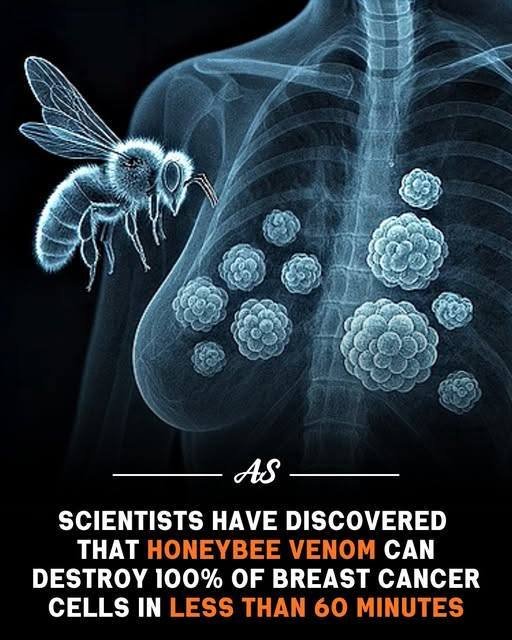
In an extraordinary scientific breakthrough, researchers in Australia have discovered a potentially game-changing treatment for breast cancer. Using a natural substance that has been buzzing around us for centuries, scientists have found that honeybee venom can destroy 100% of aggressive breast cancer cells in less than 60 minutes. This groundbreaking discovery brings new hope to the fight against one of the most common and aggressive forms of cancer.
As the world continues to search for more effective treatments for cancer, this study offers a promising development that could revolutionize how we approach cancer therapy, particularly in cases that are resistant to traditional treatments. Here’s everything you need to know about this stunning revelation and its potential impact on cancer research and treatment.
The Science Behind the Discovery: How Honeybee Venom Works
The key to this groundbreaking discovery lies in a substance found within honeybee venom known as melittin. Melittin is a protein that makes up around 50% of the venom’s composition. When injected into cancer cells, melittin attacks their membranes, causing them to break down and ultimately leading to the death of the cancerous cells.
What sets melittin apart from other substances used in cancer treatment is its ability to selectively target cancer cells without harming healthy cells. This is a crucial development in cancer treatment, as many existing therapies, such as chemotherapy and radiation, often damage healthy cells in the process of attacking cancer cells. This new method, using honeybee venom, has the potential to avoid these damaging side effects, which have long been a concern for cancer patients undergoing treatment.
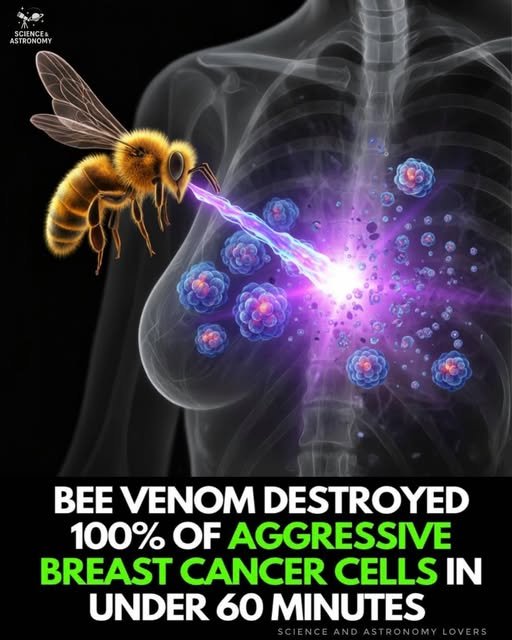
In the Australian study, scientists found that the venom, when used in small doses, was able to break down 100% of aggressive breast cancer cells in less than an hour. These are the types of cancer cells that are typically resistant to many conventional treatments and are often the most challenging to target with traditional methods.
The Role of Melittin in Targeting Cancer Cells
So, how does melittin work to destroy cancer cells so effectively? The answer lies in its unique mechanism of action. Melittin targets the cell membrane of cancer cells, which is a critical part of the cell’s structure. It attaches to the membrane and creates tiny holes, disrupting the cell’s integrity. These holes cause the cell to lose vital components, leading to its death.
What makes melittin particularly effective is its ability to specifically target cancer cells while leaving healthy cells unharmed. This is a major breakthrough in the field of cancer research, as it means that this treatment could potentially have fewer side effects than traditional cancer treatments. Since melittin can act so swiftly, destroying cancer cells in under 60 minutes, it offers a potential advantage over slower-acting drugs that often require prolonged treatment periods.
Why Honeybee Venom?
The idea of using bee venom as a medical treatment is not new. Honeybee venom has been used in traditional medicine for centuries, particularly in the form of apitherapy, a practice that involves using products derived from bees, such as honey, propolis, and venom, to treat various ailments. However, this new discovery takes the use of honeybee venom to a whole new level by demonstrating its specific ability to target and destroy cancer cells in a highly efficient and targeted manner.
While the use of honeybee venom in medicine has been explored before, its application in cancer treatment has largely been overlooked until now. Researchers are now beginning to recognize the potential of melittin as a natural, effective option for treating cancer, especially aggressive types that have been difficult to treat using conventional therapies.
The Promise of Targeted Cancer Treatment
One of the biggest challenges in cancer treatment is the side effects caused by therapies such as chemotherapy and radiation. These treatments often destroy healthy cells in the process of targeting cancer cells, leading to painful and debilitating side effects, including hair loss, nausea, and weakened immune systems.
Honeybee venom, with its ability to selectively target cancer cells, offers a potential solution to this issue. By directly attacking cancer cells and leaving healthy cells unharmed, it could drastically reduce the side effects associated with traditional cancer treatments. This would not only improve the quality of life for cancer patients but could also make treatment more effective and less invasive.
The Next Steps: Clinical Trials and Future Research
While the discovery that honeybee venom can target and destroy cancer cells is incredibly promising, there is still much work to be done before it can be widely used in clinical settings. Researchers are now focusing on further refining this treatment method, including determining the best way to administer the venom, the appropriate dosage, and any potential long-term effects.
Clinical trials will be necessary to evaluate the safety and efficacy of melittin as a cancer treatment. These trials will help determine whether the honeybee venom can be used as a stand-alone treatment or if it should be used in conjunction with other therapies, such as chemotherapy or immunotherapy, to enhance its effectiveness.
Additionally, researchers are exploring how melittin can be delivered to cancer cells in the most efficient way. In the study, the venom was applied to cancer cells in the lab, but for it to be useful in real-world medical applications, scientists will need to determine how best to administer the venom to patients in a controlled and safe manner. This could involve injections or developing new delivery methods that allow the venom to target cancer cells more precisely.
The Broader Implications: A Natural Approach to Cancer Treatment
This discovery also opens the door to the possibility of using other natural substances to target cancer cells. Honeybee venom is just one example of the vast potential that nature holds in terms of medical treatments. Scientists are increasingly looking to nature for solutions to the world’s most pressing health problems, and this discovery serves as a powerful reminder that we have only scratched the surface when it comes to the healing potential of natural substances.
As research continues, we may see even more natural remedies emerge as viable treatments for cancer and other diseases. From plant-based compounds to animal-derived substances like honeybee venom, the future of medicine could be found in the natural world, offering new hope for those fighting against life-threatening conditions.
Conclusion: A Buzzing New Hope for Cancer Treatment
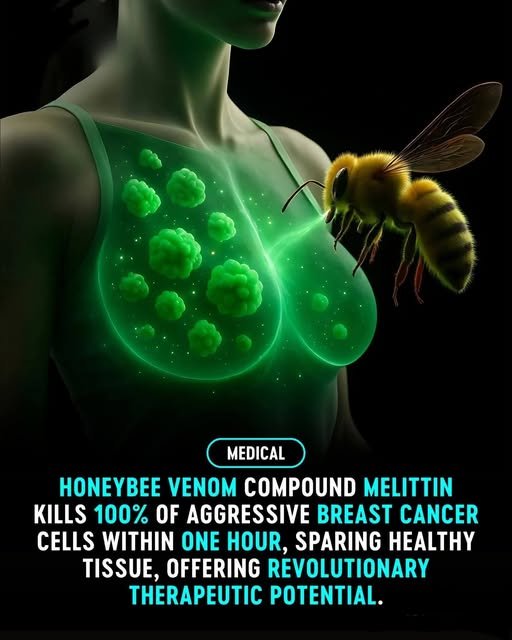
The discovery that honeybee venom can destroy 100% of aggressive breast cancer cells in less than 60 minutes is nothing short of revolutionary. With its ability to selectively target cancer cells without harming healthy ones, honeybee venom could become a game-changer in the fight against cancer, offering a new, more effective, and less harmful treatment option for patients around the world.
While we are still in the early stages of research, the potential of this natural remedy is vast, and it brings renewed hope to those who have longed for a more effective, less invasive cancer treatment. As scientists continue to explore the possibilities of melittin and other natural substances, we may be on the brink of a new era in cancer treatment—one where nature’s own remedies provide the cure we’ve been waiting for.