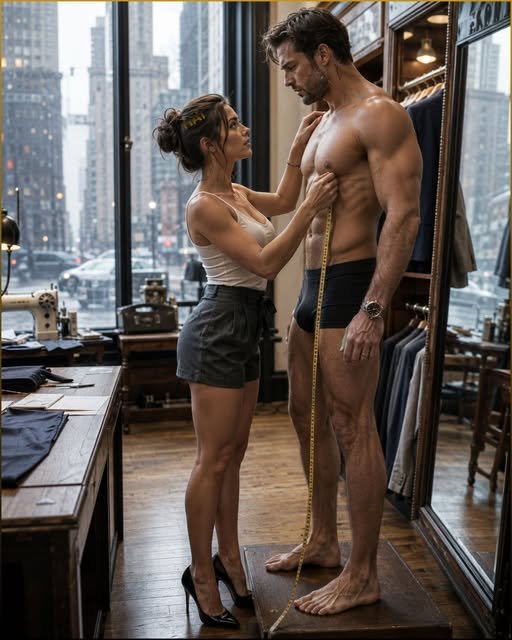
He Asked the Broke Tailor If She Had a Boyfriend, Then Smiled When She Said “Not Yet”—But His Jealousy Was a Warning, Not a Proposal From the Billionaire Who Needed Her Alive
She opened it anyway.
Inside lay an industrial deadbolt heavy enough to bruise a foot if dropped. Beneath it was a cream card with sharp, slanted handwriting.
Your lock is a joke. Replace it tonight. — A
Her first emotion was anger. It came hot and clean. Someone had entered her home. Someone had stepped across the line between threat and violation, between protection and control.
Her second emotion was fear.
Her third was something she refused to name.
She turned the card over. On the back, in smaller writing, was a phone number.
Not mine, the note read. Emergency only. It reaches someone faster than 911.
Mara crushed the card in her fist. She should have thrown the deadbolt out the window. She should have called the police. She should have marched into Adrian Vale’s office and told him that men who broke into women’s apartments did not get to pretend they were heroes.
Instead, after twenty minutes of staring at her cheap brass lock, she found her father’s old toolbox under the sink and replaced the deadbolt with shaking hands.
Thursday arrived tasting of burnt coffee and exhaustion.
Mara had slept six hours in three days. The charcoal three-piece suit stood in the center of the shop on a wooden valet, shaped by her blistered fingers and corrected by instincts inherited from her father. It was beautiful. Worse, it was perfect. The wool fell like shadow. The silk lining caught light like dark water.
At noon exactly, the bell rang.
Adrian entered alone.
No Bruno. No visible weapon, though Mara knew better than to believe he was unarmed. He wore a black overcoat and a dark turtleneck. Rain glittered on his shoulders.
“You look like hell,” he said.
“Customer service is extra.”
“Did you install the lock?”
Her jaw tightened. “I did. I’m billing you for the time.”
“Send it to my accountant.”
“Don’t send anyone into my home again.”
The silence that followed was cold enough to raise gooseflesh along her arms.
Adrian crossed the shop slowly. Mara stood her ground, though every practical part of her brain screamed for distance.
“I mean it,” she said. “You cross my threshold without an invitation again, and I call the police.”
“And wait twenty minutes while they transfer you twice?”
“I’m not asking you to save me.”
His face changed. Not much. Just enough for her to see the anger beneath the calm was not aimed at her.
“No,” he said. “You’re asking the world to be decent because you are. That’s different.”
For one second, Mara had no answer.
He reached out. His knuckles brushed beneath her eye, where lack of sleep had painted shadows into her skin. The touch was gentle enough to hurt more than force would have.
“The lock buys three minutes,” he said. “That’s all I need.”
“Three minutes from where?”
He did not answer.
Instead, he looked toward the suit.
“Put it on,” she ordered, because work was safer than whatever this was.
He obeyed.
When he stepped out of the fitting room, Mara forgot to breathe.
The suit did what a good suit was supposed to do. It lied elegantly. It softened brutality into power, covered weapons with clean lines, and made a man who could ruin lives with one phone call look like he belonged in a boardroom rather than a back alley. Mara walked around him with chalk in hand, pretending she needed to check things she already knew were right.
“It’s good,” he said.
“It’s perfect,” she corrected.
“I have dinner tonight.”
“I’m not altering dinner.”
“You’re coming.”
Mara looked up from the cuff. “Excuse me?”
“A sit-down. West Harbor and South Loop. I need my cuffs checked before I walk in.”
“You need a mirror. I need sleep.”
“You’re coming,” he repeated.
It was not a request. That should have ended the conversation. But the exhaustion gave Mara a dangerous kind of courage.
“I don’t do mob dinners, Mr. Vale.”
“You do tonight.”
“Why?”
His eyes held hers in the mirror. “Because they need to know your face.”
The answer chilled her more than any threat could have. It implied she had already been discussed by men she had never met.
“I’m not territory,” she said.
“No,” Adrian replied. “You’re evidence.”
The word made no sense then. Later, Mara would remember it as the first honest thing he had ever given her.
At seven, Bruno drove her to a restaurant in Little Italy with no sign on the door and no windows in the back room. The place smelled of garlic, red wine, old smoke, and secrets. Mara sat in a corner booth with her sewing kit on her lap while men with heavy watches and careful smiles discussed shipping containers, union contracts, missing invoices, and percentages as if they were ordering dessert.
Adrian sat at the center of the long table. The suit fit him like armor.
Across from him sat Victor Raines, an older man with silver hair and lawyerly hands. Beside Raines lounged a younger man in a shiny blue suit, drunk enough to be reckless and stupid enough to think recklessness was courage.
His name, Mara learned from the conversation, was Cal Raines.
About an hour in, Cal’s attention slid toward her.
“So that’s her?” he asked, smirking. “The little seamstress.”
The table went silent.
Mara tightened her grip on the sewing kit.
Adrian did not immediately look at him. He lifted his water glass, took one slow sip, set it down, and then raised his eyes.
“Her name is Mara.”
Cal laughed. “She looks like she came with the tablecloths. You bringing civilians to business now, Vale?”
Victor Raines placed two fingers against his temple as if a headache had begun behind his eyes.
Adrian leaned back. He did not shout. He did not move toward the gun Mara knew was hidden under the jacket she had made. He simply looked at Cal until the younger man’s smile began to die.
“Mara Whitcomb is the only person in this city who touches what protects me,” Adrian said. “If you insult her work again, I’ll assume you’re questioning my judgment. If you look at her again like that, I’ll assume you’re threatening my property.”
Mara’s face burned.
Victor Raines spoke quickly. “Cal has had too much wine.”
“Then pour coffee into him before I pour something else out.”
Cal went pale.
Mara should have felt protected. Instead, she felt branded.
When the dinner ended, Adrian found her near the hallway that led to the kitchen. Fluorescent lights hummed above them. The restaurant staff had vanished, trained by experience to disappear before powerful men stopped pretending to be polite.
“You didn’t need to do that,” she said.
“Do what?”
“Threaten him because he embarrassed me.”
“He didn’t embarrass you. He tested me.”
“I’m not part of your test.”
Adrian stepped closer. Mara refused to back away.
“You are already part of it,” he said.
“No. I’m a tailor. I sew cloth. I fix hems. I argue with old ladies about sleeve length. Whatever you think I am, I am not that.”
“You’re Edwin Whitcomb’s daughter.”
The name hit her like a slap.
Mara’s father had been dead for two years. Most people in Adrian’s world had forgotten him, or pretended to. Edwin Whitcomb had been a quiet man with kind eyes, exact hands, and a stubborn belief that every person deserved to stand straighter inside a well-made coat.
“What does my father have to do with you?”
Adrian looked toward the empty kitchen, then back at her.
“More than you know.”
Before she could demand an explanation, Bruno appeared at the end of the hall.
“Boss,” he said. “Not here.”
Adrian’s face shut down.
Mara understood then that the evening had not been about cuffs, or jealousy, or making other men recognize her. It had been about something older and uglier, something tied to her father’s name.
On Tuesday, that something found her in the rain.
Mara had refused Bruno’s ride because pride was sometimes the only coin she had left. She closed the shop at eight-thirty and walked toward the train beneath an umbrella that kept flipping inside out. West Randolph was nearly empty. The warehouses wore their steel shutters like blindfolds. Puddles reflected broken neon.
She was passing the alley beside a closed dry cleaner when a voice called her name.
“Mara.”
She turned.
Cal Raines stepped out from the shadow of a loading dock. His blue suit was wrinkled, his left eye bruised purple, his smile wet and mean.
“You know,” he said, “I had a bad week because of you.”
Mara’s fingers found the pepper spray on her keychain. “Stay where you are.”
Cal laughed. “You sound just like your old man.”
The rain seemed to grow colder.
“What did you say?”
“He said that too. Stay where you are. Don’t touch the ledger. Don’t make me call anyone.” Cal tilted his head. “Brave man, your father. Stupid, but brave.”
Mara’s heart thudded once, hard.
Her father had died of a heart attack in the shop basement, according to the report. She had found him on a Monday morning beside the old boiler, one hand closed around nothing. The doctor said stress could do that. Grief had made the explanation acceptable because grief had no energy left for suspicion.
Cal reached into his jacket.
Mara raised the pepper spray.
The metal in his hand caught the streetlight.
A gun.
Time narrowed until the world held only rain, Cal’s smile, and the ugly black circle aimed at her chest.
“Vale thinks you’re special,” Cal said. “Maybe I’ll find out why.”
A dark SUV slammed to a stop at the mouth of the alley.
Bruno hit Cal from the side before Mara even understood he had moved. The gun skidded into a puddle. Cal went down hard, cursing, struggling. Bruno pinned him with one knee and twisted his arm behind his back.
“Don’t,” Mara screamed when Bruno reached into his coat. “Don’t kill him!”
Bruno paused.
Adrian stepped from the SUV into the rain.
He wore no coat. His white shirt darkened almost instantly, plastering to his chest. He did not look at Cal. He came straight to Mara and caught her face in both hands.
“Are you hit?”
“No.”
“Did he touch you?”
“No.”
His control cracked for half a second. Mara saw terror underneath it—raw, furious terror.
Then he turned toward Bruno. “Alive.”
Cal spat blood onto the pavement and laughed. “Getting sentimental, Vale?”
Adrian crouched beside him. Rain ran down his face like something carved from stone.
“You mentioned Edwin Whitcomb,” Adrian said. “That was your mistake.”
Cal stopped laughing.
Mara’s stomach twisted. “Adrian. What is he talking about?”
Adrian did not answer her. He looked at Bruno.
“Call Ellis. Tell him we have the nephew alive.”
That night, Adrian did not take Mara to his penthouse.
He took her to a private office above an old freight terminal near the Chicago River. The building had once belonged to Graves Logistics before Adrian bought out his cousins and turned the company into a quiet empire of warehouses, data systems, cold storage, and port contracts. From the outside, it looked abandoned. Inside, behind steel doors and biometric locks, it looked like a war room.
Maps covered one wall. Photographs covered another. Shipping routes, names, bank accounts, license plates, union locals, shell companies. At the center of the board, pinned beneath a strip of red thread, was a photograph of Edwin Whitcomb.
Mara stopped breathing.
It was an old photo of her father standing outside the shop, sleeves rolled up, tape measure around his neck, smiling at someone outside the frame.
“Why do you have that?” she whispered.
Adrian stood behind his desk, soaked and silent.
A woman in a navy pantsuit entered carrying a tablet. She was Black, early forties, with calm eyes and a federal badge clipped to her belt.
“Mara Whitcomb?” she said. “I’m Special Agent Dana Ellis.”
Mara looked from the badge to Adrian.
“No,” she said slowly. “No, absolutely not.”
Agent Ellis’s expression softened. “I know this is a lot.”
Mara let out a laugh that sounded close to breaking. “A mob boss brings me to a secret office with my dead father on a wall, and an FBI agent tells me it’s a lot. That’s your opening?”
Adrian said her name. “Mara.”
“Don’t.” She pointed at him. “You do not get to say my name gently right now.”
Agent Ellis stepped forward. “Your father was not supposed to die.”
The room tilted.
Mara gripped the edge of a chair. “What?”
“Edwin Whitcomb kept books,” Ellis said. “Not for criminals. For himself. He had a gift for numbers. He noticed payments moving through garment leases on Randolph Street—small businesses being used as paper fronts for money laundering without the owners knowing. He copied records. He was going to bring them to us.”
“My father hated cops.”
“He hated dirty cops,” Ellis corrected. “There’s a difference.”
Mara turned to Adrian. “And you knew?”
“I found out too late,” he said.
The anger in his voice was so controlled it barely sounded human.
Agent Ellis touched the tablet and sent an image to the large monitor. A scanned page appeared: Edwin Whitcomb’s handwriting, neat columns, names, dates, amounts. Mara recognized that handwriting instantly. It had labeled her lunch bags when she was in elementary school. It had written birthday cards. It had corrected her first crooked invoices.
Her knees weakened.
Adrian moved as if to help her, but she lifted one hand.
“Don’t touch me.”
He stopped.
Ellis continued carefully. “Your father hid the original ledger before he died. We believe Cal Raines and his uncle have been searching for it. We also believe they recently discovered that Edwin’s daughter still owns the shop.”
Mara stared at the board, struggling to assemble the pieces. “So Adrian asking if I had a boyfriend…”
“I needed to know if anyone had gotten close to you,” Adrian said. “A new boyfriend, a helpful landlord, a repairman, anyone asking about your father’s old things.”
The jealousy. The lighter. The sudden, terrifying rage.
It had not been romance.
It had been panic.
Mara hated that the truth made him less monstrous and more complicated.
“You could have told me.”
“If I told you, you would have gone looking.”
“I am going looking now.”
Adrian’s jaw tightened. “No.”
Mara turned on him. “You do not get to lock me in your life and call it protection.”
“I kept you breathing.”
“You also broke into my apartment.”
“I had Bruno test the lock after we found Raines surveillance on your building.”
“You should have told me.”
“Yes,” he said.
The admission was simple, immediate, and somehow more disarming than any defense would have been.
“Yes,” he repeated. “I should have told you. I didn’t because I was arrogant enough to think fear was safer than trust.”
The room went quiet.
Agent Ellis watched them both with the tired patience of a woman who had seen too many dangerous men learn morality too late.
Mara swallowed hard. “What do you need from me?”
Ellis answered. “Help finding the ledger, if it’s still in the shop.”
Mara looked at her father’s photo.
A memory surfaced, small and strange. Her father in the basement, tapping the side of the old Singer sewing machine that no longer worked. “People hide money in safes,” he had said, smiling. “Tailors hide secrets in seams.”
At dawn, they returned to Whitcomb & Daughter.
No police cars. No flashing lights. Just Adrian, Agent Ellis, Bruno, and Mara entering through the back while the street still smelled of rain and bread from the bakery two doors down.
For two hours, they searched the basement.
Mara found old buttons, tax receipts, bolts of moth-eaten fabric, her father’s Christmas ornaments, and a cracked photo of herself at seven years old wearing a suit jacket far too big for her. She did not find a ledger.
Frustration rose until it pressed behind her eyes.
“He wouldn’t have hidden it in a box,” she muttered. “He hated boxes. Said they made people lazy.”
Adrian stood near the stairs, watching her but wisely saying nothing.
Mara looked at the old Singer machine in the corner. It had been broken for years. Her father refused to throw it away because it had belonged to his mother.
Tailors hide secrets in seams.
She crossed the basement slowly and knelt in front of the machine. The black enamel body was decorated with faded gold vines. Beneath the table was a narrow cloth dust cover, stitched by hand around the underside.
Mara ran her fingers along the seam.
One section felt thicker than the rest.
Her breath caught.
She took a seam ripper from her pocket and opened the stitches. A flat oilcloth packet slid into her palm.
Inside was a ledger, a flash drive, and a letter addressed to her.
Mara did not open the letter immediately. She sat back on her heels and pressed the packet against her chest while the grief she had delayed for two years finally came for her with both hands.
Adrian lowered himself to the floor a few feet away. Not touching. Not crowding. Just there.
Agent Ellis took the ledger gently. “This can end it.”
Mara looked at Adrian. “End what?”
“Raines,” he said. “The dirty port contracts. The laundering. The men who used shops like yours until they collapsed.”
“And you?”
His silence answered before his mouth did.
Agent Ellis looked uncomfortable. “Mr. Vale has been cooperating for eighteen months.”
Mara’s laugh came out hollow. “Cooperating.”
Adrian’s eyes stayed on hers. “I inherited Graves Logistics from a family that had already made compromises with men like Raines. I spent years telling myself I was controlling the damage. Then my younger brother died in a warehouse fire that wasn’t an accident. Then your father died because he tried to do what I should have done sooner.”
Mara’s grip tightened around the unopened letter.
“So you became one of them.”
“I was already one of them,” Adrian said. “The difference is I stopped lying to myself.”
The honesty should have been satisfying. It was not. It made the pain harder to organize.
By noon, federal agents moved through Chicago like weather nobody could stop.
Victor Raines was arrested in a Loop law office with his tie still perfectly knotted. Cal Raines was taken from a private clinic, one arm in a sling, cursing until Agent Ellis played a recording of his alley confession. Two port officials resigned before dinner. A deputy commissioner shot himself in the foot trying to run through a back exit and became the subject of jokes before he became the subject of charges.
By evening, the news used words like racketeering, conspiracy, logistics fraud, and long-running criminal enterprise.
They also used Adrian Vale’s name.
Not as a hero.
Not yet.
Maybe not ever.
Mara watched the broadcast from the shop, sitting on the floor behind the cutting table with her father’s letter in her lap. She had not turned on the lights. Dusk filled the room with blue-gray shadow.
Adrian stood near the door.
He looked tired. Not polished-tired. Not billionaire-after-a-long-board-meeting tired. Truly tired, as if every year he had survived had finally demanded payment.
“You should go,” Mara said.
“I know.”
“You’re turning yourself in?”
“Yes.”
“For what?”
“For enough.”
She looked up. “That isn’t an answer.”
“It’s the only one that won’t make me sound like I’m asking you to forgive me.”
Mara opened her father’s letter because she could not look at Adrian anymore.
My brave girl,
If you are reading this, I failed to come home from whatever trouble I stepped into. First, breathe. You come from people who survived worse men than the ones wearing nice coats now.
I found numbers that do not belong to honest work. I copied what I could. If I am wrong, burn this and laugh at your old man. If I am right, trust no one who asks too quickly about the shop.
There is one exception if he has found his courage by then: Adrian Vale.
You will hate that name. I did too, at first. His family helped build the machine that is choking this neighborhood. But the boy came to me with blood on his shirt and grief in his mouth after his brother died. He asked me how to make things right. I told him rich men always ask that question after cashing the check.
He did not argue.
I do not know if he will become good. That is not a word I trust easily. But I believe he wants to become useful, and sometimes that is where good begins.
Do not let any man own you, Mara. Not a criminal. Not a savior. Not even grief. Keep the shop if you love it. Leave it if it becomes a cage. A life is not loyal because it suffers.
All my love,
Dad
Mara read the letter twice.
Then she folded it carefully along its original creases.
Adrian had not moved.
“My father believed in you,” she said.
His face tightened. “He shouldn’t have.”
“He believed you wanted to become useful.”
“That sounds like him.”
“You knew him well?”
“Not long enough.”
Mara stood. Her legs felt unsteady, but her voice did not. “I don’t forgive you for frightening me. I don’t forgive you for deciding what I could handle. I don’t forgive you for confusing protection with control.”
“I know.”
“And I don’t belong to you.”
“No,” Adrian said. “You don’t.”
The answer broke something in the room. Not dramatically. No thunder. No music. Just a quiet fracture in the old pattern of fear and claim and resistance.
He reached into his coat and took out an envelope.
Mara stared at it. “If that’s money, I’ll throw it at your head.”
“It’s a deed.”
That was worse.
“What deed?”
“The building.”
Her anger flared. “Adrian.”
“I bought the mortgage from the bank two weeks ago because Raines was trying to acquire it through a shell company. I put it in a trust this morning. Your name. No conditions. No rent owed. No favor owed. Agent Ellis has a copy so you can sue me if I lied.”
Mara’s throat tightened.
“You can’t just give me a building.”
“I’m not giving it to you,” he said. “I’m returning what men like me helped steal.”
She wanted to reject it on principle. Pride rose first, familiar and fierce. But behind pride stood reality: her father’s shop, the tenants upstairs, Mrs. Alvarez’s alterations business in the back unit, the bakery next door that would be pushed out if a developer bought the block.
Sometimes refusing help only protected your ego while the people around you drowned.
Mara took the envelope.
“This doesn’t buy forgiveness.”
“I know.”
“It doesn’t buy me.”
“I know.”
“It doesn’t mean I’ll wait for you.”
Adrian looked at her then, and the old darkness was still there, but changed by grief, stripped of performance.
“I wouldn’t ask you to.”
For a moment, she saw the man beneath the reputation: not innocent, not clean, not romantic in the easy way stories liked to make dangerous men romantic, but human. A man who had made terrible compromises and was finally walking toward the cost.
The bell above the door rang when Agent Ellis entered.
“It’s time,” she said.
Adrian nodded.
He walked to the door, then stopped beneath the bell and looked back at the shop: the cutting table, the mirrors, the shelves of fabric, the old Singer machine visible through the open basement door. Finally, his eyes settled on Mara.
“The shoulders on the navy suit really were off,” he said.
Despite everything, Mara almost smiled. “I know.”
“Would you have fixed it?”
“No.”
That time, his smile was real, small and exhausted.
“Good.”
Then he left with the FBI.
Eighteen months passed.
Chicago changed the way cities change: loudly on the surface, secretly underneath. Warehouses changed ownership. Men who had once dined in windowless rooms discovered that judges were less impressed by their watches than waiters had been. The Raines case dragged names into daylight, and daylight did what it always did to rot. It did not heal everything, but it made denial harder.
Whitcomb & Daughter survived.
More than survived. Mara used the building trust to stabilize rents for the tenants. She turned the upstairs storage floor into a workshop for apprentices from the neighborhood. She hired Mrs. Alvarez’s niece, a shy seventeen-year-old named Sofia who could hand-stitch a buttonhole better than most adults could sign their names. She repaired the front sign but kept the old gold lettering because some things deserved restoration, not replacement.
The first winter after the arrests, she found a package at the shop door. No black box. No red ribbon. Just brown paper and plain twine.
Inside was an antique thimble that had belonged to Adrian’s grandmother, according to the note. The handwriting was still sharp, but humbler somehow.
For the apprentice who pricks her finger the least.
Mara gave it to Sofia and did not write back.
The second package came in spring: a book on nineteenth-century tailoring techniques from a prison library sale. The note said only, Thought your father would argue with chapter six.
Mara laughed in spite of herself.
She did write back that time.
He would have thrown the whole book across the room.
Months later, Adrian Vale testified for seven days.
The news cameras loved his face because it carried contradiction well. Billionaire heir. Logistics king. Criminal associate. Federal cooperator. Villain. Witness. Maybe something else, though the anchors did not know what to call a man who refused to ask for mercy while giving prosecutors everything.
Mara watched only part of the testimony. Enough to hear him say her father’s name clearly. Enough to hear him admit that Edwin Whitcomb had been braver than men with armies. Enough to see Victor Raines look old for the first time.
Adrian received four years, reduced for cooperation, with the possibility of early release. The judge called his crimes serious and his assistance substantial. Mara thought both things could be true. That had become the shape of adulthood to her: learning that truth rarely arrived clean.
Two years after the lighter snapped shut in her shop, Mara stood on the same wooden stool measuring a nervous groom whose wedding was three weeks away.
“Do you think my fiancée will like it?” he asked.
Mara adjusted his lapel. “She agreed to marry you in spite of your current wardrobe, so I’d say your odds are strong.”
Sofia laughed from the cutting table.
The bell above the door rang.
Mara looked up.
Adrian Vale stood in the entrance wearing a plain gray coat, no bodyguard, no visible weapon, no billion-dollar armor. His hair was shorter. His face was leaner. The scar at his jaw remained, but something in his posture had changed. He no longer entered the room as if he owned the air.
He waited by the door.
The groom turned, recognized him from television, and went very still.
Mara patted the groom’s sleeve. “You’re done for today, Mr. Nolan. Sofia will schedule your next fitting.”
Sofia, wide-eyed but quick, guided the groom toward the back.
When the shop emptied, rain tapped softly against the window, gentle this time.
Adrian took one step forward. “Hello, Mara.”
She folded her arms. “Do you have an appointment?”
“No.”
“Then customer service is extra.”
A ghost of a smile touched his mouth. “I remember.”
Silence settled, but it was not the old suffocating silence. It had space in it. Air.
“You’re out early,” she said.
“Good behavior.”
“That must have been new for you.”
“It was a learning curve.”
She looked him over. “No Bruno?”
“He opened a gym in Cicero. Teaches boxing to kids and yells at anyone who skips school.”
That surprised a laugh out of her. “Of course he does.”
Adrian’s eyes moved around the shop, pausing on the restored sign, the apprentices’ work pinned near the mirror, the old Singer machine displayed in the corner like a relic that had earned peace.
“You kept it,” he said.
“I chose it.”
He nodded, accepting the correction.
Then he placed a folded garment bag over one arm. “I brought something.”
“If it’s another off-the-rack suit with bad shoulders, I reserve the right to insult you.”
“It is.”
“Then you’ve learned nothing.”
“I learned who to ask.”
Mara did not move for a moment. Then she took the garment bag and opened it. Navy wool. Decent cloth. Terrible structure. The shoulders were, in fact, a disaster.
She sighed. “This is offensive.”
“I was hoping you’d say that.”
“You always did have expensive ways of asking for attention.”
His expression grew serious. “I’m not here to claim yours.”
Mara looked up.
Adrian stood with his hands visible at his sides, as if he knew she needed to see them empty.
“I’m here to ask if I may earn a little of it,” he said. “Slowly. Properly. With doors locked from the inside by you.”
The memory of his old question moved between them.
Do you have a boyfriend?
The lighter. The fear. The blood on linen. The black box. The alley. Her father’s letter. The testimony. The years that had forced them both to become less dramatic and more honest.
Mara walked to the fitting platform and set the navy jacket on the stand.
“I’m busy,” she said.
Adrian’s face closed carefully, accepting the answer before she finished.
Mara picked up her yellow measuring tape.
“But I have twenty minutes before my next client.”
Hope moved across his face so cautiously it hurt to see.
She pointed to the platform. “Arms up, Mr. Vale.”
He stepped onto the pedestal.
This time, when Mara looped the tape across his shoulders, her hands did not tremble. His pulse still beat steady beneath the cloth, but it no longer felt like a cage closing. It felt like proof that people could survive the worst versions of themselves and still be asked to stand still while someone measured what needed fixing.
Adrian looked at her reflection in the mirror.
“Mara?”
“Yes?”
“Do you have a boyfriend?”
The shop went quiet.
Sofia dropped a spool of thread in the back room and whispered, “Oh my God,” badly pretending not to listen.
Mara held Adrian’s gaze in the mirror. The old answer waited on her tongue, familiar and dangerous.
Not yet.
She did not give it to him.
Instead, she smiled, small and steady.
“Ask me after the fitting,” she said. “And this time, try not to sound like a threat.”
Adrian lowered his eyes, and when he looked back up, there was no victory in his face. Only gratitude.
“Yes, ma’am.”
Mara pulled the tape taut, marked the crooked seam with chalk, and began where all honest repair begins: not with ownership, not with rescue, not with fear disguised as love, but with the patient work of taking something badly made apart, stitch by stitch, until there was room to make it better.
THE END